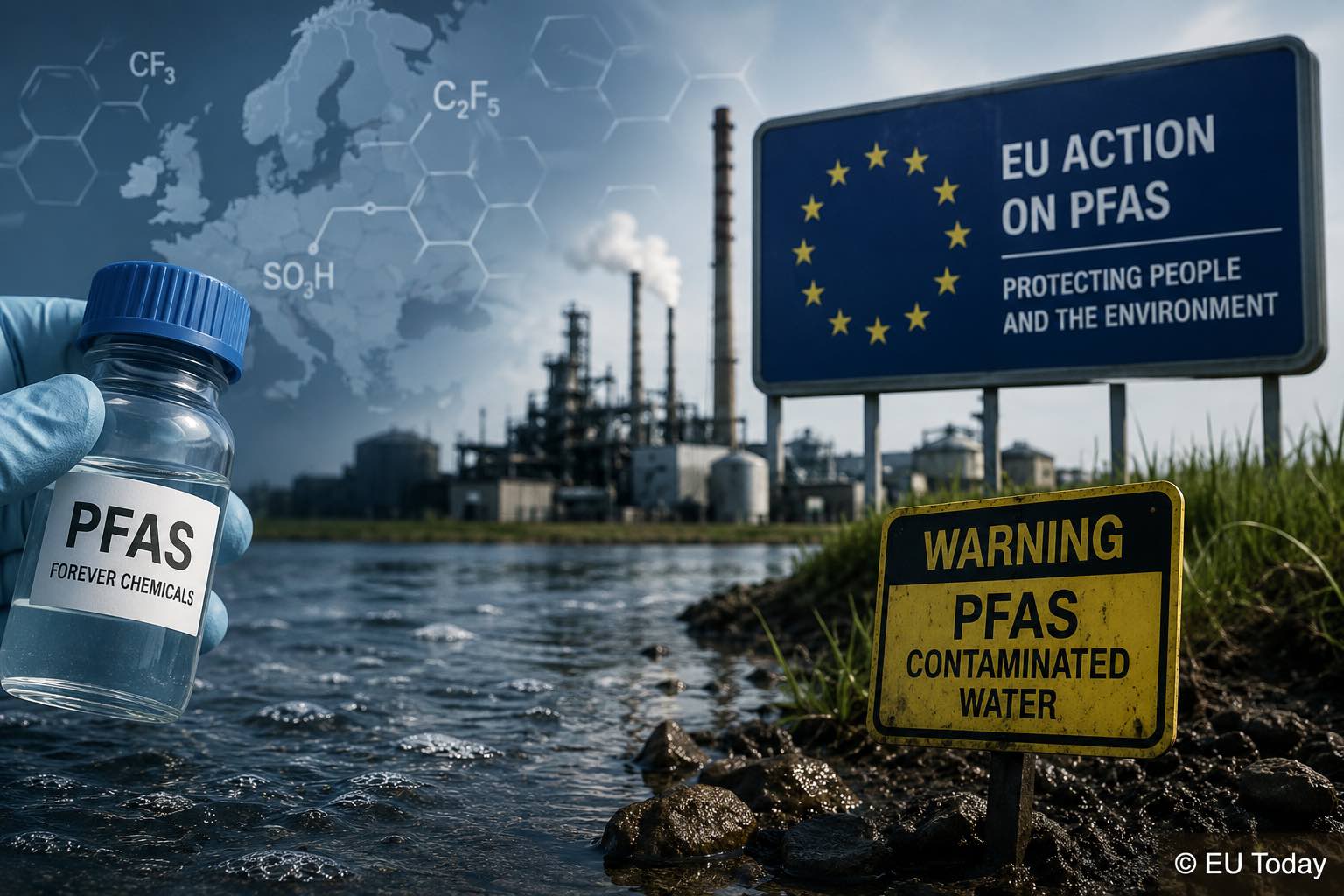
The European Union’s campaign against PFAS — the vast family of industrial compounds often referred to as “forever chemicals” — is rapidly emerging as one of the most consequential environmental battles of the decade.
What was once a largely technical discussion among chemists and regulators has become a defining test of Europe’s ability to balance environmental protection, public health and industrial competitiveness. The outcome could reshape manufacturing supply chains across the continent and set a global benchmark for chemical regulation.
PFAS are prized for their resistance to heat, water and grease. They are found in thousands of everyday products, from non-stick cookware and waterproof clothing to medical devices, semiconductors and aerospace components. Their commercial success, however, is matched by growing concern over their persistence in the environment.
Unlike many pollutants, PFAS do not readily break down. Once released, they can remain in soil, groundwater and ecosystems for decades, if not centuries. Traces have been detected in rivers, agricultural land and drinking water supplies across Europe. Researchers have also identified PFAS compounds in human blood samples, raising questions about long-term health implications.
The challenge facing policymakers is that PFAS are not a single substance but a sprawling class of several thousand chemicals, many of which perform critical industrial functions. Regulators increasingly argue that addressing them individually is both impractical and ineffective. Industry groups counter that a broad-brush approach risks sweeping away materials that currently have no viable alternatives.
The debate has intensified as several European countries, including Denmark, Germany, the Netherlands, Norway and Sweden, have pushed for some of the most far-reaching restrictions ever proposed for PFAS use. Their initiative reflects a growing view among environmental authorities that the costs of contamination are being borne by society while the benefits remain concentrated among manufacturers and consumers.
For businesses, the implications are profound.
European manufacturers face the prospect of redesigning products, restructuring supply chains and investing heavily in alternative materials. Sectors ranging from automotive production to electronics and pharmaceuticals are closely monitoring developments. Some executives warn that overly restrictive rules could weaken Europe’s industrial base at a time when companies are already grappling with high energy costs and fierce competition from Asia and the United States.
The concern is particularly acute in advanced manufacturing. PFAS play a role in semiconductor fabrication, battery technologies and various clean-energy applications that are themselves central to Europe’s green transition. Policymakers therefore face an uncomfortable paradox: chemicals viewed as environmental liabilities are also embedded in technologies intended to support climate objectives.
Yet public pressure continues to build.
Environmental campaigners point to mounting evidence of contamination hotspots near industrial facilities and airports. Municipal authorities increasingly face costly clean-up operations, while water utilities are investing in expensive treatment systems to remove persistent pollutants from drinking water supplies. In many cases, local taxpayers bear much of the financial burden.
The controversy reflects a broader shift in European environmental policy. Over recent decades, regulators have moved from addressing visible pollution toward tackling less obvious risks that accumulate over time. PFAS sit squarely within this new frontier, where scientific uncertainty coexists with growing demands for precautionary action.
The political dimension is becoming harder to ignore. Voters across Europe have shown strong support for measures that protect public health and environmental quality. At the same time, governments are under pressure to safeguard jobs and maintain economic competitiveness. The result is a delicate balancing act that is likely to define negotiations for years to come.
What happens next will be closely watched beyond Europe. Other jurisdictions, including parts of North America and Asia, are considering similar approaches. Should the EU succeed in implementing comprehensive restrictions, multinational companies may find it more efficient to adopt new standards globally rather than maintain separate production systems for different markets.
That prospect underlines the significance of the current debate. The question is no longer whether PFAS will face greater scrutiny, but how rapidly the transition can occur and who will bear the associated costs.
Europe’s regulators have often shaped global environmental standards through the size and influence of the single market. The emerging battle over forever chemicals may prove to be the next example of that phenomenon — one whose consequences extend far beyond the laboratories and factories where these substances were first developed.
___________________________________________________________________________________________________________________
Click here for more News & Current Affairs at EU Today
Click here to check out EU TODAY’S SPORTS PAGE!
___________________________________________________________________________________________________________________