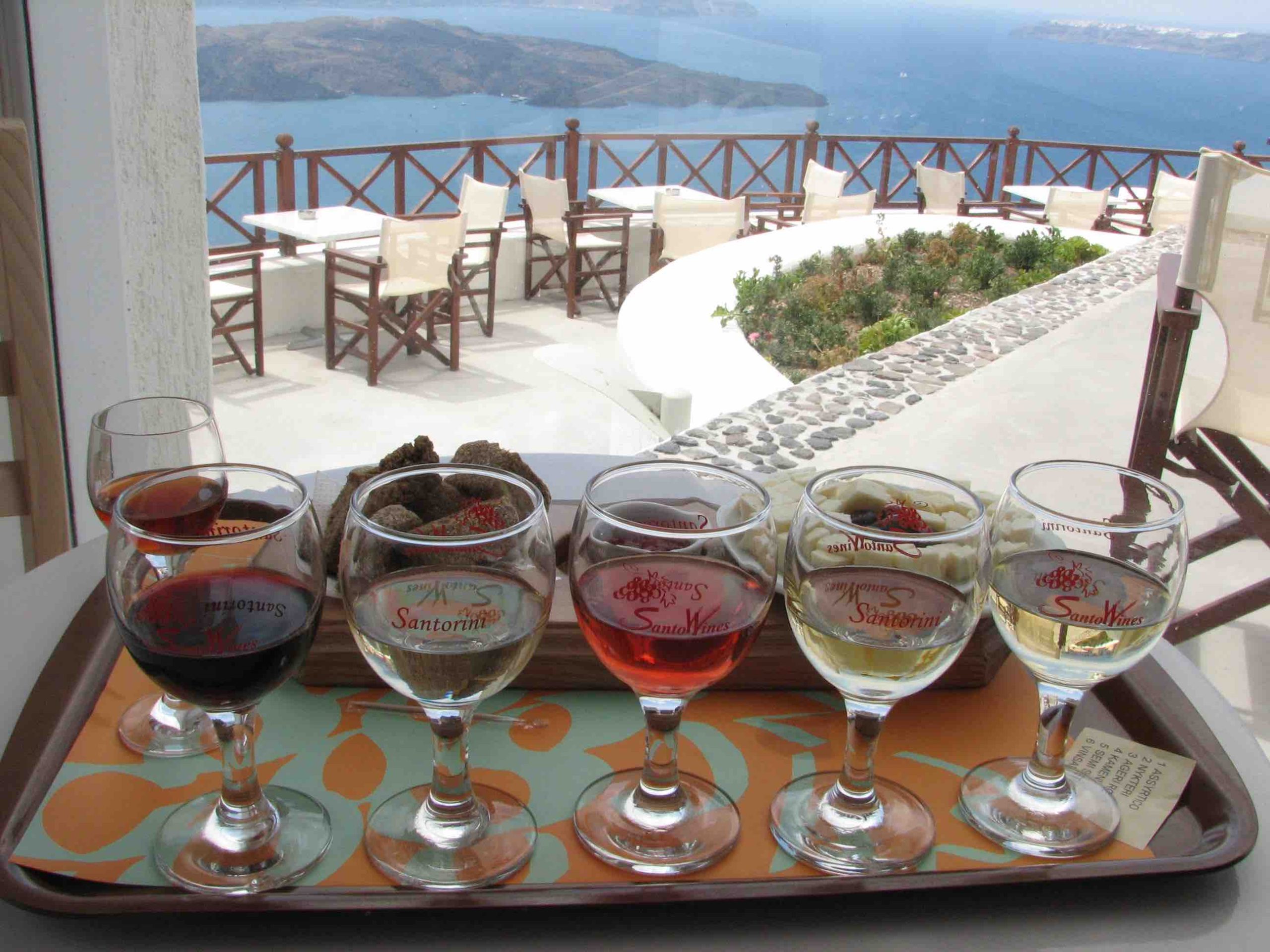
For centuries, Europe’s vineyards have been defined by geography. From the volcanic soils of Santorini to the limestone slopes of Burgundy and the rolling hills of Tuscany, the relationship between place and grape has been the foundation of the continent’s wine industry. Climate change is beginning to redraw that map.
The latest warning comes from the Greek island of Santorini, where winemakers are confronting a combination of prolonged drought, rising temperatures and mounting pressure on increasingly scarce water resources. What is unfolding on one of Europe’s most distinctive wine-producing islands offers a glimpse of the challenges facing vineyards across the continent.
Santorini’s celebrated Assyrtiko vines have evolved over centuries to survive harsh Aegean conditions. Their distinctive basket-shaped training system, known locally as kouloura, protects grapes from fierce winds and intense sunshine. Yet even these remarkably resilient vines are reaching their limits.
After three successive years of exceptionally low rainfall and extreme heat, production of Assyrtiko grapes has collapsed from around 2,500 tonnes in 2022 to roughly 500 tonnes last year. Some vines approaching a century in age have succumbed to drought, while grape prices have climbed to about €10 per kilogram, approaching levels more commonly associated with Champagne.
The economic implications extend well beyond one Greek island. Europe accounts for roughly two-thirds of global wine production, and viticulture supports thousands of rural communities, tourism businesses and export industries. Climate disruption therefore represents not simply an agricultural problem but a strategic challenge for an industry worth tens of billions of euros annually.
The effects are becoming increasingly visible across southern Europe. Earlier harvests, more frequent heatwaves, erratic rainfall and prolonged drought are changing both the quantity and quality of grapes. Traditional growing calendars, refined over generations, have become less reliable as weather patterns become more volatile.
For producers, adaptation has shifted from being a long-term aspiration to an immediate commercial necessity.
On Santorini, growers are experimenting with techniques that would have been almost unthinkable only a decade ago. One proposal involves irrigating vineyards using treated wastewater from homes and hotels, potentially providing a more sustainable alternative to energy-intensive desalination plants. Other trials include planting vines in organised rows to improve irrigation efficiency, subsurface watering systems that minimise evaporation, and even experimental technology that captures atmospheric moisture using solar-powered hydrogels.
These innovations illustrate a broader transformation taking place across European viticulture. Precision irrigation, drought-resistant rootstocks, altered canopy management and revised planting densities are increasingly becoming part of mainstream vineyard management rather than experimental projects.
Yet technological adaptation has limits.
Wine occupies a unique position among agricultural products because its value derives not simply from yield but from identity. Protected geographical indications, appellation systems and centuries-old traditions tie particular grape varieties to specific landscapes. Altering those relationships risks changing the very character that gives Europe’s wines their commercial premium.
Higher temperatures accelerate sugar accumulation while reducing acidity, altering flavour profiles and increasing alcohol levels. For premium producers whose reputations rest on consistency and regional character, these subtle shifts may prove as economically significant as declining harvest volumes.
The dilemma is particularly acute across the Mediterranean, where warming is occurring faster than the global average. Climate scientists recently concluded that the severe European heatwave experienced this month would have been virtually impossible without human-induced climate change, with unusually high night-time temperatures becoming around one hundred times more likely than they were two decades ago.
Such findings reinforce concerns that extreme weather events are no longer isolated anomalies but part of an emerging pattern.
Competition for water adds another layer of complexity. Santorini illustrates how tourism, agriculture and residential demand increasingly compete for finite freshwater resources. During the summer months, millions of visitors place additional pressure on island infrastructure precisely when vineyards require moisture to sustain grape development. Similar tensions are emerging elsewhere in southern Europe, forcing policymakers to balance economic priorities that increasingly collide.
Some regions may ultimately benefit from these climatic shifts. Northern European vineyards, once regarded as marginal, have begun producing increasingly respected wines as growing seasons lengthen and average temperatures rise. England’s sparkling wine industry has expanded significantly over the past two decades, while producers in Belgium, Denmark and southern Scandinavia are attracting growing attention.
For established southern regions, however, relocation is rarely an option. Vineyards represent generations of investment, cultural heritage and legally protected appellations that cannot simply migrate northwards.
The financial implications are becoming more apparent. Lower yields increase production costs while insurance premiums rise in response to greater climate risk. Investment in irrigation infrastructure, new vineyard layouts and experimental technologies demands substantial capital, placing additional strain on smaller family-owned wineries already operating with narrow margins.
Consumers may ultimately bear much of the cost. Scarcer harvests, higher production expenses and increased investment requirements are likely to place upward pressure on premium wine prices, particularly for iconic European regions where supply is inherently limited.
The challenge facing Europe’s wine sector therefore extends beyond adapting vineyards to hotter conditions. It involves preserving the authenticity, reputation and economic value of products whose identities have been shaped over centuries by stable climatic conditions that can no longer be taken for granted.
Santorini’s dying century-old vines serve as a powerful symbol of that transition. They remind us that climate change is not merely altering harvest dates or reducing yields. It is testing whether one of Europe’s oldest and most culturally significant industries can preserve its identity while adapting to an environment that is changing faster than tradition can comfortably accommodate.
Main Image: By Marcelo Costa – originally posted to Flickr as Santo Wines @ Santorini, CC BY 2.0, https://commons.wikimedia.org/w/index.php?curid=12218938
__________________________________________________________________________________________________________________
Click here for more News & Current Affairs at EU Today
Click here to check out EU TODAY’S SPORTS PAGE!
___________________________________________________________________________________________________________________