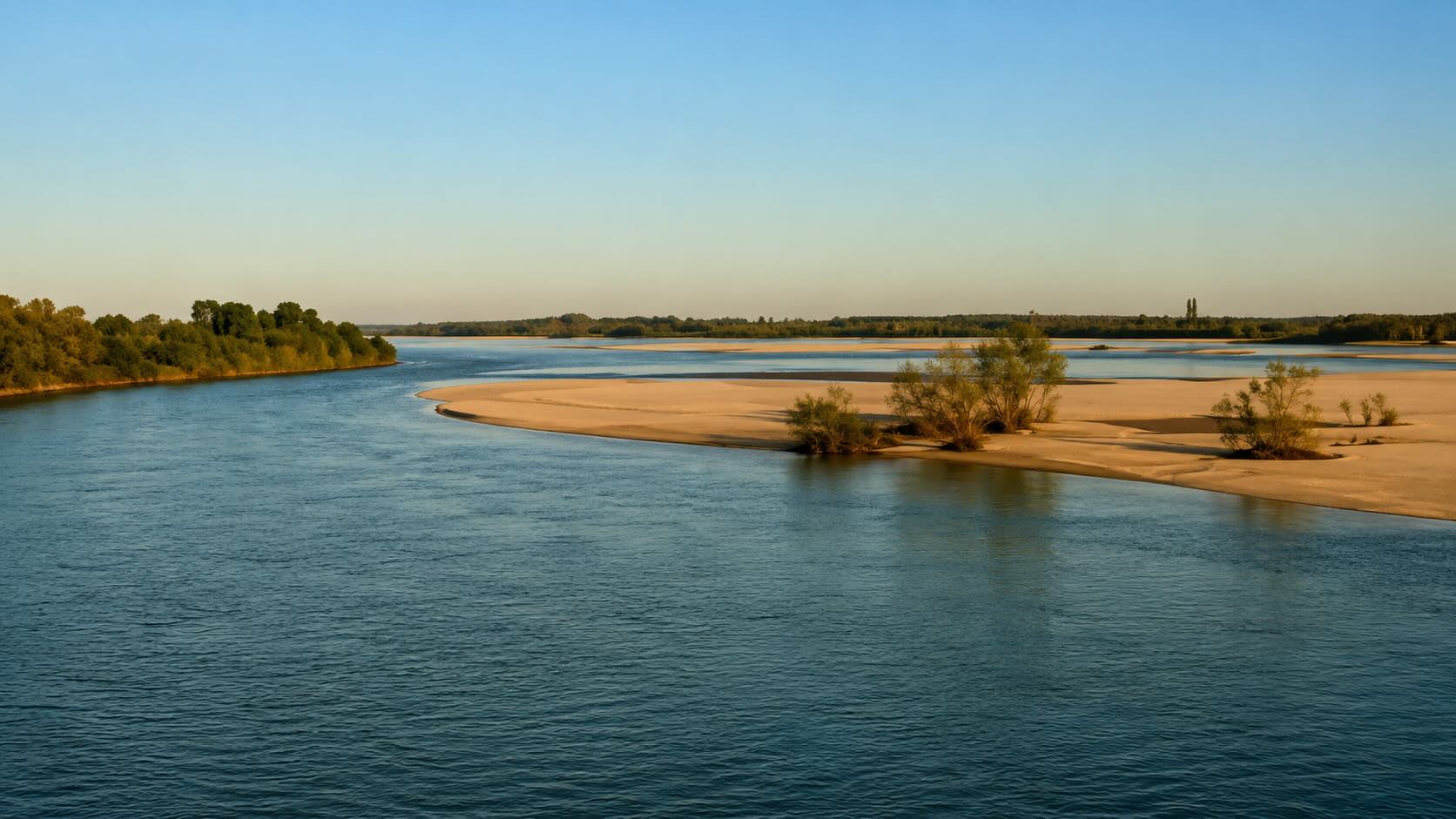
Seawater has pushed up to 18 kilometres into the Po Delta as river flows collapse during an early heatwave. The immediate danger is to farms in northern Italy, but the wider warning concerns Europe’s ability to manage water, food production and climate adaptation together.
Saltwater has moved as far as 18 kilometres inland through Italy’s Po Delta after river flows fell sharply during an early heatwave, forcing authorities to restrict irrigation and raising the risk of crop damage across one of Europe’s most productive agricultural regions.
The intrusion occurs when the force of the river is no longer sufficient to hold back the Adriatic Sea. Flow at the last measuring point before the Po divides into its delta branches fell from around 1,000 cubic metres per second to below 300 in less than two weeks, according to reporting from the affected region.
Local water managers have closed some irrigation canals rather than allow saline water to reach fields, where it can burn crops and damage soil. Soybeans, maize, rice, sunflowers and alfalfa are among the crops at risk.
The episode is not simply another consequence of hot weather. It exposes a structural competition between agriculture, households, industry, ecosystems and energy production for increasingly unreliable water supplies.
An early crisis is especially dangerous
Northern Italy experienced a severe drought in 2022, when low Po flows and saltwater intrusion produced major agricultural losses. This year’s pressure has arrived earlier in the growing season, when crops require reliable irrigation and farmers have already committed money to seed, fertiliser and labour.
An early interruption can therefore affect both yields and planting decisions. Even where plants survive, saline water may reduce productivity and leave longer-term effects in soil. Farmers cannot simply compensate by pumping more water if the available source itself has become unsuitable.
Existing barriers constructed in parts of the delta during the 1980s were designed for different hydrological conditions. Their limitations illustrate a wider European problem: much of the continent’s water infrastructure was built around historical rainfall, snowmelt and river-flow patterns that no longer provide a dependable planning baseline.
The Po is an economic system
The Po basin supports intensive agriculture, major cities and a large share of Italian manufacturing. It is also connected to hydropower, inland ecosystems and food-processing industries. A disruption at the delta can therefore move through supply chains well beyond the farms immediately affected.
Lower harvests raise costs for livestock producers and food processors. Restrictions on water use can disrupt factories. Hydropower output can fall just as electricity demand rises because of air conditioning. Environmental damage can weaken fisheries and tourism.
EU Today recently examined how France was bracing for record temperatures during the same broad heat episode. The Italian case adds a harder economic dimension: extreme heat is interacting with freshwater scarcity and coastal salinity to threaten production, not merely public comfort.
Europe still manages water in fragments
Water policy is divided among river-basin authorities, municipalities, regions, national ministries and EU frameworks. The Water Framework Directive creates common objectives, while the Common Agricultural Policy can support adaptation. In practice, decisions on irrigation, reservoirs, abstraction and emergency restrictions remain politically difficult and locally fragmented.
Farmers have legitimate concerns about losing production while urban and industrial users continue drawing supplies. Environmental groups warn that emergency engineering can further damage rivers and wetlands. Governments often postpone allocation decisions until a drought is already under way.
The Po Delta shows why that approach is becoming untenable. Managing scarcity requires agreed priorities before a crisis, real-time data on withdrawals, investment in efficient irrigation and leakage reduction, and rules that prevent groundwater extraction from worsening saline intrusion.
Adaptation cannot mean engineering alone
Physical defences can slow seawater, but they cannot replace river flow indefinitely. New barriers, adjustable gates and improved pumping may protect particular areas. They need to be combined with changes in land use and agricultural practice.
Drought-resistant crops, altered planting calendars, soil measures that retain moisture and the reuse of treated wastewater can reduce demand. Precision irrigation can help, although it requires capital that smaller farms may struggle to obtain. Public support should reward measurable resilience rather than simply reimburse losses after each emergency.
The EU also needs to consider food security in climate-adaptation spending. Europe’s agricultural market is integrated: a production shock in northern Italy can affect prices and processors elsewhere. Yet water resilience is often treated as a regional environmental issue rather than part of industrial and economic security.
A warning from the coast
It would be premature to calculate the final harvest impact while the heatwave and river conditions continue. Rainfall could improve flows, and the degree of salt exposure varies across the delta. Authorities should therefore avoid both complacency and dramatic forecasts unsupported by field data.
What is already clear is that the margin for error has narrowed. When seawater travels kilometres inland in June, Europe is seeing not a distant climate projection but an operating constraint on farming and infrastructure.
The Po Delta is where a continental river meets the sea. It is also where Europe’s policies on climate, water, agriculture and competitiveness now collide. Keeping salt out of irrigation canals will require immediate management. Keeping productive regions viable will require governments to plan for a climate in which the river can no longer be assumed to do the work for them.