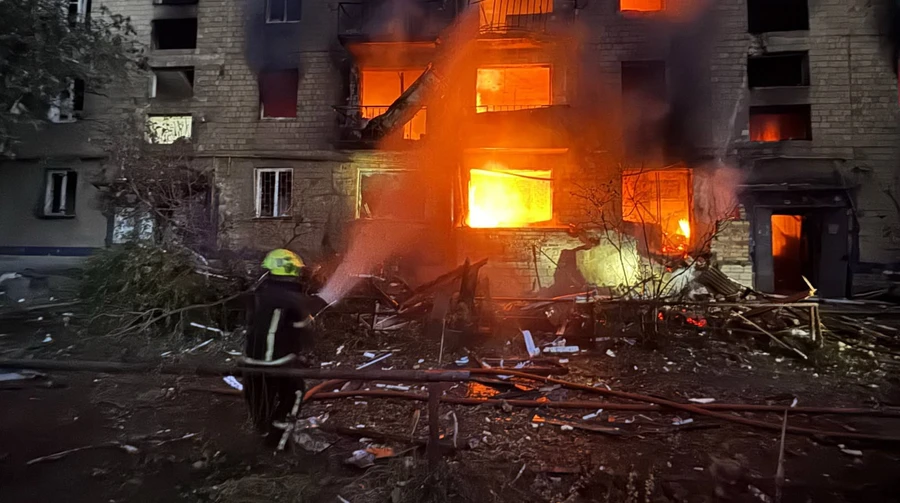
Russia’s latest missile and drone attack on Kyiv killed at least ten people and injured 34, according to updated casualty figures. The strike points to a longer problem for Ukraine: how to defend large cities if Russian air attacks continue for years, not months.
Russia’s latest mass missile and drone attack on Kyiv has again shown that Ukraine’s war is not only being fought along the front line. It is also being fought over the future habitability of the country’s largest cities.
At least ten people were killed and 34 injured in the overnight attack on the Ukrainian capital, according to the latest casualty figures reported after rescuers worked through damaged residential areas and other impact sites. Earlier updates had put the toll at two dead and 16 injured, but the number rose as emergency services continued their search and recovery operations. The attack caused damage across Kyiv, with fires reported in residential buildings and civilian infrastructure after missiles and drones struck the city.
The strike came after Ukrainian officials had warned of another large Russian attack. Residents took shelter in underground stations as explosions were heard across the capital. Reports from the city described damage in several districts, including fires in apartment blocks and private homes, as well as the partial collapse of a residential building. In one of the earlier official updates, Kyiv’s mayor said emergency workers were among the injured, while Polish aircraft were scrambled as air alerts spread across the region during the Russian attack on the capital.
The immediate military purpose of such attacks is clear enough: to test and exhaust Ukrainian air defences, damage infrastructure and force Kyiv to spend scarce interceptor missiles. But the wider purpose is also demographic. Repeated strikes on residential districts, energy infrastructure and transport networks are intended to make ordinary life in Ukrainian cities less sustainable.
That is why the attack should not be read only as another episode in Russia’s air campaign. It is part of a longer effort to put pressure on Ukraine’s population. Night-time strikes force civilians to spend hours in shelters, disrupt families, frighten children, limit normal economic life and create a continuing incentive for people to leave major cities or the country altogether.
This does not mean that Russia has unlimited resources. The intervals between some mass attacks may suggest that Moscow is having to accumulate missiles and drones before launching larger combined strikes. Another possibility is that Russia is conserving part of its arsenal for the autumn and winter, when attacks on the Ukrainian energy system would carry greater consequences. The objective would be familiar: to combine physical damage with pressure on civilian morale during the heating season.
Ukraine’s long-range strikes on Russian military and energy infrastructure have imposed costs on Moscow. Ukrainian operations against refineries, fuel depots and defence-linked facilities have created logistical and economic pressure, including reported disruption in parts of Russia’s fuel system. Ukraine has also claimed further attacks on Russian industrial targets, including the Ufa oil refinery and a missile-component plant.
Those attacks may reduce Russian capacity and complicate the Kremlin’s war economy. They have not, however, ended Russia’s willingness to continue an attritional campaign. The latest strike on Kyiv therefore underlines a political conclusion that is often avoided: there is no reliable basis for assuming a quick end to the war.
Even if Russian ground offensives slow or stop, missile and drone attacks on Ukrainian cities could continue. A reduction in fighting along the line of contact would not automatically make Kyiv, Kharkiv, Dnipro, Odesa or other large cities safe. The war could fade into a pattern of intermittent but destructive air attacks, especially if Russia retains the ability to rebuild stocks of drones and missiles.
That raises two practical questions for Ukraine and its allies. The first is air defence. Ukraine needs more systems, more interceptor missiles, better protection against ballistic missiles and a larger domestic production base for counter-drone and air-defence technologies. Russia’s use of drones is likely to increase, not decline, as production becomes cheaper and more scalable.
The second question is civil protection. Ukrainian cities cannot rely only on metro stations and improvised shelters. Kyiv’s underground railway has saved lives, but it cannot accommodate everyone. Many residents do not live close to stations. Other large Ukrainian cities do not have metro systems at all. If mass attacks continue, the shortage of protected spaces will become a central urban-planning problem.
That requires a change in priorities. The rebuilding of damaged cities cannot mean only repaired facades, new parks or restored commercial buildings. It must also mean functioning shelters, protected rooms in public buildings, secure underground spaces and clear rules for new construction. Hotels, schools, hospitals, apartment blocks and offices should be assessed partly by their capacity to protect civilians during air attacks.
Many existing shelters in Ukraine have fallen into disuse or have been treated as ordinary basements. Restoring them is less visible than building new public spaces, but it is more urgent. Local budgets, national reconstruction funds and international assistance will have to reflect that reality.
Russia’s latest attack on Kyiv is therefore not only a story of destruction and casualties. It is a warning about the type of security environment Ukraine may face in the 2020s and possibly beyond. The country is being forced to build a system of urban resilience while still under attack.
The question is no longer whether another mass strike will come. The question is whether Ukrainian cities can be made ready for a future in which air defence, shelters and civil protection are treated not as emergency measures, but as permanent infrastructure.