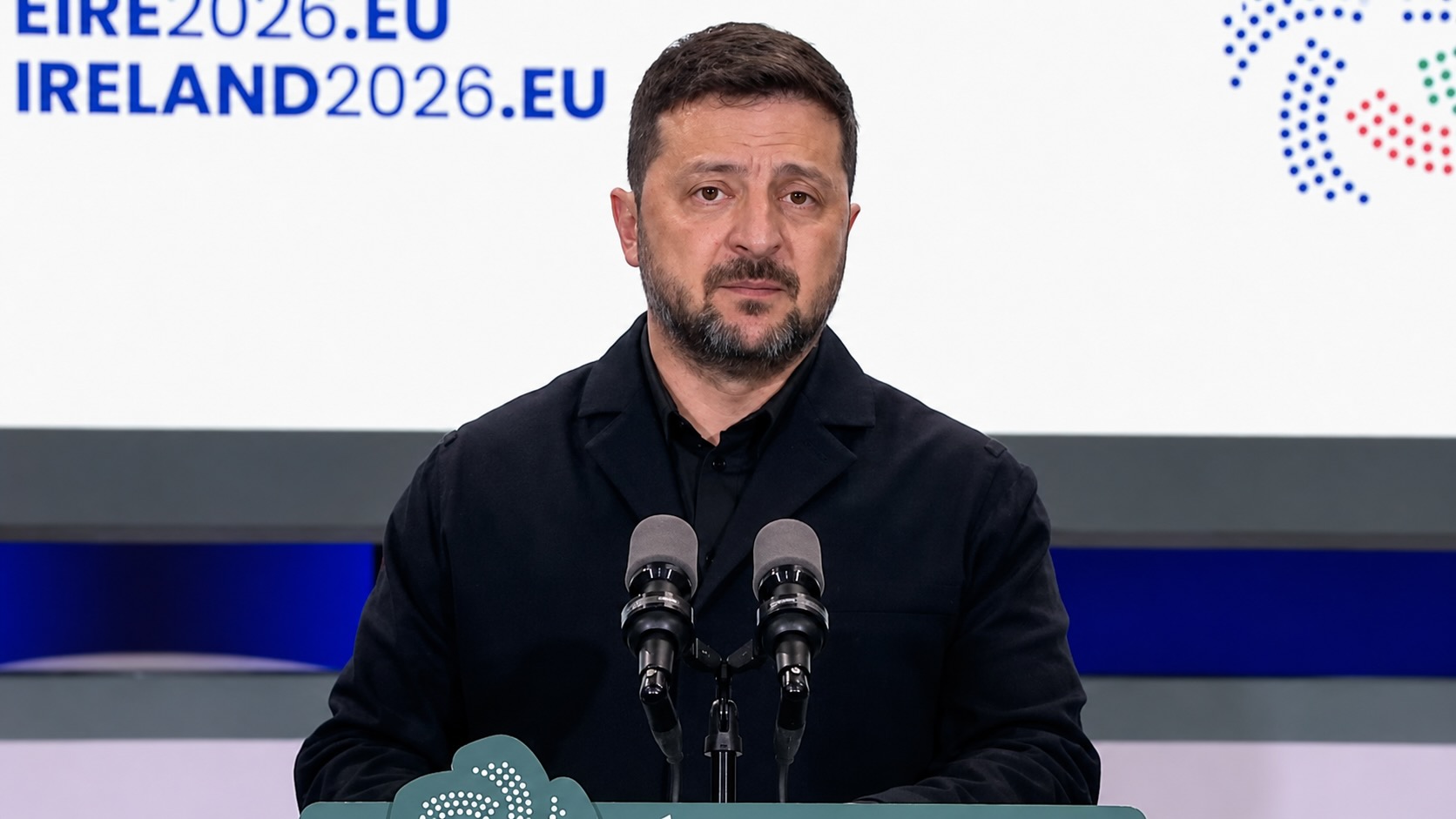
Ukraine’s president has pressed Dublin to complete its investigation into Aughinish Alumina, confronting Ireland’s new EU presidency with a dispute over Russian ownership, industrial jobs and the credibility of sanctions enforcement.
President Volodymyr Zelenskyy has used a visit to Dublin to urge Ireland to complete and publish its investigation into alumina exports from the Russian-owned Aughinish refinery, placing a politically difficult sanctions case at the start of Ireland’s presidency of the Council of the European Union.
The Ukrainian request concerns whether alumina exported from the County Limerick plant to Russia is entering supply chains that produce aluminium for weapons. Ireland says its review is close to completion.
Aughinish is Europe’s largest alumina refinery and an important employer. It is also owned by Russia’s Rusal, making the plant a test of how EU sanctions policy deals with industrial assets whose operations matter to a member-state economy but whose output may support Russia’s war economy.
A known problem becomes a presidential demand
The issue is not new. EU Today reported in June that Ireland faced growing pressure over Aughinish exports. The fresh development is Zelenskyy’s direct intervention during Ireland’s EU presidency and the government’s indication that its investigation is nearing an end.
Irish reporting has traced alumina from Aughinish through Russian smelters to downstream companies, including sanctioned military manufacturers. An RTÉ examination of the supply chain said exports to Russia had increased from €196 million in 2021 to €318 million in 2025.
Alumina is not itself a weapon. It is refined into aluminium, a material used across civilian construction, transport, packaging and energy as well as missiles, aircraft and military vehicles. That breadth makes sanctions design difficult: restricting supply can affect legitimate industry, yet leaving trade untouched may allow material to reach military production.
Ireland’s competing obligations
Dublin must reconcile three interests. It has committed to EU sanctions and political support for Ukraine. It wants to protect employment and a strategically important refinery. It also needs to ensure that companies operating on Irish territory do not undermine the purpose of European restrictions.
Supporters of continued exports argue that banning Irish alumina would threaten the plant without materially constraining Russia, which could source material elsewhere. They also warn of higher commodity prices and damage to European aluminium supply.
Critics respond that sanctions lose credibility if commercially inconvenient supply chains are exempted despite evidence of military use downstream. The point is not only whether Russia can replace the material, but whether an EU member should continue supplying it while asking other countries and companies to accept sanctions costs.
The investigation must therefore establish more than ownership. It should examine destinations, counterparties, contractual controls, knowledge of downstream use and whether existing EU rules were breached or revealed a loophole.
A presidency-level credibility problem
Ireland assumed the rotating Council presidency on 1 July. The role does not give Dublin unilateral control over EU sanctions, which require agreement among member states, but it gives the country responsibility for brokering Council work and representing institutional continuity.
That makes prolonged ambiguity over Aughinish particularly awkward. Ireland cannot credibly lead discussions on tougher enforcement while withholding clear findings about a major Russian-owned industrial exporter at home.
The case may also shape future sanctions. The EU could target particular export routes, Russian recipients or downstream military users rather than prohibit alumina trade entirely. It could strengthen due-diligence requirements or require proof that consignments do not enter restricted supply chains.
EU Today recently covered how the EU’s twentieth sanctions package expanded action against Russia’s military-industrial base. Aughinish shows that adding names to a sanctions list is easier than policing complex commodity flows.
The investigation must answer the hard question
The Irish review will be judged on whether it distinguishes legal compliance from policy credibility. A transaction can fall outside the literal scope of current sanctions and still undermine their strategic purpose.
If the government finds no breach, it should explain the evidence and the safeguards preventing military diversion. If it identifies risk, it must decide whether national action is sufficient or an EU measure is required.
For Ukraine, the case is straightforward: material from Europe should not strengthen the weapons industry attacking Ukrainian cities. For Ireland, the economic and legal trade-offs are real. Avoiding a decision is no longer a neutral option.
Zelenskyy’s intervention has moved Aughinish from a domestic review into the centre of Ireland’s European role. The presidency’s first sanctions test is now located on the Shannon Estuary.