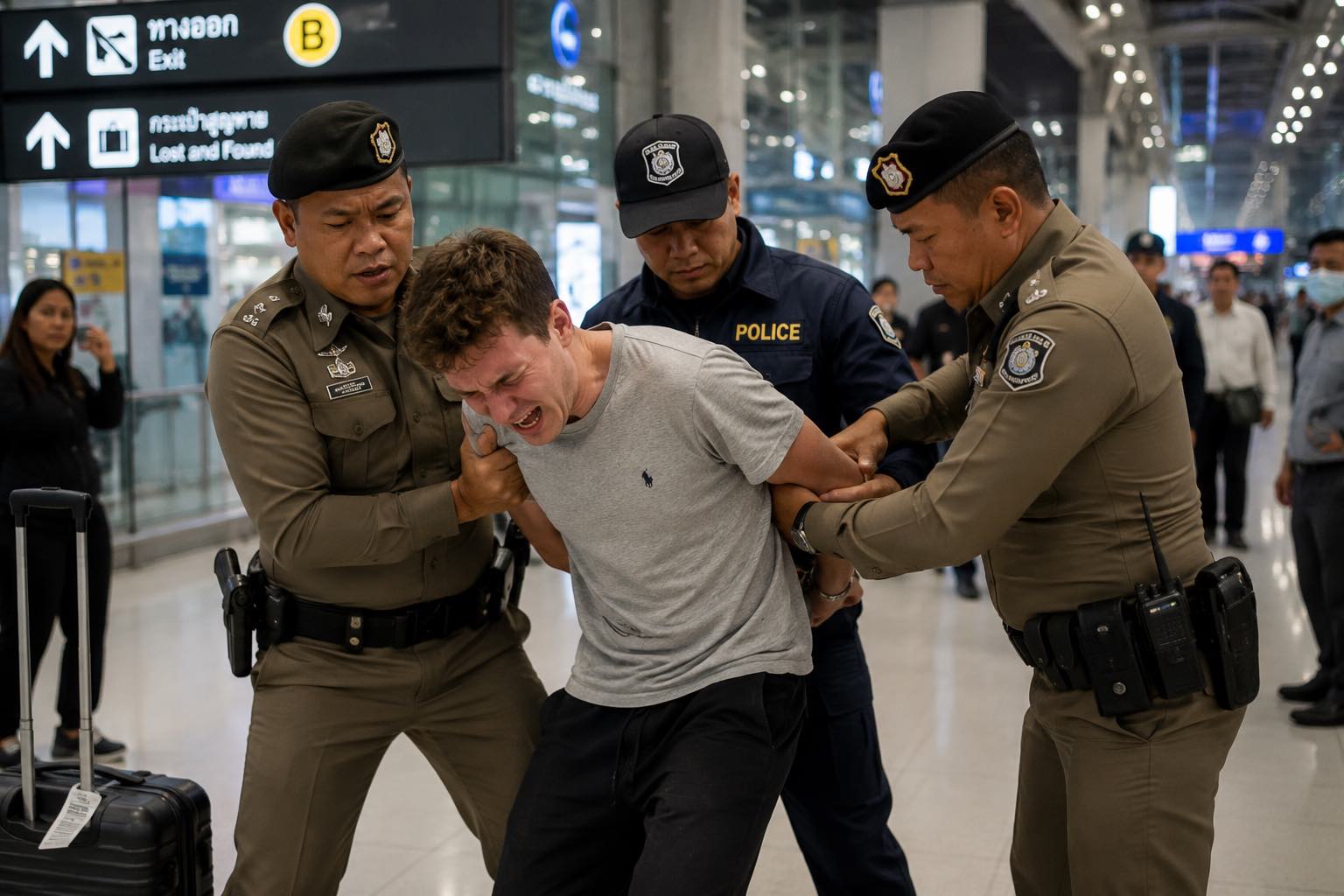
The promise is seductively simple. A free holiday in Thailand, business-class flights, designer hotels, and spending money. In return, all that is required is bringing home a suitcase. For some young travellers, it can appear to be an irresistible bargain.
Britain’s Border Force believes that illusion is becoming one of organised crime’s most effective recruitment tools. As the summer holiday season reaches its peak, the Home Office has launched a public awareness campaign warning young Britons that what appears to be a free holiday may instead be an introduction to a criminal enterprise with life-changing consequences.
The campaign reflects a broader shift in the economics of international drug trafficking. Criminal organisations have become increasingly sophisticated in identifying vulnerable recruits, exploiting social media platforms where carefully curated lifestyles and promises of easy money resonate with younger audiences. Rather than relying solely on established criminal networks, traffickers are increasingly recruiting ordinary holidaymakers with no previous criminal record.
.
It is a model built on psychology as much as logistics.
Those approached are often assured that the risks are minimal. They may be told that customs officers rarely inspect luggage, or that someone else has already cleared the route. The suitcase may already be packed when it is handed over. In many cases, recruits are encouraged to believe they are merely carrying personal belongings for another traveller.
Reality is considerably harsher.
Border Force officers stress that passengers remain legally responsible for everything contained within their luggage. Claims of ignorance provide little protection once prohibited substances are discovered. Depending on the jurisdiction, those arrested overseas can face years—sometimes decades—in prison, while successful importation into the United Kingdom can still result in lengthy custodial sentences.
The warning comes as law enforcement agencies report evolving methods of cannabis smuggling into Britain, particularly from parts of South-East Asia where legal frameworks surrounding cannabis have changed in recent years. Criminal groups have adapted rapidly to these developments, seeking to exploit increased tourist traffic and the perception that cannabis offences carry relatively limited consequences.
Officials argue that such assumptions are dangerously misplaced.
Behind every successful smuggling operation lies a highly organised criminal network. The courier receives only a fraction of the profits while assuming almost all of the legal risk. If arrested, the individual is unlikely to receive assistance from those who orchestrated the operation. Organised crime groups simply replace one courier with another.
Border Force’s latest campaign therefore focuses less on enforcement than prevention. Officers have published five practical recommendations designed to help travellers avoid becoming unwitting participants in criminal activity. These include never agreeing to carry items for strangers, packing luggage personally, remaining suspicious of offers that appear too generous, and recognising that social media contacts may not be who they claim to be.
The strategy reflects wider thinking within law enforcement that disrupting recruitment can be as important as intercepting drugs at the border.
Britain’s border agencies have demonstrated considerable success in recent years in detecting illicit shipments. According to government figures presented to Parliament, Border Force seized more than 150 tonnes of illegal drugs during the year ending March 2025—the highest annual total on record and a 40 per cent increase on the previous year.
Those figures illustrate both the scale of enforcement activity and the continuing profitability of international narcotics trafficking. Organised crime groups remain highly adaptive, constantly modifying routes, concealment techniques and recruitment strategies as authorities improve detection capabilities.
The National Crime Agency describes cross-border trafficking in drugs, firearms and people as one of organised crime’s most lucrative business models. Effective border security therefore depends not only upon technology and intelligence but also upon reducing opportunities for criminal exploitation.
For younger travellers, the challenge is compounded by the increasingly blurred boundary between genuine online friendships and criminal grooming. Social media allows traffickers to cultivate trust over extended periods before introducing apparently harmless requests. Financial pressures, student debt or aspirations for luxury lifestyles may further increase susceptibility.
This makes public awareness campaigns more than simple government messaging exercises. They represent attempts to disrupt criminal recruitment before it progresses beyond an online conversation.
There is also a broader reputational dimension. Countries across Asia and elsewhere continue to impose severe penalties for drug offences, regardless of a suspect’s nationality. British diplomatic assistance overseas cannot exempt citizens from local criminal justice systems. Consular officials may provide welfare support, but they cannot secure release from prison or overturn convictions.
The Home Office hopes that emphasising these realities before departure will encourage potential recruits to reconsider seemingly attractive offers.
For Border Force itself, the campaign complements an expanding operational role. Alongside immigration controls, officers now undertake increasingly sophisticated customs enforcement, using intelligence-led targeting, detector dogs, advanced scanning technology and international cooperation to identify illicit shipments entering Britain. Recent operations have included record cannabis seizures as well as significant interceptions involving endangered wildlife and other forms of organised smuggling.
Ultimately, the government’s message is deliberately uncomplicated.
No holiday is genuinely free. No criminal organisation offers easy money without demanding something in return. The apparent glamour of international travel can conceal a transaction in which the traveller bears almost all of the risk while criminals collect almost all of the reward.
For many young people preparing to travel this summer, that may be the most valuable travel advice they receive before leaving home.
__________________________________________________________________________________________________________________
Click here for more News & Current Affairs at EU Today
Click here to check out EU TODAY’S SPORTS PAGE!
___________________________________________________________________________________________________________________