Undisclosed contacts between former German officials and senior Russian figures have revived concerns about back-channel diplomacy, Kremlin influence and attempts to shape Berlin’s approach to the war in Ukraine.
Azerbaijani President Ilham Aliyev has confirmed that prominent German and Russian figures were present in Baku at the same time for an undisclosed meeting, although neither government had informed Azerbaijan that talks were taking place.
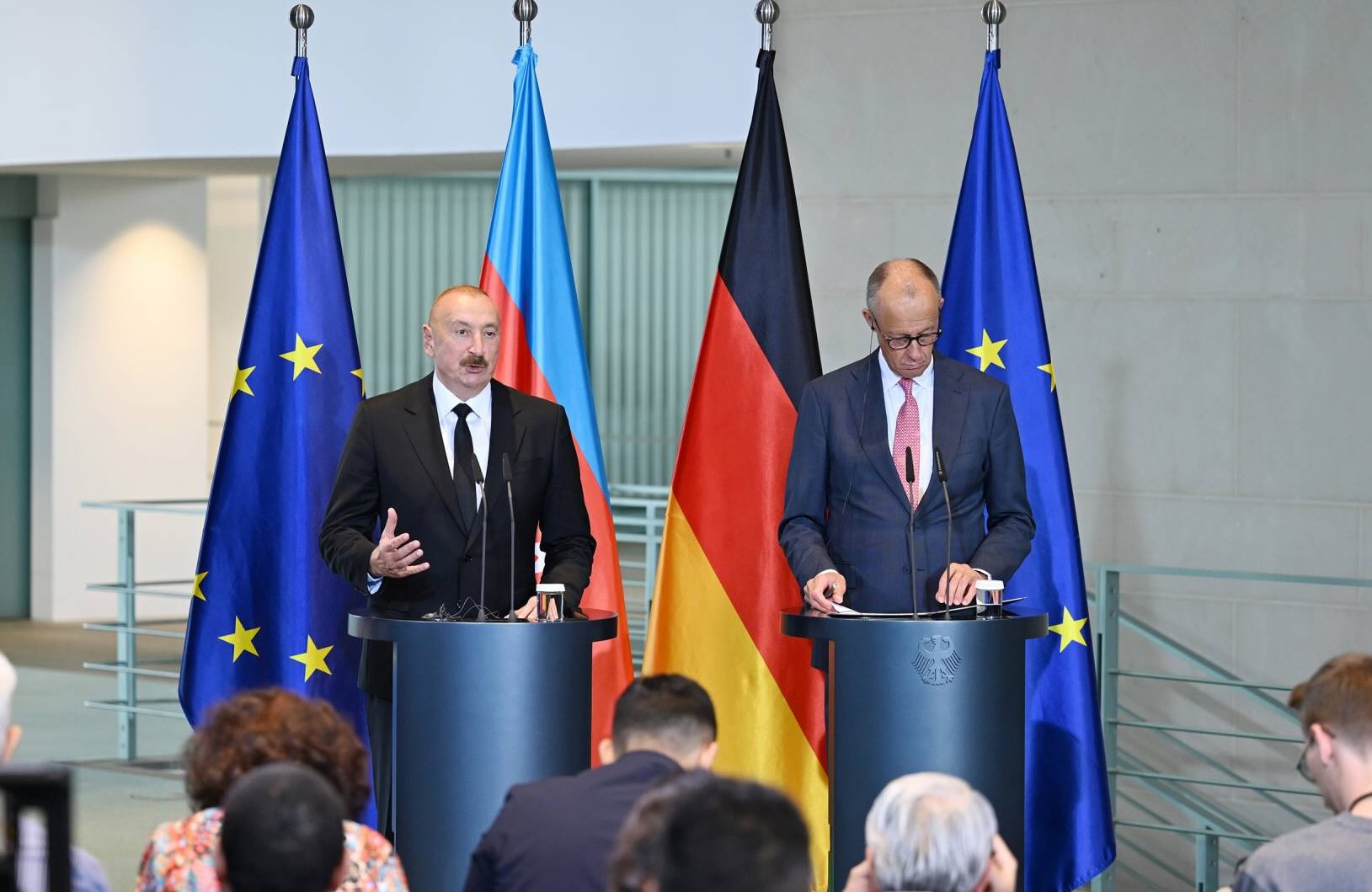
Speaking beside Chancellor Friedrich Merz in Berlin on 21 July, Aliyev said Azerbaijani authorities had examined flight and immigration records after learning about the reported meeting. The inquiry indicated that the participants had been in Baku between 12 and 14 July.
According to the official transcript of the joint press conference, Aliyev said Azerbaijan had received no information about the meeting from either Germany or Russia. He added that Baku could not comment on the substance of discussions at which Azerbaijani officials had not been present.
Aliyev nevertheless said Azerbaijan would welcome any contact that genuinely contributed to ending Russia’s war against Ukraine. Merz responded that he had no information indicating that such a meeting had taken place. The German government’s record of the press conference similarly presented the talks as an initiative outside official German policy.
The German participants reportedly included Ronald Pofalla, who served as Angela Merkel’s chief of staff, and Matthias Platzeck, a former minister-president of Brandenburg and former chairman of the Social Democratic Party.
They were photographed travelling through Baku during an investigation into what German reporters described as a continuing unofficial channel between former German political figures and representatives close to the Kremlin.
The Russian participants included Viktor Zubkov, a former prime minister who remains chairman of Gazprom’s board, and Valery Fadeyev, chairman of Russia’s presidential Human Rights Council and an adviser to Vladimir Putin. Alexei Gromyko, director of the Institute of Europe at the Russian Academy of Sciences, has also been linked to the wider series of meetings.
The contacts appear to draw on relationships formed through the Petersburg Dialogue, established in 2001 by Putin and former German chancellor Gerhard Schröder. The forum brought together politicians, business figures and civil-society representatives at a time when Berlin sought closer economic and political relations with Moscow.
Germany’s section of the organisation was dissolved after Russia’s full-scale invasion of Ukraine. However, an investigation into the Baku network found that some former participants continued meeting Russian representatives privately.
The July encounter was not the first. German investigations identified a series of contacts beginning in 2024, usually in Baku, with at least one meeting held in Abu Dhabi. A previous investigation into the revived Petersburg Dialogue network reported that an April 2025 meeting included Ralf Stegner, an SPD Bundestag member who at the time served on the parliamentary body responsible for overseeing Germany’s intelligence services.
Stegner said the discussions were private and not conducted on behalf of the German government. Other participants have also characterised the meetings as unofficial efforts to maintain communication and consider possible routes towards ending the war.
That distinction is legally and politically important. Former ministers and officials are generally free to hold private discussions. There is no publicly available evidence that Pofalla or Platzeck carried instructions from Merz’s government or possessed authority to negotiate for Germany.
The controversy concerns the influence that former senior officials may retain through party contacts, personal networks and access to serving decision-makers. Russian representatives could use such meetings to transmit proposals or political messages without engaging formally with Berlin, Brussels or Kyiv.
German security authorities reportedly assess the network as a possible Russian influence operation intended to affect domestic debate. That remains an intelligence assessment rather than a judicial finding. The participants deny acting as agents of Moscow and maintain that their objective is dialogue.
The identity of the Russian delegates nonetheless gives the meetings wider political weight. Zubkov is not merely a retired politician; his position at Gazprom connects him directly to the energy relationship that once formed the economic foundation of German-Russian ties.
The discussions therefore raise questions not only about possible peace proposals, but also about whether Moscow is testing German attitudes towards post-war economic normalisation, sanctions relief and renewed energy trade.
Russia has repeatedly argued that the war should end on terms that preserve its control over occupied Ukrainian territory and prevent Ukraine from joining NATO. Any attempt to carry those conditions into German political circles would support Moscow’s effort to present territorial concessions as the price of peace.
For Ukraine, the concern is that informal German-Russian contacts could develop into negotiations conducted without Kyiv’s participation. Germany remains one of Ukraine’s largest military and financial supporters, making any appearance of a separate channel politically sensitive.
Baku’s role is different. There is no evidence that the Azerbaijani government organised the meeting. Aliyev’s public remarks instead appeared designed to establish that the participants had used Azerbaijan as a convenient venue without involving its authorities.
Baku offers direct transport connections to both Russia and Germany, while Russian figures facing European restrictions can travel there more easily than to an EU capital. Azerbaijan has also developed a broader diplomatic role as a meeting point between governments and political groups that cannot readily hold talks in Europe.
The episode does not demonstrate that Germany is secretly negotiating with Russia. It does show that Moscow retains access to networks created during an earlier period of German-Russian cooperation.
The resulting challenge for Berlin is one of transparency and political authority. Private dialogue is not necessarily improper, but former officials should not create uncertainty over whether they are speaking for themselves, their parties or the German state.
The Baku meetings are therefore less important as an immediate peace initiative than as evidence of an unresolved struggle over Germany’s Russia policy. Moscow is seeking channels through which it can influence European debate, while Berlin must ensure that unofficial contacts do not undermine its declared policy towards Ukraine or create the impression of negotiations conducted behind Kyiv’s back.