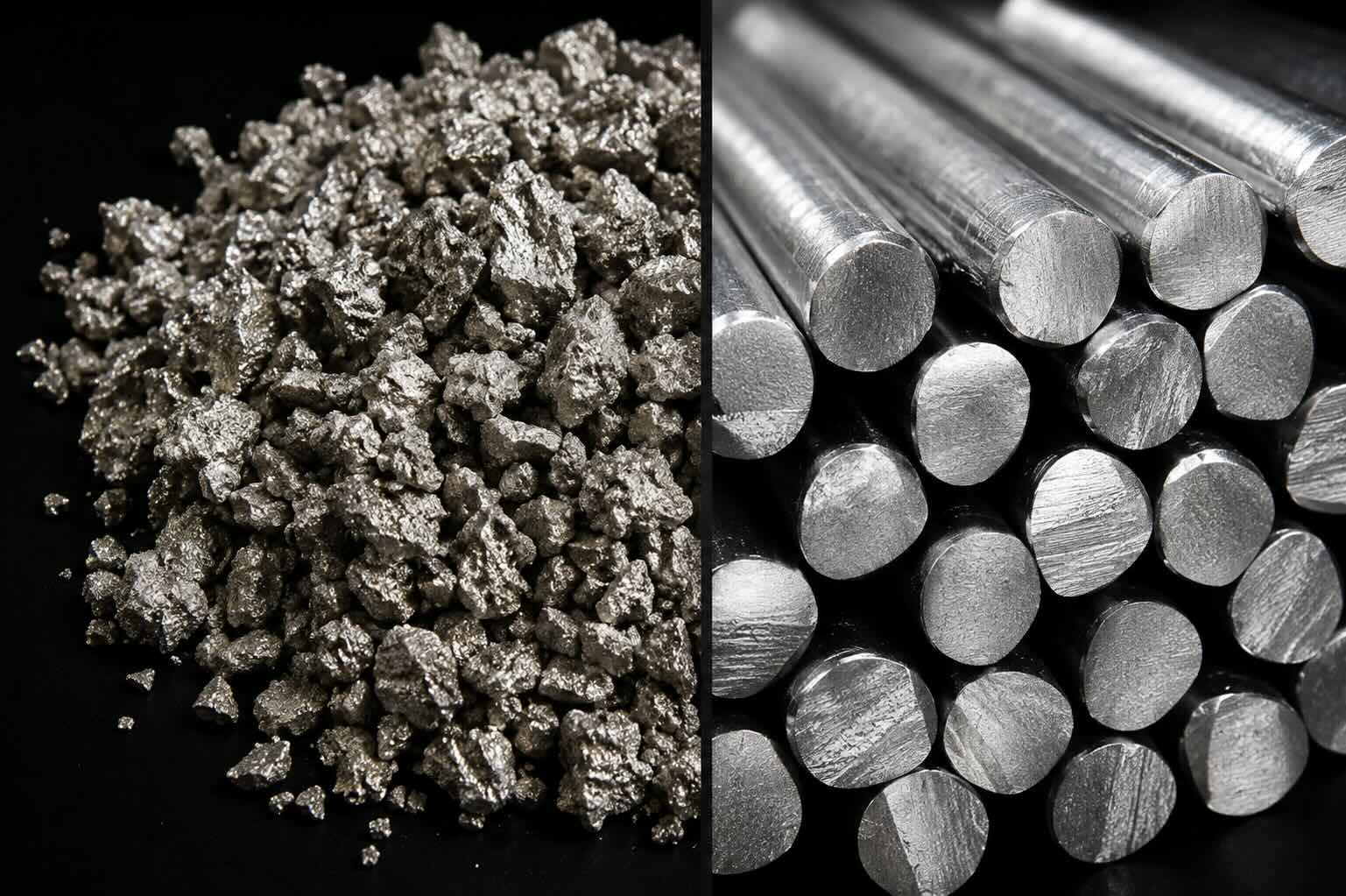
Sanctions on Russian titanium and the loss of US domestic production are creating openings for Chinese suppliers in a material essential to aircraft engines, landing gear and airframes.
Nearly two dozen Chinese companies attended the Farnborough Airshow seeking Western aerospace customers, with at least three suppliers saying their titanium was already used in Airbus aircraft, according to Reuters aerospace reporting. Airbus did not confirm the supplier claims. The issue is nevertheless strategically important because titanium sits inside some of the most sensitive parts of aircraft production.
Titanium is valuable because it combines strength, low weight and resistance to heat and corrosion. It is used in engines, landing gear, fasteners, structural components and other high-stress applications. Aerospace-grade titanium is not interchangeable with ordinary metal supply. It requires certification, traceability, quality control and confidence that materials will perform safely over long service lives.
Western aerospace companies historically relied heavily on Russian titanium. After Russia’s full-scale invasion of Ukraine, sanctions, reputational risk and supply uncertainty forced manufacturers to reduce exposure. That was strategically necessary, but it did not automatically create abundant alternative supply. When a major supplier becomes politically unacceptable, the rest of the market gains leverage.
China is now trying to fill part of that space. Chinese titanium producers can offer scale, lower costs and an expanding industrial base. For aircraft manufacturers under pressure from delivery delays and supply-chain bottlenecks, that is attractive. But replacing Russian dependence with Chinese dependence creates a different strategic vulnerability.
EU Today recently covered the Airbus-Boeing subsidy dispute and broader aerospace supply-chain pressure through its business archive, while earlier analysis of Airbus and Boeing emergency An-124 airlifts showed how fragile aerostructure logistics remain. The titanium issue adds a raw-material layer. Aircraft production is not constrained only by final assembly or engines. It can be constrained by certified materials several tiers down the supply chain.
The disappearance of US domestic production deepens the problem. If Western aerospace lacks sufficient domestic or allied titanium capacity, companies must buy from politically sensitive suppliers or accept production delays. That is a dangerous choice in a sector that supports civil aviation, defence aircraft, space systems and missile production.
Certification is both a barrier and a protection. A supplier cannot simply appear at an airshow and enter an aircraft programme immediately. Materials must meet strict standards, undergo qualification and be approved through long supply-chain processes. That slows substitution. But once a supplier is qualified, it can become difficult to replace quickly. Today’s supply decision can shape dependency for years.
The Airbus claim is therefore sensitive. If Chinese titanium is already used in Airbus aircraft, European aerospace is more exposed to Chinese material supply than policymakers may appreciate. If the claims are exaggerated, the fact that suppliers are making them publicly still shows how aggressively Chinese firms are seeking credibility in Western markets.
Tariffs and sanctions complicate the economics. Western governments may want to reduce dependence on China, but manufacturers facing production delays may resist measures that raise costs or restrict inputs. Aviation customers want aircraft delivered. Airlines do not want strategic-material debates to delay fleets. Governments, however, see critical materials as part of security policy.
The defence implications are obvious. Titanium used in civil aircraft is also relevant to military aircraft, helicopters, missiles and engines. A supply chain that is acceptable for commercial production may still raise security questions when the same firms or materials feed defence programmes. Dual-use materials make the boundary between civil and military dependence porous.
Europe’s policy response should not be panic. Chinese supply can be commercially legitimate and technically capable. The issue is concentration and resilience. Europe needs diversified sources, recycling, stockpiles, allied production, transparent supplier mapping and incentives for certified capacity outside politically risky jurisdictions.
The lesson from Russian titanium should be fresh. For years, Western companies treated Russian supply as manageable because commercial relationships seemed stable. War changed that assumption quickly. If Europe’s answer is to shift quietly toward another strategic rival without building resilience, it will repeat the same mistake in a different direction.
The Farnborough push is therefore more than an exhibition story. It is a warning from deep inside the aerospace supply chain. Strategic dependence does not always arrive as a headline takeover or a visible factory. Sometimes it arrives as a certified material in a landing gear component, accepted because production schedules are tight and alternatives are scarce.