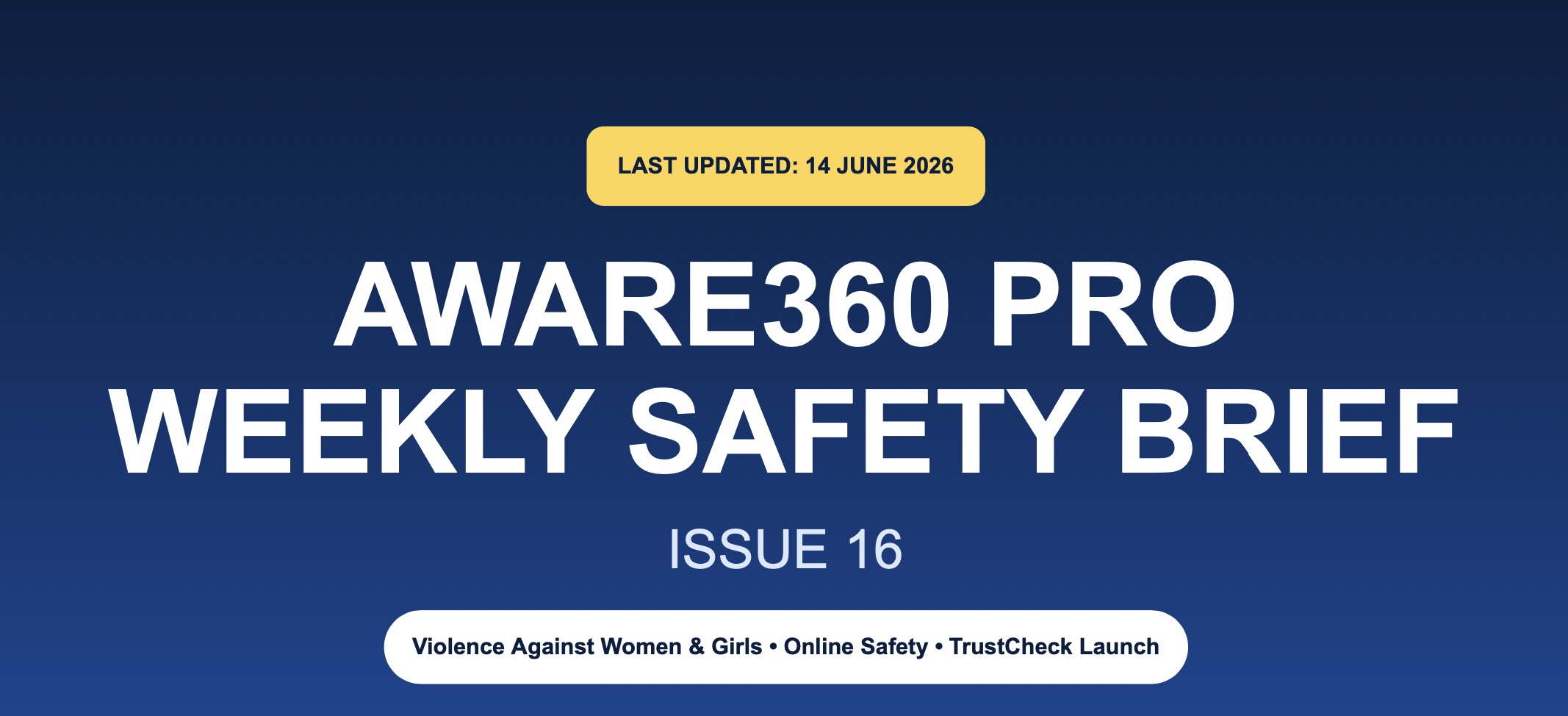
The latest edition of Aware360 Pro Weekly Safety Brief arrives with an ambitious proposition: that many of society’s most troubling incidents are neither wholly random nor entirely unforeseeable.
Published against a backdrop of rising concern over violence against women, online harms and declining public trust, the briefing seeks to shift the conversation from reaction to prevention.
It is a difficult balancing act. Safety publications often fall into one of two traps. Some overwhelm readers with alarming statistics and worst-case scenarios, while others retreat into bureaucratic language that drains urgency from the subject matter. This publication largely avoids both pitfalls. Instead, it adopts a clear editorial philosophy, repeated throughout its pages: “Turning Real Incidents Into Real Prevention.”
The strongest section examines violence against women and girls through the lens of a recent criminal case involving post-separation abuse. Rather than dwelling on sensational details, the briefing concentrates on the behavioural patterns that preceded the fatal outcome. Stalking, coercive control, technology-enabled monitoring and the misuse of family connections are presented not as isolated phenomena but as interconnected warning signs.
This emphasis on early recognition reflects a broader shift within safeguarding practice. The publication argues persuasively that the period after leaving an abusive relationship can represent heightened danger rather than safety, an observation supported by many practitioners working in the field. The discussion of hidden tracking devices is particularly timely. As consumer technology becomes cheaper and more accessible, the opportunities for coercive surveillance expand correspondingly.
The treatment of online safety is equally pragmatic. Rather than depicting the internet as inherently threatening, the briefing acknowledges its benefits while examining how malicious actors exploit familiar environments. A case involving the grooming of a child through an online gaming platform serves as a case study in how trust can be cultivated gradually through apparently innocuous interactions.
Importantly, the analysis focuses less on technology itself and more on human behaviour. Shared interests become conversations; conversations evolve into trust; trust creates opportunities for manipulation. The lesson is not that digital spaces should be feared, but that users — particularly young people and those responsible for their care — require the tools to recognise how exploitation develops.
The publication also ventures into the emerging territory of artificial intelligence-enabled deception. Deepfakes, voice cloning and fabricated online identities are introduced not as distant possibilities but as practical challenges already confronting society. While this section is necessarily speculative in places, its underlying argument is difficult to dismiss: public awareness has struggled to keep pace with technological change.
Perhaps the most intriguing element of the briefing is the introduction of TrustCheck, a proposed framework designed to assess organisational transparency and commitment to good practice. In an economy increasingly shaped by online reviews and digital reputation, the notion that consumers seek reassurance beyond price and convenience has merit.
The concept itself remains underdeveloped. Questions inevitably arise about governance, independence and verification standards. Who decides what constitutes best practice? How are assessments conducted? What mechanisms exist for appeal or oversight? Yet these uncertainties do not invalidate the broader premise. As regulators intensify scrutiny of misleading online reviews and questionable marketing practices, there is growing appetite for systems that reward demonstrable commitments to safety and accountability.
Stylistically, the publication prioritises accessibility over sophistication. Risk levels are clearly identified. Key learning points are summarised succinctly. Actionable advice appears throughout. Critics may regard the frequent use of bullet points and simplified frameworks as overly instructional. Yet this criticism perhaps misunderstands the intended audience. This is not an academic journal or policy white paper; it is designed to engage parents, educators, employers and members of the public who may have little formal safeguarding training.
Indeed, the newsletter’s greatest strength lies in its insistence that prevention is everyone’s responsibility. Governments and police forces retain essential roles, but the briefing repeatedly returns to the influence of friends, colleagues, family members and communities. Awareness, it suggests, is not merely informational. Properly applied, it can become intervention.
There are, however, areas that warrant further development. At times the publication moves too quickly from identifying problems to proposing solutions linked to Aware360 Pro’s own educational initiatives. Greater exploration of competing perspectives or independent evidence would strengthen its credibility. Some readers may also question whether complex social problems can realistically be addressed through awareness campaigns and scenario-based learning alone.
Even so, these reservations do little to diminish the publication’s central achievement. At a time when public discourse frequently oscillates between outrage and resignation, this weekly briefing attempts something more constructive. It asks not only what happened, but what might have prevented it.
That distinction matters. Prevention rarely attracts headlines. Successful interventions are, by their nature, invisible. The incident that never occurs cannot be measured as easily as the one that dominates news cycles. Yet if public safety is to evolve beyond perpetual crisis management, the questions posed by this edition deserve serious consideration.
As a piece of public-interest communication, Aware360 Pro Weekly Safety Brief succeeds in challenging readers to think differently about risk. Its tone is measured, its intentions clear and its subject matter undeniably important. Whether its proposed initiatives ultimately fulfil their promise remains to be seen. But its underlying message — that warning signs often exist long before harm occurs — is one that policymakers, institutions and individuals would do well to heed.
In an age defined by complexity, uncertainty and accelerating technological change, prevention may prove to be society’s most valuable form of preparedness.
Click here for more News & Current Affairs at EU Today
Click here to check out EU TODAY’S SPORTS PAGE!
___________________________________________________________________________________________________________________