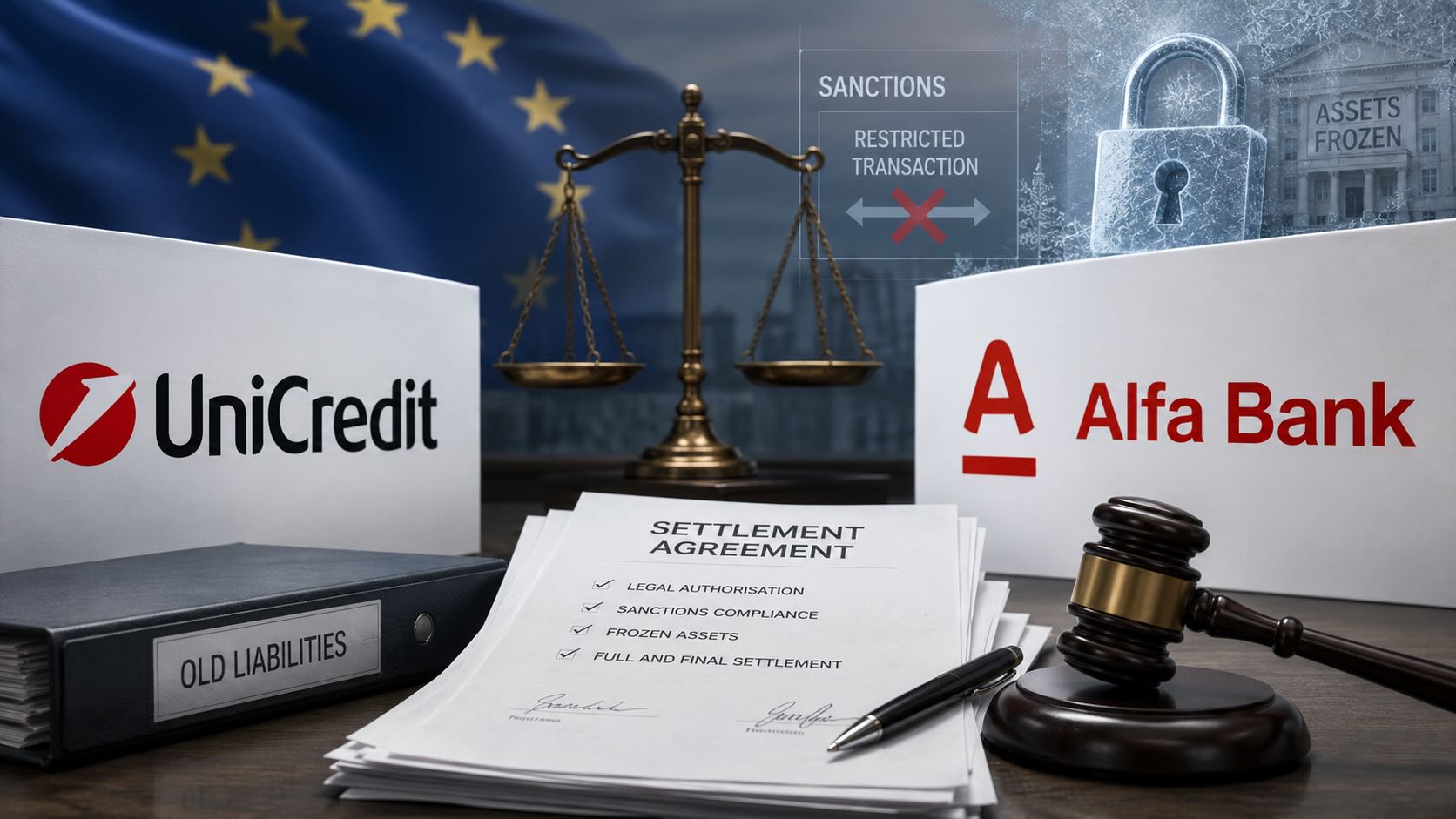
A tightly framed derogation in the EU’s latest Russia measures illustrates the difficult boundary between preserving sanctions pressure and allowing European companies to settle liabilities created before the invasion.
A narrow provision in the European Union’s 21st Russia sanctions package could provide UniCredit with a legal route to settle a long-running contractual dispute connected to Alfa Bank and sanctioned Russian businessmen Mikhail Fridman and Petr Aven.
The significance lies less in the value of a single transaction than in the way EU law handles old commercial obligations. Sanctions are designed to freeze assets and deny resources to listed persons. They are not intended to produce uncontrolled windfalls, leave European banks permanently trapped in litigation or prevent every court-supervised resolution of a pre-sanctions contract.
The Council’s account of the 21st package describes a broad escalation against Russian energy, financial services and circumvention networks. The binding text, rather than the political summary, contains the conditions under which national authorities may authorise otherwise prohibited dealings.
Any use of a derogation is not automatic. UniCredit would need to demonstrate that the transaction falls within the legal wording and obtain approval from the competent national authority. Funds and economic resources cannot simply be released because a private party considers a settlement commercially desirable.
The pre-war liability problem
European sanctions law distinguishes between prohibitions and derogations. A prohibition establishes the rule; a derogation permits a national authority to authorise a transaction in defined circumstances. That structure enables case-by-case control while keeping assets frozen by default.
Legacy contracts create hard cases. A European company may have acquired an asset or entered an agreement years before a counterparty was listed. Subsequent litigation can produce competing judgments in different jurisdictions. Paying a settlement might reduce the European company’s risk, yet it could also make funds available to a sanctioned person.
The legal test must therefore examine the recipient, the destination of funds, the origin of the obligation and the safeguards attached to payment. An authorisation may require money to be placed in a blocked account rather than transferred for unrestricted use.
This is why describing the provision as an “exemption from sanctions” can be misleading. It does not remove Fridman or Aven from the EU list, nor does it generally legalise business with Alfa Bank. It creates a possible route for resolving a defined pre-existing matter under official supervision.
UniCredit’s Russian exposure
UniCredit has faced sustained pressure from regulators and investors to reduce its Russian operations. The bank must manage local legal requirements, capital restrictions, customer obligations and European supervisory expectations at the same time.
A settlement connected to an older Alfa Bank transaction would sit inside that larger problem but would not solve it. The European Central Bank’s concerns about euro-area banks’ Russian exposure concern governance, capital, liquidity and the ability to execute a credible reduction plan. One legal resolution cannot substitute for an orderly exit strategy.
UniCredit should therefore explain any authorised transaction with precision: the relevant legal basis, the authority granting permission, the treatment of funds and the effect on its balance sheet. Transparency is especially important because a bespoke-looking provision can create suspicion that sanctions law has been written for a particular company.
The EU institutions must provide comparable clarity. If the derogation is available to any operator meeting objective conditions, that should be evident from the legal text and national implementation. If its practical use is extremely narrow, the reasons should withstand judicial and political scrutiny.
Sanctions integrity
Derogations are not inherently weaknesses. A sanctions regime without mechanisms for humanitarian payments, legal fees, divestment and legacy claims can become arbitrary and difficult to administer. Clear exceptions can strengthen compliance by replacing informal workarounds with documented authorisations.
The danger arises when wording is broad enough to transfer substantial value without adequate control or when similarly placed applicants receive different treatment. National authorities must record decisions, coordinate with one another and prevent forum shopping.
The Commission can support consistency through guidance, while the Council can amend the regime if an exemption is used more widely than intended. Courts remain available to review both listings and administrative decisions.
EU Today has previously examined a Russian judgment involving Euroclear and frozen assets. Both cases expose the collision between EU sanctions and litigation in Russia or involving Russian parties. European firms may face orders that cannot lawfully be satisfied in the EU, while Russian courts may disregard European restrictions.
That conflict cannot be eliminated, but it can be managed. European banks need to preserve sanctions compliance, contest abusive claims and avoid decisions that place employees or local subsidiaries at unnecessary risk.
A precedent worth watching
If UniCredit obtains authorisation, the conditions will matter more than the headline. A payment into a frozen account, a release of competing claims and strict reporting would have a different sanctions effect from an unrestricted transfer.
Other companies will study the case for guidance on legacy contracts. The EU should resist both extremes: claiming that any derogation is a capitulation, or treating commercial inconvenience as a reason to release frozen value.
The proper standard is whether the measure permits an orderly resolution without making funds available for Russia’s war economy or undermining the position of listed persons. That requires a traceable legal process and enforceable safeguards.
The 21st package is presented as a major tightening of pressure on Moscow. Its credibility will also depend on how carefully Brussels and national authorities administer the narrow paths through the rules. Sanctions policy is strongest when it can distinguish a controlled settlement of an old liability from a return to business as usual.