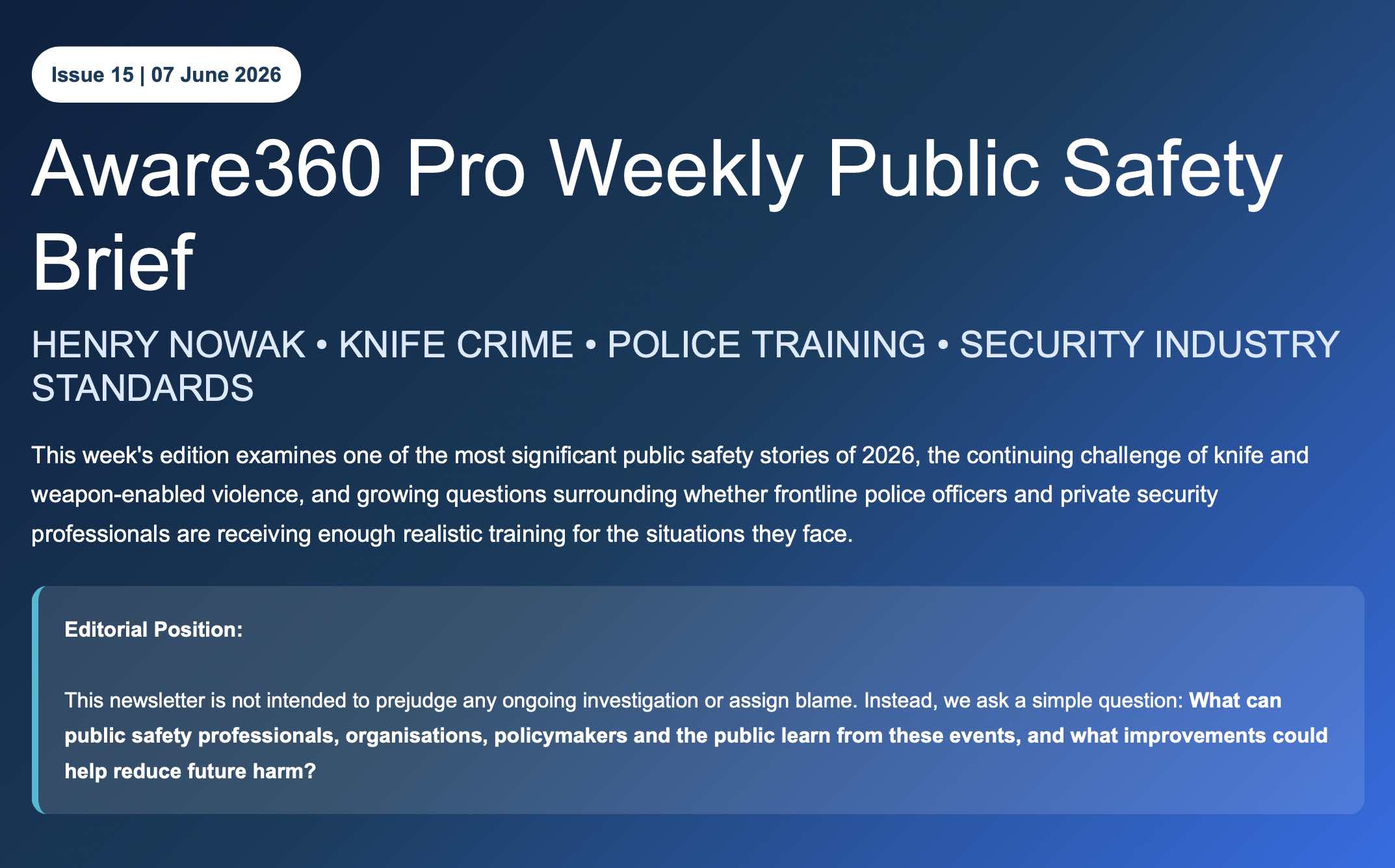
The latest edition of the Aware360 Pro Weekly Public Safety Brief focuses on one of the most widely discussed public safety incidents of 2026: the tragic death in the UK of 18-year-old Henry Nowak following a knife attack.
Rather than attempting to assign blame or reach conclusions about ongoing investigations, the publication examines the broader lessons that can be learned by police services, private security professionals, policymakers and the public. Throughout the briefing, a recurring theme emerges: whether current training systems adequately prepare frontline personnel for the increasingly complex situations they encounter.
The newsletter argues that major public safety incidents should be viewed as opportunities for learning and improvement. The Henry Nowak case has generated significant public debate across the United Kingdom and internationally, with discussions ranging from police accountability and public confidence to operational decision-making under pressure. The briefing emphasises that professionals should focus not solely on outcomes but also on understanding how decisions were made, what information was available at the time and whether training can be improved to help prevent future tragedies.
A substantial section is devoted to the educational value of police body-worn camera footage. According to the briefing, such recordings have transformed learning within public safety professions by providing objective records of incidents. They allow organisations to review communication, situational awareness, decision-making, casualty recognition and incident management in a way that was previously impossible.
The newsletter notes that major incidents often involve conflicting witness statements, distressed victims, incomplete information and rapidly changing circumstances. These realities create challenging environments where decisions must be made quickly and sometimes with imperfect information. As a result, continual reassessment of developing situations is presented as an essential skill for frontline personnel.
The report also explores concerns regarding police training. Drawing on conversations with serving and former officers, it highlights a perceived gap between controlled training environments and the unpredictability of real-world incidents. Modern police officers are expected to handle a vast range of situations, including knife attacks, mental health crises, domestic abuse incidents, missing persons cases, medical emergencies, public disorder and potential terrorist threats. Officers interviewed by Aware360 Pro suggested that many operational lessons are learned through experience rather than formal training. Several common observations emerged, including the difficulty of replicating decision-making under pressure, the importance of communication skills and the need for realistic scenario-based exercises that better reflect operational realities.
The newsletter examines wider policy discussions through the lens of the Police Anti-Racism Commitment introduced in England and Wales in 2025. The document, which seeks to tackle racism, improve public confidence and strengthen fairness within policing, has attracted renewed attention following the Henry Nowak case. Aware360 Pro notes that some members of the public have questioned how policy priorities interact with operational effectiveness, while others argue that public trust is fundamental to successful policing.
The publication ultimately concludes that operational competence and public confidence should be complementary rather than competing objectives. Frontline professionals require both strong practical skills and strong ethical foundations if they are to maintain legitimacy and effectiveness.
One of the strongest themes running throughout the briefing concerns the gap between training and reality. The publication argues that evolving criminal behaviour, technological change and rising public expectations mean that training systems across numerous sectors may struggle to keep pace.
This challenge extends beyond policing to include healthcare workers, teachers, retail staff, transport employees, security personnel and community organisations. Aware360 Pro suggests that modern threats require continuous adaptation and that learning programmes should evolve alongside emerging risks. Interactive investigations, violence prevention education, public safety simulations and professional development resources are presented as potential methods for addressing these challenges.
Knife crime and weapon-enabled violence receive particular attention. The briefing stresses that regardless of political debates or investigative outcomes, a young man lost his life and that knife-related violence continues to devastate families and communities across Britain.
It notes that concerns about weapon carrying, youth violence and criminal exploitation are no longer confined to major cities but are increasingly affecting towns and communities throughout the country. The report identifies several factors commonly associated with knife carrying, including fear, self-protection, social media influence, criminal exploitation and the pursuit of status or reputation. Importantly, it argues that enforcement alone cannot solve the problem. Effective prevention requires education, mentoring, community engagement, early intervention and greater public awareness.
The newsletter also provides guidance on weapon awareness and recognising potential warning signs. It cautions that no single behaviour automatically indicates that a person is carrying a weapon, but notes that experienced practitioners often look for patterns such as repeatedly touching pockets or waistbands, unusual clothing choices, nervous scanning behaviour, attempts to conceal one side of the body and sudden changes in body language.
One principle is repeatedly emphasised: “Distance Creates Time. Time Creates Options.” The publication advises members of the public who suspect someone may be carrying a weapon to create distance, avoid confrontation, use barriers where possible and contact emergency services when appropriate.
Looking beyond Britain, the briefing discusses wider public safety challenges across Europe. Organised crime, youth recruitment into criminal networks, drug-related violence, weapon-enabled offences and human trafficking are identified as concerns affecting multiple countries.
Particular emphasis is placed on the growing relationship between social media platforms, criminal recruitment and youth exploitation. The publication argues that modern public safety increasingly requires cooperation between police forces, schools, parents, community groups, security professionals and government agencies. No single organisation, it suggests, can effectively tackle these challenges in isolation.
The private security industry forms another major focus of the report. Security personnel often serve as first responders in shopping centres, hospitals, transport hubs, licensed premises, construction sites and public events. They are frequently expected to manage conflict, support vulnerable individuals, preserve evidence, handle emergencies and identify threats.
Aware360 Pro recounts a discussion with a licensed security professional who admitted lacking confidence in certain procedures and in physically restraining a violent individual if necessary. Rather than criticising the individual, the newsletter uses the example to question whether similar concerns may exist more broadly across the industry. It argues that obtaining a licence should represent the beginning, not the end, of professional development.
Feedback gathered from security professionals revealed recurring requests for more practical and scenario-based training. Participants highlighted a need for stronger conflict management skills, improved communication training, greater weapon awareness, better understanding of legal boundaries and enhanced confidence in incident decision-making. Many expressed interest in learning tools that focus less on memorising information and more on applying knowledge in realistic situations. These findings closely mirror observations made by police officers regarding the value of experiential learning and realistic simulations.
In its concluding sections, the briefing summarises key lessons for police officers, security professionals and communities. For police, realistic training, effective communication, casualty recognition and learning from bodycam footage are highlighted as priorities.
For security personnel, the report stresses the importance of continuous professional development, accessible procedures and confidence-building through practical experience. For communities, the focus is on violence prevention, supporting young people, early intervention and raising awareness of the dangers associated with knife crime.
The publication concludes with recommendations encouraging police services to expand scenario-based training, security organisations to invest in ongoing professional development and communities to strengthen violence prevention initiatives.
Throughout the document, Aware360 Pro advocates the use of technology-driven learning tools, including simulations, interactive case studies and decision-making exercises. Its overarching message is that public safety depends upon continuous learning, adaptability and cooperation between professionals, organisations and communities. By improving preparedness, awareness and confidence, the briefing argues, it may be possible to reduce harm and strengthen public trust in those responsible for keeping society safe.
Click here for the Aware360 Pro Weekly Public Safety Brief website
Click here for more News & Current Affairs at EU Today
Click here to check out EU TODAY’S SPORTS PAGE!
___________________________________________________________________________________________________________________