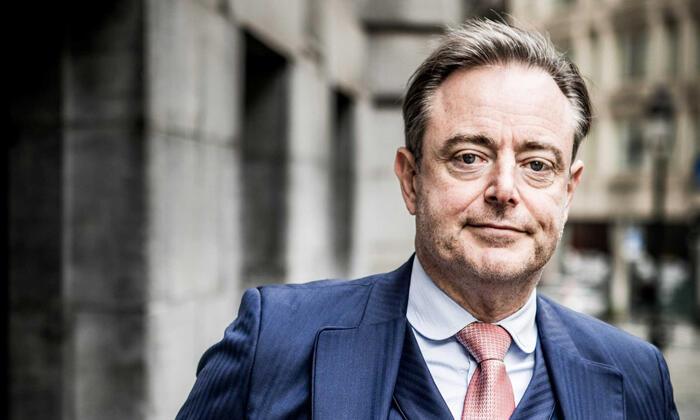
In European politics there is always a moment when “realism” begins to sound suspiciously like surrender. Belgium’s prime minister, Bart De Wever, appears to have reached that point.
De Wever has argued that the European Union should seek a mandate to negotiate directly with Russia over the war in Ukraine. His reasoning was stark: Europe, he said, cannot decisively defeat Russia militarily and cannot economically “choke” Moscow without full American support, leaving negotiation as “the only method left”.
“Since we are not capable of threatening Vladimir Putin by sending weapons to Ukraine, and we cannot choke him economically without the support of the US, there is only one method left: making a deal,” he told the Belgian newspaper L’Echo.
At first glance this might seem like sober pragmatism. Wars end in negotiations; diplomacy is unavoidable. Yet the deeper problem with De Wever’s argument lies not in the idea of talks, but in the tone of fatalism behind it. The Belgian prime minister’s remarks sound less like a strategy for peace and more like an early rehearsal for capitulation.
And, as with much of De Wever’s career, the controversy does not stand alone. It fits into a long pattern of political positioning that mixes ideological certainty with a curious indifference to the broader implications of his words.
The Fatalism of “Realism”
De Wever’s central argument is that Europe simply lacks the means to force Russia to retreat. Without full American backing, he claims, Moscow cannot be brought “to its knees”.
This may be analytically arguable, but politically it is extraordinarily clumsy. The war in Ukraine is not merely a military struggle. It is also a contest of will and perception. When the leader of an EU member state publicly suggests that victory is essentially impossible, he strengthens the very narrative Russia seeks to promote: that Western unity will eventually fracture.
European diplomacy relies heavily on signals. If the message from Brussels becomes one of pessimism, it invites the Kremlin to wait out the West.
In that sense De Wever’s intervention is not simply unhelpful. It is strategically naïve.
The Paradox of a Nationalist
The irony is especially striking given De Wever’s own political origins. For decades he built his reputation as the leading figure of Flemish nationalism, arguing that Belgium itself is an artificial state whose future lies in greater autonomy — perhaps even independence — for Flanders.
Yet when another nation fights for sovereignty against invasion, De Wever appears far less enthusiastic about the principle.
This contradiction runs through his politics. He has long entertained the romantic notion of a “Greater Netherlands”, arguing that Dutch and Flemish people are essentially one nation artificially divided by history.
Such historical nostalgia may appeal to Flemish nationalists. But it sits uneasily beside the modern reality of Ukrainian cities under missile attack.
One begins to suspect that De Wever’s attachment to national self-determination is selective.
A Government of Controversies
Even before his remarks on Russia, De Wever’s premiership had already generated a formidable list of controversies.
His government’s austerity programme triggered massive protests across Belgium in 2025, with tens of thousands demonstrating against cuts to pensions, unemployment benefits and healthcare spending.
Trade unions accused the government of dismantling social protections while ordinary workers bore the burden of fiscal tightening. The images of tear gas and water cannon on the streets of Brussels were hardly the triumphant debut of a new administration.
At the same time, De Wever has pushed for what supporters describe as the strictest migration policies in Belgian history.
Critics see something darker. Over the years his rhetoric on immigration and Islam has repeatedly sparked accusations of racism and cultural hostility. In one interview he suggested that Muslim communities were more inclined to create tensions in public life than Jewish communities — comments that provoked fierce backlash from political opponents.
For a politician who presents himself as a calm intellectual, De Wever has a remarkable habit of igniting political fires.
The Russian Assets Dispute
The Ukraine debate has already exposed further fault lines in De Wever’s thinking.
Belgium hosts the financial clearing house Euroclear, where vast sums of frozen Russian state assets are held. Many European leaders have proposed using those funds to support Ukraine’s defence.
De Wever has resisted, warning that confiscating Russian assets could destabilise the global financial system or even provoke retaliation from Moscow.
There are legitimate legal questions surrounding the issue. Yet once again his tone has been one of caution bordering on paralysis.
In geopolitics, excessive prudence can become a form of strategic inertia.
Europe’s Moment of Decision
The broader context makes De Wever’s comments all the more unsettling.
Europe is currently navigating its most dangerous security crisis since the end of the Cold War. The war in Ukraine has reshaped NATO strategy, accelerated defence spending and forced the EU to confront uncomfortable questions about its own military capabilities.
In such moments, leadership matters.
European leaders must project confidence, even when uncertainty lurks beneath the surface. They must reinforce unity, not question it.
De Wever, by contrast, has chosen to emphasise Europe’s limitations.
That may be intellectually honest. But politics is not a seminar room. Words spoken by prime ministers carry consequences far beyond academic debate.
The Brussels Paradox
There is a further irony here. Belgium hosts both NATO headquarters and the central institutions of the European Union. It is, geographically and symbolically, the heart of the Western alliance.
For the prime minister of that country to publicly doubt Europe’s ability to resist Russian aggression sends an unfortunate signal.
One might expect such pessimism from fringe populists or isolationist commentators. Hearing it from the leader of a founding EU member state is another matter entirely.
The Limits of Pragmatism
Defenders of De Wever will insist that he is simply confronting reality. Wars are costly. Western unity is fragile. Diplomacy will eventually be necessary.
All of this is true.
But there is a difference between preparing for negotiations and announcing defeat before negotiations even begin.
The lesson of twentieth-century European history is painfully clear: when aggression is rewarded, it rarely stops.
Pragmatism without principle can quickly become appeasement.
A Question of Leadership
None of this is to deny that Bart De Wever is a formidable political figure. He is intellectually sophisticated, rhetorically skilled and deeply influential within Flemish politics.
But leadership requires more than analysis. It requires judgement about when realism strengthens a cause — and when it undermines it. By presenting negotiations with Russia as Europe’s only viable option, De Wever risks doing precisely that. In the end, the danger is not that his words are wrong. The danger is that they may become self-fulfilling.
Click here for more News & Current Affairs at EU Today
Click here to check out EU TODAY’S SPORTS PAGE!
_______________________________________________________________________________________________________________________