
At times Europe’s leaders display such impressive reserves of denial that one wonders whether Brussels should bottle the stuff and sell it as a strategic resource.
Kaja Kallas, the EU’s foreign policy chief, offered a particularly pure sample this weekend. Speaking at the Doha Forum mere hours after Washington released a startlingly forthright policy paper aligning the United States with Europe’s nationalist far-right movements, Kallas assured her audience—straight-faced, unblinking—that “the US is still our biggest ally.”
If this is what passes for clear-eyed realism in the upper echelons of the European Union, then the bloc may be entering far more turbulent waters than its leaders admit.
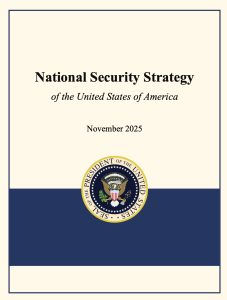
The American document in question—the Trump administration’s new National Security Strategy—does not leave much room for ambiguity. Across 33 pages, it articulates an ideological vision that could not be further removed from Brussels’ self-image.
The text, carrying the President’s own signature, speaks of Western civilisation’s “real and stark prospect of civilizational erasure,” warns that unnamed European countries may soon become “majority non-European,” and frames the continent’s political trajectory through the lens of demographic struggle. The unmistakable echo of the “great replacement” conspiracy theory—long a staple of fringe far-right discourse—reverberates throughout the document. Now it sits at the heart of American grand strategy.
One might have expected alarm bells to ring in Brussels. Instead, Kallas doubled down on her faith in Atlantic unity. Yes, she conceded, there is “a lot of criticism,” but “we are the biggest allies, and we should stick together.” It was a performance that would have been touching were it not so thoroughly detached from political reality. If anything, Kallas resembled an amiable host who, upon discovering that her houseguest has set fire to her curtains, politely insists that the bond of friendship remains undiminished.
For years, EU leaders have pinned their foreign policy worldview on the presumption of American constancy. The reflex is understandable: the transatlantic alliance is the bedrock upon which Europe’s post-war order was rebuilt. But this sentimental attachment has survived long past the point where it can be supported by evidence.
The Trump administration has never disguised its disdain for Europe’s political class – nor has Kallas tried to hide her disdain for Donald Trump. The new National Security Strategy merely codifies what has long been blindingly obvious.
That makes Kallas’s posture all the more peculiar. Her insistence that the US remains Europe’s indispensable ally comes across less as strategic calculation and more as a desperate attempt to will an earlier era back into existence. The world has changed; Brussels has not.
One wonders what precisely the EU’s foreign policy leadership believes it can gain by pretending otherwise. Washington has made its preferences brutally clear.
____________________________________________________________________________________________________________________________
“American diplomacy should continue to stand up for genuine democracy, freedom of expression, and unapologetic celebrations of European nations’ individual character and history. America encourages its political allies in Europe to promote this revival of spirit, and the growing influence of patriotic European parties indeed gives cause for great optimism.
“Our goal should be to help Europe correct its current trajectory.” U.S. National Security Strategy 2025 (p.26).
____________________________________________________________________________________________________________________________
The administration has little interest in multilateralism, little patience for Brussels’ moral sermonising, and even less appetite for underwriting Europe’s defence while being scolded for ideological impurities. Where the EU sees a project of consensual integration, the White House sees a bloated bureaucracy suppressing national sovereignty. The two visions are, to put it mildly, not compatible.
Kallas’s response, however, seems determinedly trapped in the diplomatic script of a decade ago. She speaks as if transatlantic harmony were a simple matter of good intentions and polite language. Yet the challenge Europe now confronts is not one of tone, but of substance: an American administration that believes the future of the West lies with nationalist insurgencies, not with the federalising ambitions of Brussels.
To be fair, Kallas is hardly alone among EU leaders in clinging to outdated assumptions. The Commission, the Council, and a good portion of Europe’s foreign ministries continue to conduct policy as though partnership with Washington were self-evident, inevitable, almost metaphysical. But international politics has no time for nostalgia. If America’s strategic horizon has shifted, then Europe must adjust—or be blindsided.
Pretending that nothing fundamental has changed does not constitute a foreign policy. It is diplomatic escapism.
Europe faces a stubbornly inconvenient question: what does it mean if its greatest security partner is now actively encouraging political forces that seek to dismantle the EU from within? The answer is not to issue bland reassurances about alliance unity. It is to confront the uncomfortable reality that the foundations of the post-Cold War order are buckling—and that Brussels, for all its declarations of “strategic autonomy,” is desperately unprepared.
Kallas may genuinely believe that America, no matter who occupies the White House, remains Europe’s trustworthy anchor. But such faith is no substitute for analysis. The continent’s security cannot rest on sentimental illusions, nor can its diplomacy proceed on the premise that allies will behave as they once did. Europe’s political class must deal with the world as it is, not as it was—or as they fondly imagine it to be.
For now, though, Brussels appears intent on averting its gaze from reality. And so its foreign policy chief steps onto the world stage to assure us all that the transatlantic alliance is unshaken, even as Washington embraces the most radical ideological pivot in its modern history.
This is not strategy. It is self-comfort masquerading as statesmanship. And if Europe continues down this path, it may soon discover—too late—that its most cherished assumptions have become its gravest vulnerabilities.
Click here for more News & Current Affairs at EU Today
Click here to check out EU TODAY’S SPORTS PAGE!
____________________________________________________________________________________________________________________________



