
Analysis offers in-depth reporting and data-led context on European policy, politics, economics, security and international affairs. Articles explain what is happening, why it matters and the likely implications for the EU and its partners.
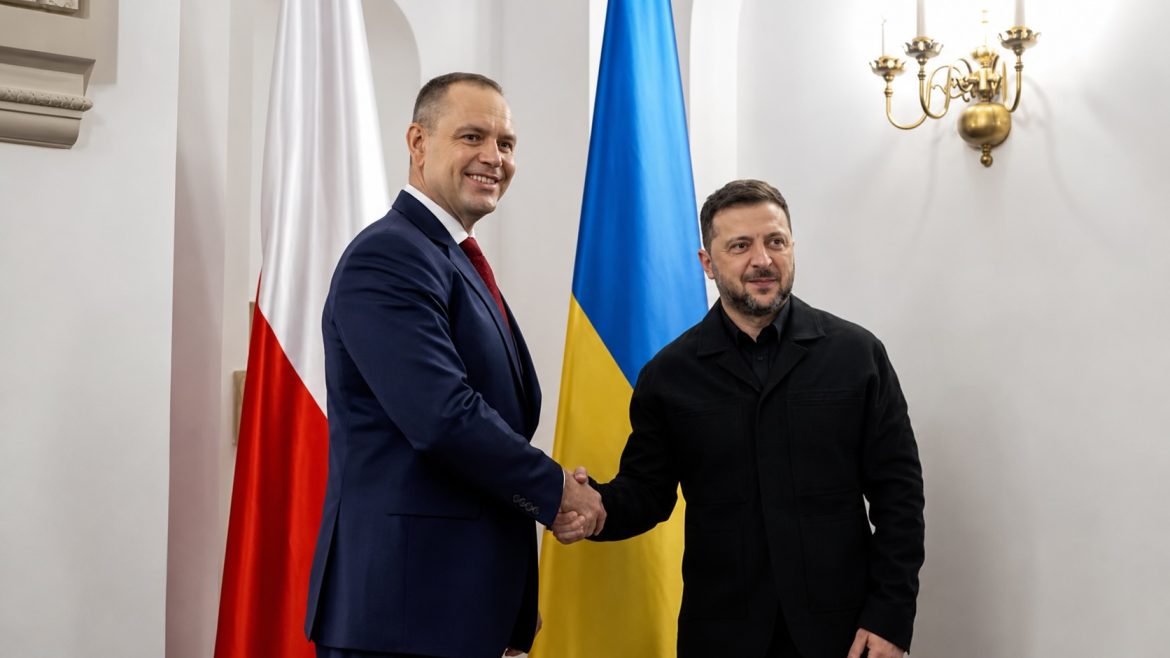
The diplomatic dispute between Ukraine and Poland over historical memory has moved from symbolic politics into the centre of wartime strategy. What began as a row over the naming of a Ukrainian military unit after the Ukrainian Insurgent Army has now threatened to overshadow the Ukraine Recovery Conference in Gdańsk, one of the most important international gatherings for Kyiv’s reconstruction agenda.
The conference, scheduled for 25–26 June, is intended to focus on international support, investment, energy, critical infrastructure and logistics. Instead, it is now being preceded by a dispute between two states whose strategic interests remain closely linked. Polish President Karol Nawrocki’s decision to revoke the Order of the White Eagle from President Volodymyr Zelenskyy has revived one of the most sensitive issues in Polish-Ukrainian relations: the legacy of the Ukrainian Insurgent Army, known as the UPA, and its role in the wartime massacres of Poles in Volhynia and Eastern Galicia.
For Warsaw, the UPA remains associated with crimes against Polish civilians during the Second World War. For many Ukrainians, it is remembered as a national liberation force that fought against both Nazi Germany and Soviet rule. These two historical narratives are not easily reconciled. They are rooted not only in archival disputes, but in family memory, national identity and political culture.
The immediate question, however, is no longer only historical. It is political and strategic. Zelenskyy’s criticism of Nawrocki reflects a view in Kyiv that the Polish president’s move is not simply about memory, but also about internal Polish politics. The confrontation comes in a divided Polish political environment, where competition between the nationalist right and the camp around Prime Minister Donald Tusk continues to shape foreign policy debates.
This does not mean that Polish concerns over the UPA are artificial. They are real and widely shared across much of Polish society, including beyond Nawrocki’s political camp. Nor does it mean that Ukraine will accept external limits on its own state symbols, military traditions or interpretation of national history. Kyiv sees the naming of military units as a matter of sovereign choice, especially during an existential war against Russia.
The problem is that both positions can be strongly held and still produce a damaging political result. Poland remains one of Ukraine’s most important partners in the war. It has been a major logistical, military, humanitarian and diplomatic base for Ukraine since Russia’s full-scale invasion. Ukraine, in turn, remains central to Poland’s own security environment. A weakened or defeated Ukraine would expose Poland to a far more dangerous strategic position on its eastern flank and create migration, security and political pressures on a scale far beyond those already experienced since 2022.
That is why the dispute carries risks beyond bilateral symbolism. Moscow has a direct interest in tensions between Kyiv and Warsaw. Any weakening of Polish-Ukrainian co-operation complicates Ukraine’s military resilience, Western supply routes and regional political cohesion. It also feeds narratives used by Russia to portray Ukraine as isolated from its neighbours and divided from its partners.
Tusk’s warning that the dispute is a “strategic mistake” reflects this wider calculation. Poland’s internal political divisions are deep, but the security reality remains unchanged. Russia’s war against Ukraine continues. Moscow has shown no readiness to end the conflict on terms compatible with Ukrainian sovereignty. Poland and Ukraine therefore face a shared problem that cannot be solved through historical gestures, state decorations or public ultatums.
The more difficult conclusion is that a full Polish-Ukrainian reconciliation over wartime memory may not be achievable in the near term. Historical commissions, archives and academic dialogue may reduce misunderstandings, but they are unlikely to erase the emotional weight of Volhynia in Poland or the role of the UPA in Ukrainian national memory. These issues may require generations rather than months of diplomacy.
For that reason, both governments may need to separate historical disagreement from security co-operation. This does not mean forgetting the past. It means preventing the past from disabling policies necessary for survival in the present. The priority for Kyiv is to keep its western routes open, maintain military and political support, and secure reconstruction commitments. The priority for Warsaw is to ensure that Ukraine remains a functioning state capable of resisting Russian pressure.
The Gdańsk conference will now test whether both sides can contain the damage. Zelenskyy had been expected to attend, but the dispute has placed the visit in doubt. If he attends, it will signal that the relationship can absorb political shocks. If he does not, the absence will be read as evidence that a dispute over memory has begun to affect the practical architecture of Ukraine’s recovery.
Neither Poland nor Ukraine can afford that outcome. Their historical disagreement is deep. Their strategic dependence on each other is deeper.

