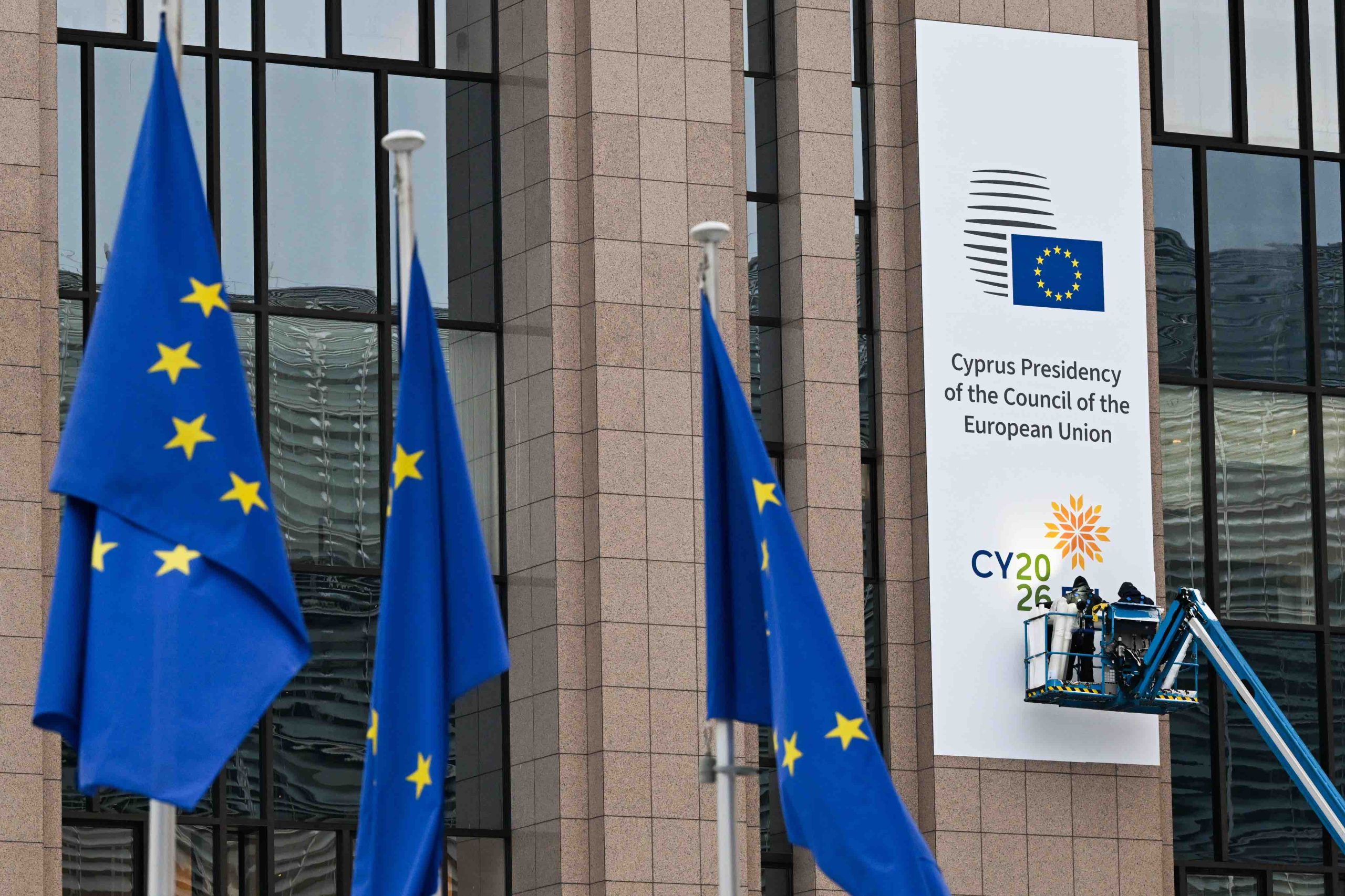
As Cyprus formally assumed the rotating presidency of the European Union on 7th January, a parade of senior figures underscored the symbolic importance of this Mediterranean island’s stewardship of the bloc for the next six months.
Ukrainian President Volodymyr Zelenskiy, flanked by European Commission President Ursula von der Leyen and European Council President António Costa, was present at the opening ceremony in Nicosia — a clear political signal of Brussels’s ongoing support for Kyiv amid a protracted conflict with Russia.
The presidency — a routinely scheduled rotational responsibility among member states — is far from routine in its geopolitical context. Cyprus, which joined the EU in 2004 and remains divided to this day following Turkey’s invasion and illegal occupation of the northern part of the island in 1974, has chosen to foreground Ukraine’s bid for European integration as a central priority of its term. President Nikos Christodoulides has used his platform to reaffirm his country’s understanding of Ukraine’s plight, drawing parallels between the northern Mediterranean island’s own experience with illegal occupation and Kyiv’s struggle for sovereignty.
There is also a deeper reason why Cyprus has been so visibly sympathetic to Kyiv’s cause. Both countries share the experience of living with illegal occupation imposed by a foreign power. Just as Ukraine has seen parts of its sovereign territory seized and held by Russian forces, Cyprus has endured the division of its island since Turkey’s invasion of the north in 1974 — an occupation that persists to this day. For Cypriots, the language of territorial integrity and international law is not abstract or fashionable; it is lived history. It is therefore entirely natural that Nicosia should instinctively side with Ukraine, seeing in its struggle an echo of its own unresolved national trauma.
That rhetorical alignment with Kyiv’s goals is significant. Cyprus has pushed for sustained support for Ukraine within EU institutions and, like many capitals, sees a robust European response to Russia’s war not just as a matter of principle but of collective security. Yet beneath the ceremonial optics lies a more complex and less encouraging reality about the broader question of European Union enlargement.
At present, Ukraine’s hopes of joining the European Union — a transformation that would mark an historic shift in the continent’s political architecture — are effectively stalled. Under the EU’s founding treaties, each of the 27 member states must agree unanimously to admit a new member. This unanimity requirement gives any single country the power to veto accession at any stage of the process.
That veto power has emerged as a formidable barrier to Ukraine’s ambitions. Hungary, under Prime Minister Viktor Orbán, has repeatedly signalled its readiness to block progress on Kyiv’s application — citing a mixture of domestic political calculations and strategic concerns. Indeed, the Hungarian government’s use of its veto to hold up formal enlargement steps has been described by critics as lending indirect support to Russia’s position by denying Kyiv a symbolically powerful Western anchor.
Slovakia, too, has occasionally aligned with Budapest on issues relating to EU foreign policy, demonstrating how internal divisions among ostensibly like‑minded allies can stymie collective action. This intra‑EU friction underscores a broader truth: the bloc’s consensus‑based structure, once a symbol of European unity, can now function as a mechanism for paralysis on issues of strategic consequence.
Against that backdrop, the idea that Ukraine might join the Union any time soon — even with staunch backing from Brussels and several capitals — must be treated with scepticism. Moscow may hope that divisions like these will pull the Union apart or at least blunt its resolve. But the more immediate obstacle lies not in external pressure but in the EU’s own decision‑making architecture and the political calculations of its members.
Cyprus’s presidency does not change that calculus. Even if Nicosia and other pro‑enlargement states muster overwhelming support for Ukraine’s accession, a single veto can derail formal progress. Proposals to reform the accession process — including altering the unanimity requirement for certain stages of membership negotiations — have been floated by European Council figures such as António Costa, but any such reform itself would require unanimous consent or treaty change, a high bar in today’s fractious political climate.
The situation with Turkey’s prospective EU membership presents a parallel illustration of how historical traumas and geopolitical fault lines can place durable obstacles in the path of enlargement. Turkey has been a candidate for EU membership for decades, yet its accession talks have long been stagnant. A key reason is the conflict over Cyprus: Ankara refuses to recognise the Republic of Cyprus — the internationally recognised government of the entire island and an EU member state — and instead maintains diplomatic and military support for the self‑declared Turkish Republic of Northern Cyprus.
That ongoing occupation, and Turkey’s persistent refusal to resolve the Cyprus dispute in a manner acceptable to Nicosia and other EU capitals, has made Turkish membership politically unthinkable in the foreseeable future. Greece, another EU member with its own historical grievances against Ankara, shares Cyprus’s opposition to Turkish accession in the absence of a comprehensive settlement that respects the sovereignty and territorial integrity of all parties.
Together, these two cases — Ukraine’s stalled accession and Turkey’s effectively frozen candidacy — highlight the broader tension at the heart of the EU’s enlargement policy. On paper, the Union remains committed to a rules‑based, open‑door approach that respects democratic choice and encourages reform. In practice, the requirement for unanimity gives disproportionate influence to individual capitals, allowing domestic politics, historical grievances, and geopolitical rivalries to shape decisions of continental consequence.
For Cyprus, presiding over the EU at a moment of acute geopolitical challenge is an opportunity to champion unity and European purpose. For Ukraine, however, Nicosia’s commitment, as heartfelt as it may be, cannot by itself overcome the structural and political realities that make accession a distant prospect. And for Turkey, the unresolved legacy of the 1974 invasion and the resulting occupation of the north of Cyprus ensures that membership remains not merely distant but politically untenable in the current environment.
In Nicosia this week, the ceremonial flags and speeches projected an image of affinity between an occupied island and a nation at war. But if the Union’s capacity to translate that affinity into political outcomes is to be judged, the coming months will test not only Cyprus’s diplomatic skills but the resilience of the EU’s own institutions and their ability to adapt to the challenges of an increasingly volatile world.
Northern Cyprus: Europe Finally Confronts Türkiye’s Forgotten Occupation
Click here for more News & Current Affairs at EU Today
Click here to check out EU TODAY’S SPORTS PAGE!
____________________________________________________________________________________________________________________________