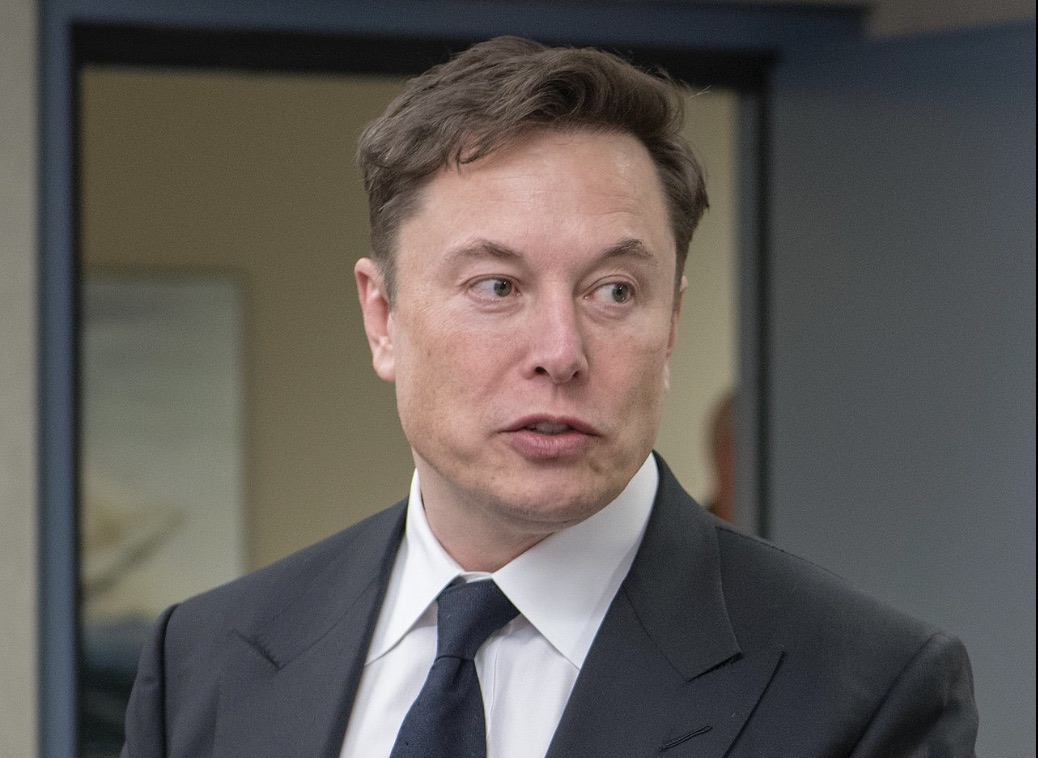
The German government has accused U.S. billionaire Elon Musk of attempting to influence its upcoming federal election, scheduled for February 23rd, through controversial commentary supporting the far-right Alternative for Germany (AfD) party.
This allegation, coupled with Musk’s contentious public statements and guest opinion pieces, has sparked intense debate about the role of foreign influence in national politics, something that Donald Trump himself alleged following his own 2020 electoral defeat.
Trump and his supporters falsely claimed that foreign-manufactured voting machines had been manipulated so that votes cast for Trump were instead recorded as votes for Joe Biden. No one has ever, either at the time or since, offered any evidence to support Trump’s assertion. On the contrary, ample evidence collected by the Intelligence Community and reviewed by the Select Committee disproves those claims.
However, whilst there has been no evidence of foreign interference in voting machines, in a de-classified report the National Intelligence Council has confirmed Russian interference in the 2020 Presidential elections, in Donald Trump’s favour: “We assess that Russian President Putin authorised, and a range of Russian government organisations conducted, influence operations aimed at denigrating President Biden’s candidacy and the Democratic Party, supporting former President Trump, undermining public confidence in the electoral process, and exacerbating sociopolitical divisions in the US.”
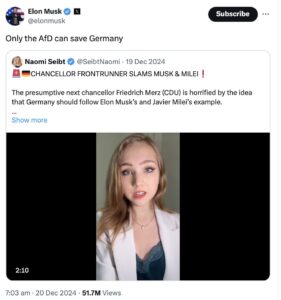
Meanwhile, at the centre of the controversy surrounding the upcoming German elections is a statement by Musk, on X, in which he endorsed the AfD as “Germany’s last hope,” prompting a significant backlash.
Musk has now made several posts on X amplifying his support for the AfD and criticising Germany’s current leadership.
The German government’s spokesperson confirmed on Monday that Musk’s actions amount to an attempt to sway the election, although they characterised some of his statements as “nonsense.”
“It is indeed the case that Elon Musk is trying to influence the federal election,” the spokesperson said, adding that while Musk is free to express his opinions, his remarks fall under the purview of freedom of speech, even when they are ill-informed or provocative.
Musk’s involvement in German politics has drawn criticism from multiple quarters. The AfD, a far-right party known for its anti-immigration stance and scepticism of climate policies, has long been a polarising force in German politics.
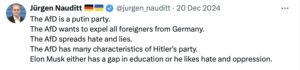
By endorsing the AfD, Musk has aligned himself with a party that many view as a threat to Germany’s democratic and progressive values.
Critics argue that Musk’s endorsement undermines the principle of non-interference in sovereign democratic processes, particularly given his status as a non-German billionaire with significant global influence.
Musk, however, has defended his foray into German politics. In a statement, he argued that his “significant investments” in Germany, including Tesla’s Gigafactory in Brandenburg, give him a vested interest in the country’s political and economic future.
Musk has praised the AfD’s approach to regulation, taxes, and market deregulation, suggesting that the party’s policies align with his vision for fostering innovation and economic growth. “I have every right to voice my opinion on matters that affect my investments and the broader business environment,” Musk said.
The timing of Musk’s intervention added to the controversy
Germans are preparing to vote in a parliamentary election after the collapse of the coalition government led by Chancellor Olaf Scholz. The political landscape is already fraught, with voters grappling with issues ranging from economic instability to rising concerns about national security.
Musk’s comments about Chancellor Scholz, including his call for Scholz’s resignation following a tragic incident at a Christmas market in December, have further inflamed tensions.
Five people were killed when a car rammed into a crowd at the market, and while Musk’s remarks stopped short of directly linking the tragedy to Scholz’s leadership, they were widely seen as an opportunistic attempt to discredit the chancellor.
German Chancellor Olaf Scholz has called on voters to ensure that next year’s snap election is shaped by citizens, not influenced by social media platform owners. His remarks come after Elon Musk publicly expressed his support for the far-right Alternative für Deutschland (AfD) party.
In a televised New Year’s Eve address Scholz emphasised that the February 23rd general election would determine Germany’s future. He urged voters to remember that the power to shape the nation lies with them, stating, “It will not be decided by the owners of social media channels.”
Scholz expressed concern about the amplification of extreme opinions in public discourse, noting, “Sometimes it feels like the more extreme the opinion, the more attention it receives.” He stressed that the direction of German society rests with “the vast majority of reasonable and decent people,” encouraging thoughtful and democratic participation.
“Freedom of opinion also covers the greatest nonsense,” a German government spokesperson said, underlining the importance of allowing open discourse even when it includes controversial or unpopular viewpoints. At the same time, officials have raised concerns about the potential for Musk’s statements to disrupt the democratic process, particularly given his immense platform and influence.
Political analysts have noted that Musk’s actions are part of a broader trend of wealthy individuals using their platforms to shape political discourse. As the world’s richest person, Musk’s influence extends far beyond the business realm, and his interventions in politics—both in Germany and elsewhere—highlight the challenges democracies face in regulating the role of money and power in public life.
Critics have called for stricter rules to prevent foreign actors from influencing elections, while others have emphasized the need for media outlets and social media platforms to take greater responsibility in curbing the spread of misinformation and divisive rhetoric.
The AfD, for its part, has welcomed Musk’s support
Party leaders have touted his endorsement as evidence of their growing appeal and credibility, particularly among business leaders and entrepreneurs. However, the party remains a deeply divisive force in German politics, with many mainstream politicians and voters rejecting its far-right ideology and questioning its commitment to democratic principles.
As the February election approaches, the impact of Musk’s intervention remains uncertain. While his endorsement of the AfD has undoubtedly drawn attention to the party, it is unclear whether it will translate into increased support at the ballot box. What is clear, however, is that Musk’s actions have added a new layer of complexity to an already contentious political landscape.
The controversy also raises broader questions about the responsibilities of influential figures like Musk. Should business leaders refrain from engaging in political debates outside their own countries? Or do they have a right—or even a duty—to speak out on issues that affect their interests and the global economy?
These are questions that Germany, and other democracies, will need to grapple with as they navigate the challenges of an increasingly interconnected and polarised world.
For now, the German government’s focus remains on ensuring a fair and transparent electoral process. Whether Musk’s controversial statements will ultimately influence the outcome of the election remains to be seen, but his intervention serves as a stark reminder of the complexities and contradictions inherent in balancing freedom of expression with the need to protect democratic integrity.
Main Image: Door NORAD and USNORTHCOM Public Affairs – https://www.northcom.mil/Images/igphoto/2002117234/ (archived), Public domain, https://commons.wikimedia.org/w/index.php?curid=80448702