Brussels moved on Sunday to place consular assistance and the possible repatriation of European nationals at the centre of its response to the widening war involving Iran, as foreign ministers from the 27 member states gathered by video link for emergency talks and officials worked through the practical consequences of a near-paralysis in regional air travel.
The Council’s public calendar listed an informal video conference of foreign ministers for 1 March to discuss the latest developments in Iran, underscoring the speed with which the crisis has been pushed to the top of the EU agenda.
The Brussels discussion was not confined to diplomacy. According to reporting from within the EU institutions, ministers examined regional stability, energy markets and the position of European citizens stranded in Iran and across the wider Middle East. Euronews reported that ambassadors met earlier on Sunday at COREPER level, while a separate Working Party on Consular Affairs exchanged information on citizens on the ground and coordinated national responses. The same report said the European Commission had activated the EU’s Local Consular Cooperation networks through EU delegations, a mechanism intended to help member states organise assistance in crisis conditions.
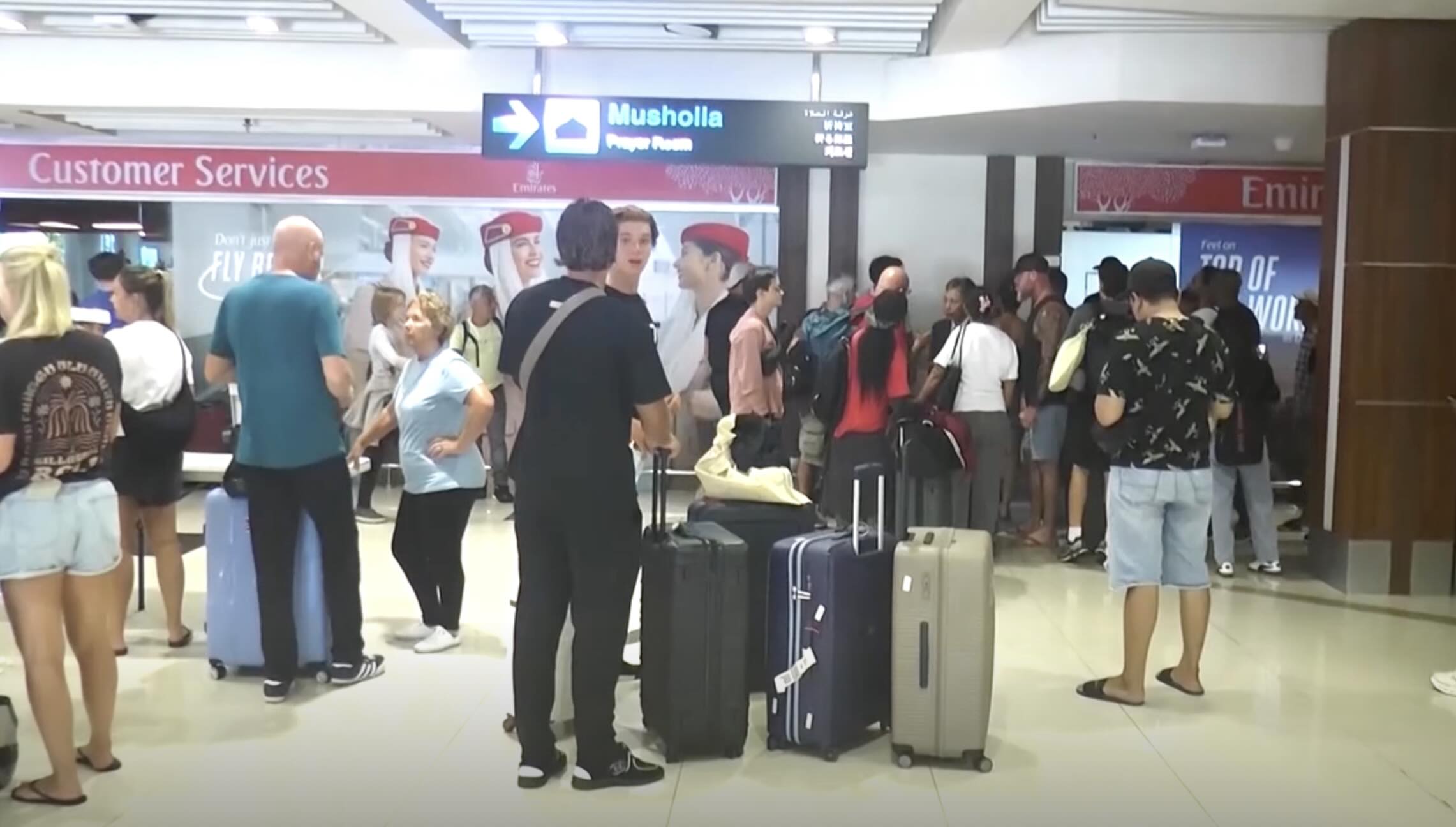
Those consular discussions come against an exceptionally difficult transport backdrop. Reuters reported on 1 March that major hubs including Dubai, Abu Dhabi and Doha were shut or operating under severe restrictions for a second day, while airspace over Iran, Iraq, Kuwait, Israel, Bahrain, the United Arab Emirates and Qatar remained largely empty. The agency said the disruption had stranded tens of thousands of passengers as far away as Bali, Kathmandu and Frankfurt, in what aviation analysts described as one of the sharpest shocks to international air travel in recent years.
Associated Press reported that more than 1,800 flights to airports across the Middle East were cancelled on Sunday, after at least the same number had been called off on Saturday. Airports or airspace in Israel, Qatar, Syria, Iran, Iraq, Kuwait, Bahrain, Oman and the UAE were closed, while the concentration of long-haul transit traffic through Gulf hubs meant the disruption reached well beyond the immediate conflict zone. AP also noted that at least 90,000 passengers normally change flights each day through Dubai, Doha and Abu Dhabi on Emirates, Qatar Airways and Etihad alone.
For Brussels, that creates a two-track problem. One is political: whether the EU can present a coherent line on a conflict that has already exposed differences between European capitals over the United States, Israel and the legality and strategic wisdom of military escalation. The other is logistical: how to help citizens leave a region where normal commercial routes are unreliable or unavailable, and where onward movement increasingly depends on coordination between embassies, neighbouring transit states and military or civil protection channels. Reuters reported on Saturday that France, Germany and the United Kingdom had jointly condemned Iranian attacks on countries in the region and called for a resumption of negotiations, while stressing that they had not taken part in the strikes carried out the same day.
The EU does have an established framework for such emergencies. In a previous Middle East evacuation operation during the Israel-Iran conflict in June 2025, the Union helped evacuate around 400 people from Israel via Jordan and Egypt, with the European Commission co-financing flights by up to 75% of transport costs under the EU Civil Protection Mechanism. The mechanism can be activated by member states seeking consular support for their nationals, and the Commission has previously stated that it can cover 75% of transport costs in repatriation operations. That precedent is likely to inform the present debate in Brussels, even if the scale of the current disruption is significantly larger because major Gulf hubs are themselves affected.
Kaja Kallas, the EU’s foreign policy chief, used a similar emergency foreign ministers’ meeting during the 2025 Israel-Iran hostilities to underline that the Union had activated the civil protection mechanism and was assisting member states to evacuate citizens who wished to leave. While no formal outcome from Sunday evening’s meeting had yet been published at the time of writing, the structure of the response appears familiar: member states remain responsible for consular protection, but Brussels is being used to share information, align messaging, mobilise networks and, where necessary, support transport.
The immediate test for the EU will be whether coordination can keep pace with events. With airspace closures extending across much of the region, and airlines suspending or rerouting services, the return of stranded Europeans is likely to depend less on ordinary ticketing systems than on emergency planning, transit corridors and joint action between capitals. That is why Sunday’s talks in Brussels matter. Whatever line the Union ultimately takes on the war itself, consular protection has already become its most concrete and urgent task.