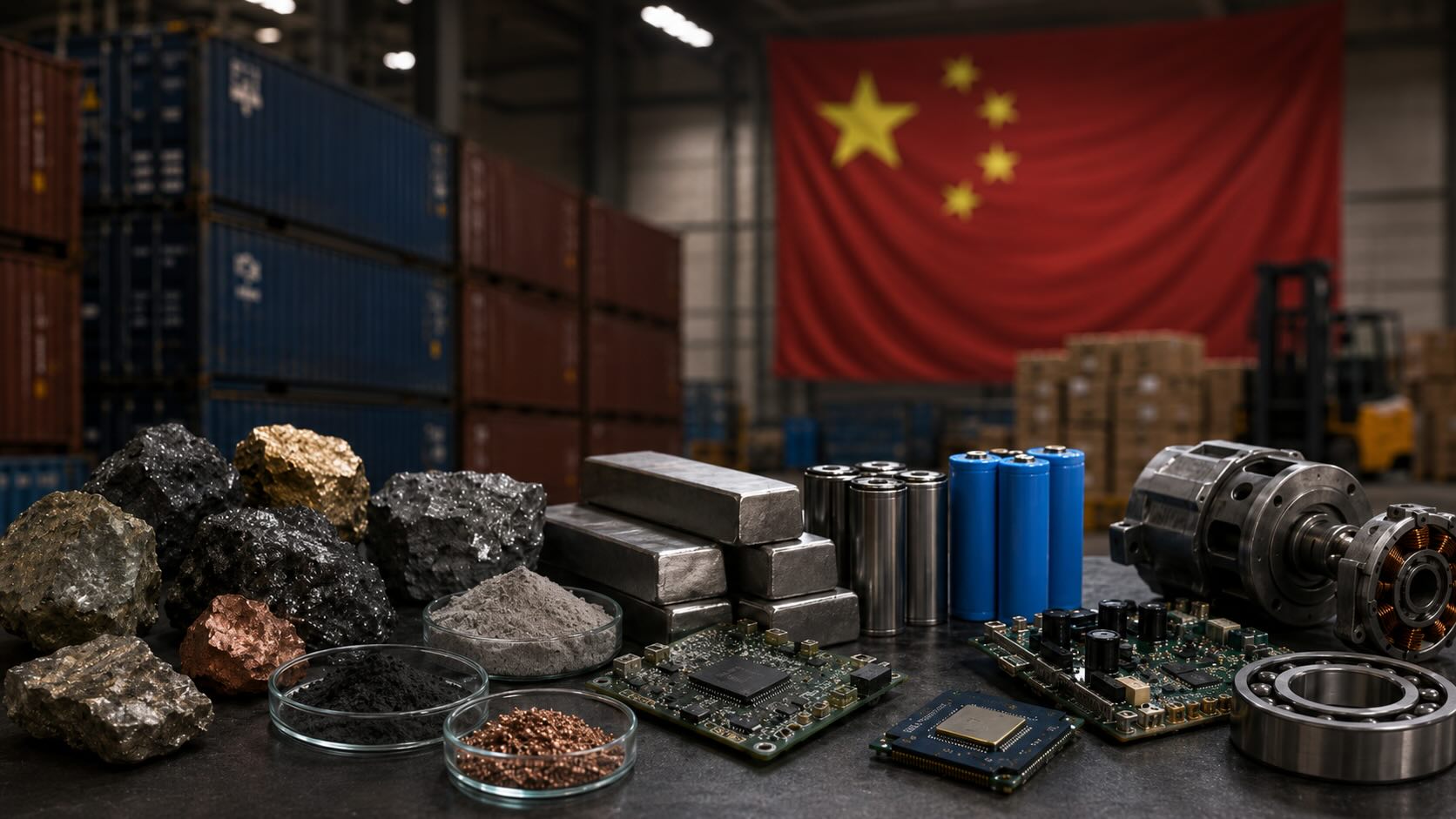
The European Commission is considering new rules that could require companies in sensitive sectors to reduce reliance on single suppliers, in a move aimed at limiting Europe’s exposure to China-dominated supply chains.
The proposal, outlined by EU Trade Commissioner Maroš Šefčovič, would form part of a broader review of the bloc’s trade defence and economic security tools. According to details reported on 5 June, the Commission is examining whether companies in critical areas should be required to diversify supplies across at least three sources, rather than depending heavily on one country or supplier.
The initiative reflects a wider shift in Brussels from voluntary “de-risking” language towards more concrete obligations for business. For several years, EU policymakers have warned that Europe must reduce strategic dependencies without cutting trade links altogether. The latest discussion indicates that the Commission is now considering whether diversification should become a legal requirement in selected sectors.
The immediate focus is likely to fall on raw materials, industrial inputs and other goods where concentration of supply could create political or economic vulnerability. The EU has already identified critical raw materials as a major risk area, noting that some inputs essential for batteries, wind turbines, aerospace, defence and digital technologies remain heavily dependent on a small number of third-country suppliers. Under the European Critical Raw Materials Act, the bloc has set a benchmark that by 2030 no more than 65 per cent of annual EU consumption of each strategic raw material at any relevant stage of processing should come from a single third country.
China is central to the debate because of its position in processing and refining key minerals, as well as its role in the supply of components used in electric vehicles, renewable energy, electronics and defence-related technologies. The concern in Brussels is not only commercial dependence, but the risk that access to key supplies could be restricted during political disputes.
Those fears are not theoretical. China has already used export controls on some critical materials, including gallium, germanium and graphite, in ways that have reinforced European concerns about economic coercion and industrial exposure. For the EU, the question is whether existing trade tools are sufficient when a supplier country can influence access to materials that underpin major parts of the European economy.
The proposed diversification requirement would mark a notable change in approach. Until now, the EU has generally relied on a mix of trade agreements, industrial policy, stockpiling, strategic partnerships and monitoring of dependencies. A legal rule requiring companies to avoid excessive reliance on single suppliers would place part of the responsibility directly on industry.
That would not be straightforward. Many companies depend on China because it offers scale, processing capacity, established logistics and competitive prices. Requiring firms to shift part of their sourcing to alternative suppliers could raise costs, complicate contracts and create short-term supply pressures. Smaller firms may find compliance particularly difficult if alternative suppliers are limited or more expensive.
The Commission appears aware of that problem. Any new rules would probably require transition periods and consultation with affected sectors. A rigid requirement imposed too quickly could damage European competitiveness, particularly in industries already facing high energy costs, weak demand and competition from subsidised foreign producers.
At the same time, leaving diversification entirely to market incentives has not delivered the level of resilience that Brussels says Europe needs. Companies generally optimise supply chains for cost and efficiency, not geopolitical risk. That model works during periods of stable global trade, but it can leave economies exposed when trade becomes a political instrument.
The EU’s own work on strategic dependencies has been moving in this direction for several years. A Commission review of strategic dependencies and capacities found that China was the main foreign source of import value for many products where the EU was highly dependent on third countries. More recent economic-security documents have also linked trade policy to supply-chain resilience, critical infrastructure and technology risks.
The new proposal would therefore fit into a broader policy line: Europe wants to remain open to trade while reducing the ability of external powers to use supply chains as leverage. That balance is difficult. If the EU moves too slowly, it risks remaining dependent on single-country suppliers in sectors linked to defence, energy transition and advanced manufacturing. If it moves too aggressively, it could raise costs for European industry and invite retaliation.
The timing is also politically important. EU-China trade relations have become more strained as Brussels investigates Chinese subsidies, overcapacity and market access barriers. The Commission has already taken a tougher approach in sectors such as electric vehicles, while also warning that the wider trade relationship is becoming unsustainable.
For European businesses, the practical question will be how narrowly the rules are defined. A targeted regime covering clearly identified critical inputs would be easier to justify than broad diversification rules across entire sectors. The Commission would also need to define what counts as a high-risk supplier, how dependencies are measured, and whether requirements apply by country, company, product category or processing stage.
The proposal is likely to face close scrutiny from member states. Some governments will support stronger action against strategic dependence on China. Others may be more cautious, particularly where national industries rely heavily on Chinese inputs or exports to the Chinese market. The result may be a negotiation over how much economic security the EU can impose without weakening its industrial base.
The policy debate is no longer about whether Europe has dependencies. That has already been established. The harder question is whether Brussels can design rules that reduce exposure without creating new costs that European companies cannot absorb. The answer will determine whether the EU’s de-risking strategy becomes a practical industrial policy or remains mostly a political slogan.