A reported limit on Meta’s access to Google’s Gemini models shows that even the world’s largest technology companies cannot assume unlimited AI capacity. For Europe, whose cloud and frontier-model infrastructure remains heavily dependent on US providers, the warning is sharper.
Google reportedly limited Meta’s use of its Gemini artificial-intelligence models after the Facebook owner sought more computing capacity than its rival could provide, exposing how competition in generative AI is increasingly determined by access to infrastructure rather than model quality alone.
The reported restriction dates to discussions around March and is said to have disrupted or delayed some internal Meta projects. The account is based on people familiar with the matter and had not been independently verified when carried on 28 June. Neither company has publicly provided a detailed capacity figure or contractual explanation.
The caveat matters. The story concerns a reported commercial arrangement between two competitors, not an announced Google policy. Its wider significance nevertheless lies in what made the disagreement plausible: advanced AI consumes enormous computing resources, and those resources remain concentrated among a small number of companies.
AI competition moves below the model layer
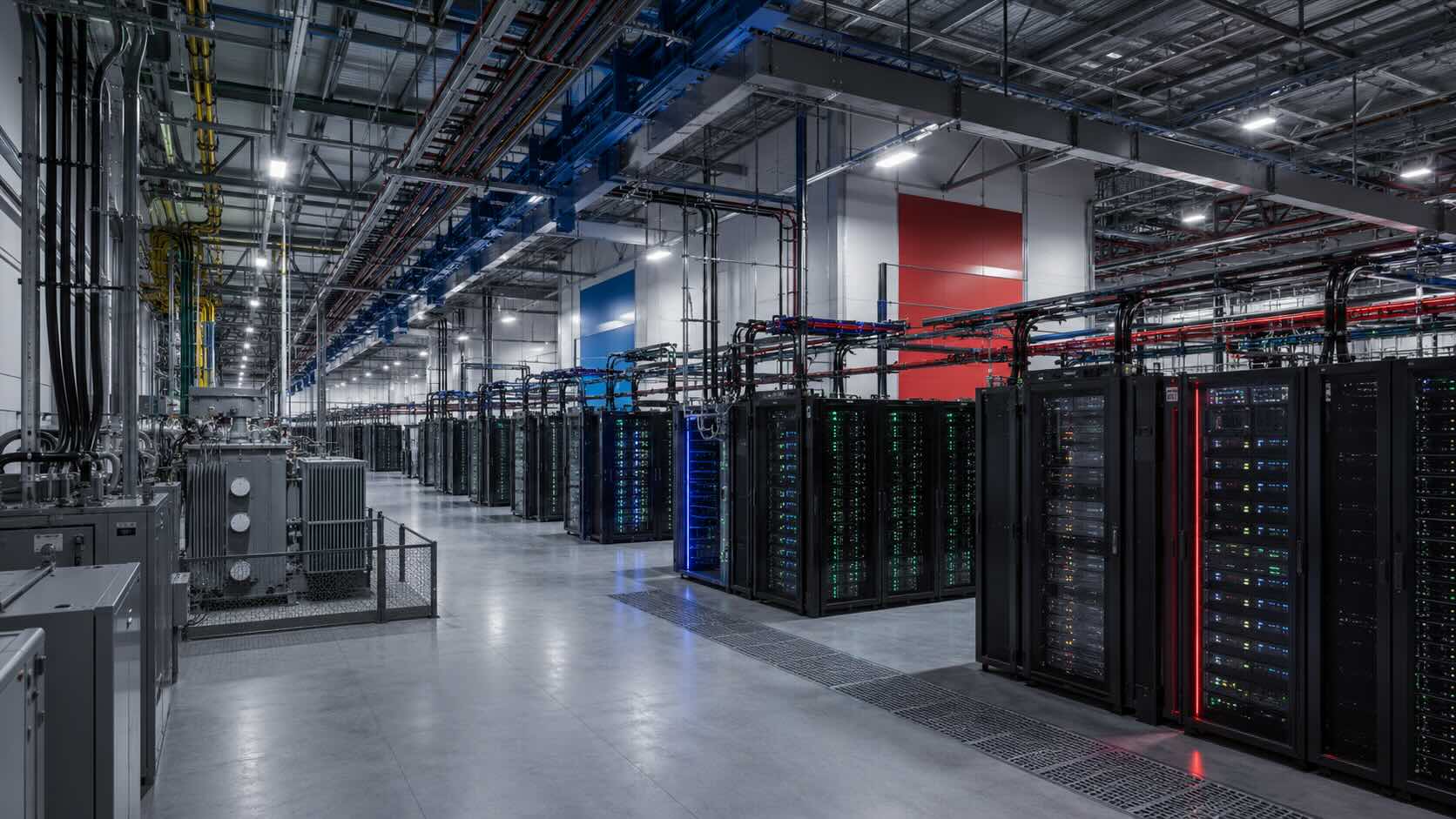
Public comparisons of AI providers focus on benchmarks, coding performance, reasoning and user features. Those measures sit above a physical system of data centres, specialised chips, networking equipment, electricity and cooling.
A company can possess data, engineers and promising models but still face a capacity constraint. Training frontier systems requires large clusters for long periods. Serving them to millions of users adds continuing inference demand. Internal experiments compete with consumer products, advertising systems and commercial cloud customers for the same infrastructure.
Meta has invested heavily in its own data centres and chips, but its reported request for Gemini capacity illustrates why even a hyperscale group may use a rival’s models or cloud resources. Companies need redundancy, benchmarking and rapid access to whichever model performs best for a particular task. Dependence on a competitor can then become strategically uncomfortable.
For Google, supplying Meta would generate revenue but could also consume capacity needed for its own products and customers. The dispute therefore reflects a basic feature of the AI market: firms are simultaneously competitors, suppliers and customers.
Europe’s dependency is much deeper
European companies face the same constraint without the balance sheets or infrastructure estates of Meta and Google. Most depend on US hyperscalers for cloud computing, advanced accelerators and access to leading proprietary models. Even European AI developers often train or serve products through non-European infrastructure.
That is why the reported episode matters to Brussels. If one US giant cannot secure all the capacity it wants from another, European start-ups and public bodies cannot assume that commercially available capacity will always be sufficient, affordable or prioritised for them.
EU Today has already examined how proposed European cloud rules could restrict US providers in sensitive state procurement. Sovereignty criteria may reduce legal and security dependence, but they do not create processors, power connections or data-centre capacity. Procurement preferences without adequate European supply could increase costs while leaving the underlying bottleneck intact.
Power is becoming technology policy
AI infrastructure is also an energy problem. Large data centres need high-capacity grid connections that can take years to approve and build. They compete with factories, housing and electrification projects for network capacity. Cooling and water use can create local resistance, particularly in regions already facing drought or grid congestion.
Europe’s difficulty is not a lack of policy ambition. The EU is supporting AI factories linked to supercomputers, revising semiconductor policy and preparing a Cloud and AI Development Act. The problem is timing and scale. US technology groups can commit tens of billions to infrastructure while European funding is divided among national programmes, EU instruments and private investors operating across fragmented markets.
Chips are another constraint. The most advanced accelerators are designed and supplied largely by American companies and manufactured through globally concentrated supply chains. Export controls, delivery delays or a surge in US demand can affect European projects before any EU rule has a chance to help.
Regulation cannot allocate scarce capacity
The EU’s AI Act governs risk and responsibility; competition law can address abusive conduct; the Digital Markets Act can open access to some platform services. None of those instruments can guarantee abundant compute.
Brussels has recently accepted delays to parts of its AI framework because standards and enforcement systems were not ready. That slower regulatory timetable may ease compliance pressure, but it does not close the investment gap.
The Google-Meta report therefore cuts through a sometimes abstract debate over whether Europe regulates too much. The continent needs rules, but it also needs power generation, grids, processors, data centres, capital and customers willing to buy European services.
Concentration creates resilience risk
Compute scarcity also strengthens the market power of companies that control both models and infrastructure. A cloud provider can determine pricing, capacity allocation and which customers receive early access. A model provider can change conditions or withdraw a service. For ordinary commercial applications, that is a procurement risk. For government, healthcare, finance or defence-related work, it can become a sovereignty concern.
Europe does not need to reproduce every American hyperscaler behind a national border. It does need enough diversified capacity to keep critical services running and to give companies credible alternatives.
The reported Google-Meta restriction may turn out to be a temporary contractual disagreement. Its policy message is more durable. The AI race is becoming an infrastructure race, and access to compute can constrain even the firms that dominate the digital economy.
Europe has spent years writing the rules of artificial intelligence. Its next test is whether it can build enough of the machinery beneath those rules to remain an actor rather than a dependent customer.