
Spanning more than 1,000 kilometres across eight European countries, the Alps stand as one of the planet’s most striking natural landmarks; among the most significant of these glaciers is the Great Aletsch Glacier.
Their towering peaks and rugged valleys have long defined the landscape, while their glaciers—remnants of ancient ice ages—have shaped the region’s topography for millennia. Yet, in an era of rapid climate change, these icy giants are retreating at an alarming rate.
The Great Aletsch Glacier, the largest in the Alps, is located in southwestern Switzerland. It stretches nearly 20 kilometres and remains an awe-inspiring sight.
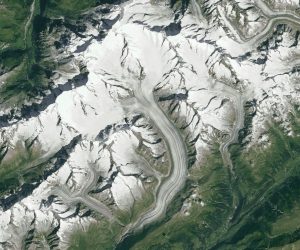
The Great Aletsch Glacier, image by NASA
However, as recent satellite imagery reveals, this once-magnificent glacier is steadily diminishing.
A pair of images taken by NASA’s Landsat satellites offers a stark comparison of Aletsch’s state over four decades. The first, captured by Landsat 5’s Thematic Mapper (TM) in September 1984, portrays a glacier with a visibly larger surface area and greater ice coverage.
By contrast, an image taken in August 2024 by Landsat 8’s Operational Land Imager (OLI) paints a very different picture—one of a shrinking, thinning glacier retreating from its previous bounds.
As of March 2025, seasonal snowfall still obscures new satellite data, but the evidence remains clear: the Aletsch Glacier has suffered significant losses. According to the Swiss Glacier Monitoring Network (GLAMOS), the glacier has retreated more than 1,300 meters since 1984. Even more concerning, it has lost an estimated 43 meters of ice, measured in water equivalent, in that time frame.
This decline, while striking on its own, is mirrored across the region, with smaller glaciers also showing signs of distress. Oberaletsch Glacier, for example, has receded more than 240 meters, while the Fiescher Glacier has retreated over 1,000 meters.
Scientists attribute this decline to a combination of rising temperatures and reduced snowfall. The summer of 2024 proved particularly devastating, with record-high temperatures melting much of the previous winter’s accumulation. Swiss glaciers collectively lost 2.5 percent of their volume in that single year alone. The consequences of such loss extend beyond aesthetics or tourism; they pose serious threats to water supply, hydroelectric power, and the delicate alpine ecosystem.
Glaciers in other parts of the world, such as those in Alaska, have contributed more in absolute terms to global ice loss. However, the relative losses in Central Europe, which encompasses Switzerland, are among the most dramatic. Between 2000 and 2023, the region lost approximately 39 percent of its glacial ice—an alarming statistic that highlights the fragility of these mountain ice reserves.
What does the future hold for the Aletsch Glacier and its counterparts? Current climate models paint a grim outlook. If global temperatures continue to rise at their current pace, experts warn that most of the Alps’ glaciers could disappear by the end of the century. This would not only transform the region’s landscape but also disrupt crucial freshwater supplies for millions of people who rely on glacial meltwater.
Efforts to mitigate these changes are ongoing. Scientists and policymakers advocate for urgent action to curb carbon emissions, while researchers continue to monitor and model glacial behavior to better understand the implications of their loss. Some have even proposed unconventional solutions, such as covering parts of glaciers with reflective blankets to slow melting—a temporary measure, but one that underscores the desperation of the situation.
For now, the Aletsch Glacier remains a breathtaking yet imperiled natural wonder. As it continues to retreat, its fate serves as a poignant reminder of the far-reaching impacts of climate change. Whether through policy, technology, or individual action, preserving what remains of these ancient ice giants will require a concerted global effort—before they become little more than memories captured in satellite images.
Main Image: Par Tobias Alt, Tobi 87 — Travail personnel, CC BY-SA 4.0, https://commons.wikimedia.org/w/index.php?curid=3362857



