
A proposal by Labour Deputy Prime Minister Angela Rayner to establish a 16-person council to develop an official Government definition of Islamophobia has sparked intense debate in the UK.
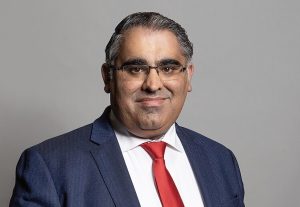
The proposal echoes a call by Labour MP Tahir Ali who in November of last year called for the introduction of blasphemy laws prohibiting the desecration of religious texts and figures revered in Abrahamic religions.
While the initiative is framed as an effort to tackle discrimination against Muslims, critics argue that such measures pose a significant risk to freedom of expression and academic inquiry.
At the heart of the concern is the potential for an official definition to serve as a de facto blasphemy law. The current working definition of Islamophobia, developed by the All-Party Parliamentary Group on British Muslims in 2018, is likely to inform the council’s deliberations.
That definition has been controversial because it not only condemns anti-Muslim discrimination but also categorizes criticism of Islamic doctrines and political structures in Muslim-majority countries as Islamophobic. This has raised fears that legitimate debate on issues related to Islam and its role in public life could be suppressed.
One particularly troubling aspect of the 2018 report is its assertion that accusing Muslims or Muslim-majority states of exaggerating Islamophobia constitutes a form of Islamophobia in itself. This creates a paradox where any critique of the concept is automatically dismissed as bigotry, effectively shutting down open discussion.
Moreover, the report classifies questioning Muslim citizens’ loyalty to the British state as Islamophobic, despite studies showing that many British Muslims place their religious identity above national identity. While discrimination against individuals based on religion is unquestionably wrong, conflating anti-Muslim bigotry with criticism of Islamic beliefs risks eroding the ability to scrutinize and debate ideological matters freely.
A key concern is that such a definition could be used to criminalise the expression of views deemed offensive to religious sensitivities.
Labour MP Tahir Ali’s remarks during Islamophobia Awareness Month in November 2023 illustrate this point. Ali called on Prime Minister Keir Starmer to introduce measures prohibiting the desecration of religious texts and figures from the Abrahamic traditions. While Starmer did not commit to such legislation, he also did not dismiss the idea outright.
This has fuelled speculation that the Labour Party is willing to entertain restrictions on free speech in the name of “social cohesion”.
The recent arrest of a man in Manchester for burning a copy of the Quran has further intensified concerns.
While incitement to violence should rightly be condemned, critics argue that punishing symbolic acts like burning religious texts—however offensive they may be—sets a dangerous precedent for curbing free expression.
Campaigners in the UK have already warned that Sharia law is being brought to the streets of Britain following the case of a man who burned a Quran at the memorial to the Manchester Arena bombing victims.
Martin Frost, 47, admitted a racially aggravated public order offence after he was filmed tearing pages from the Islamic holy book and setting them alight on Saturday.
Tim Dieppe, head of public policy at Christian Concern, claimed that police are now enforcing Sharia law on Britain’s streets.
Many fear that this signals the beginning of a broader trend toward “state-enforced tolerance,” which paradoxically could exacerbate divisions rather than fostering social harmony.
Labour’s growing reliance on the Muslim vote.
The broader political implications of this issue are also significant. Traditionally, the Labour Party has enjoyed strong support from Muslim communities, largely due to its historical advocacy for ethnic minorities and working-class rights.
According to the Labour Muslim Network, over 75% of the UK’s more than 500 Muslim councillors are members of the Labour Party. Additionally, in the 2019 General Election, more than 80% of Muslim voters backed Labour.
While not all Muslims vote Labour and not all Muslim MPs are affiliated with the party, there is a clear trend of alignment between British Muslims and Labour’s political platform.
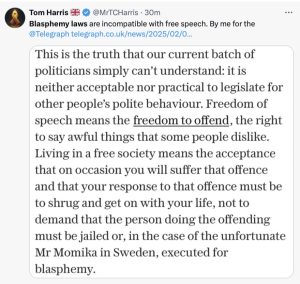
However, Labour’s efforts to legislate on Islamophobia in a way that curtails free expression could have unintended consequences. For one, it may alienate secular and liberal voters who view the protection of free speech as a fundamental democratic value.
Additionally, there is a risk that such measures could embolden accusations of “creeping Sharia” and government overreach, reinforcing divisions rather than bridging them.
Comparisons have been drawn between the proposed council’s work and Pakistan’s controversial blasphemy laws, which are widely criticized for suppressing dissent and targeting religious minorities.
While the UK is far from implementing similar draconian measures, critics argue that the logic underpinning the push for an official Islamophobia definition mirrors that of blasphemy laws—where critique of a religion is conflated with discrimination against its adherents.
The challenge for the Labour government, should it proceed with this initiative, will be to ensure that any definition of Islamophobia does not infringe on free speech or academic inquiry. A clear distinction must be maintained between protecting individuals from discrimination and shielding religious doctrines from critique.
The Labour Party must also consider the broader impact of such policies on national cohesion, ensuring that efforts to combat anti-Muslim bigotry do not inadvertently stifle legitimate discussion about Islam’s role in public life.
If Labour is serious about fostering social cohesion, it must pursue policies that balance protection from discrimination with the preservation of open discourse. This means upholding the rights of individuals to criticize religions—including Islam—without fear of legal repercussions, while simultaneously addressing genuine cases of anti-Muslim hatred.
In navigating this complex issue, Labour faces a crucial test. Will it uphold the fundamental principles of free expression, or will it allow concerns about offense to override the essential liberties that underpin British democracy?
The answer will determine not only the future of free speech in the UK but also the extent to which Labour remains a truly inclusive party that respects diverse perspectives.
Main Image. By UK Government – Angela Rayner with Deputy Prime Minister of Pakistan Ishaq Dar, 5 September 2024 CC BY 2.0, https://commons.wikimedia.org/w/index.php?curid=152294705
__________________________________________________________________________________________________________________
Tahir Ali
Read Also: LABOUR MP TAHIR ALI CALLS FOR BLASPHEMY LAWS IN UK PARLIAMENT
Labour MP Tahir Ali stirred debate in the UK Parliament this week when he called for the introduction of blasphemy laws prohibiting the desecration of religious texts and figures revered in Abrahamic religions.
__________________________________________________________________________________________________________________



