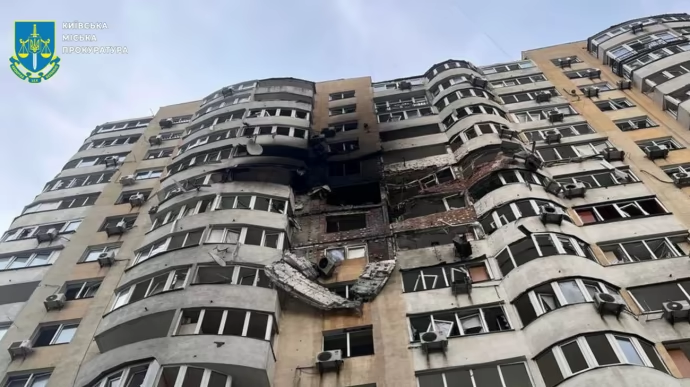
Ukrainian air defence forces repelled the vast majority of airborne threats during a large-scale Russian assault overnight, but the capital, Kyiv, sustained significant damage to civilian infrastructure, with at least four people killed and over 20 injured. The attack also disrupted the city’s underground rail system, forcing partial closure of a major metro line.
According to the Ukrainian Air Force, Russia launched 452 aerial attack assets over Ukrainian territory during the night of 5–6 June, including drones, cruise missiles, ballistic missiles, and an anti-radiation missile. A total of 406 targets were intercepted or disabled, marking one of the most extensive air defence operations since the start of the full-scale invasion.
Composition of the Attack
The wave of strikes included:
407 Shahed-type attack drones and decoys, launched from multiple points in Russia and Russian-occupied Crimea;
Six ballistic missiles (Iskander-M/KN-23 types);
Thirty-six long-range Kh-101 cruise missiles, launched from strategic bombers operating over the Caspian Sea;
Two additional cruise missiles (Iskander-K types) launched from occupied territory;
One Kh-31P anti-radiation missile, fired from over the Black Sea.
The Ukrainian military employed fighter aircraft, anti-aircraft missile batteries, electronic warfare systems, and mobile air defence teams to intercept the incoming weapons.
Civilian Casualties and Emergency Response
Despite the effectiveness of the defensive systems, Kyiv suffered serious damage. According to the Kyiv City Military Administration and the Prosecutor’s Office, four people were killed, including three emergency service personnel, and 22 others were injured. The casualties include emergency workers, a metro employee, utility personnel, and civilians, including an 11-year-old girl who was treated for smoke inhalation caused by a fire in a residential building.
Fire and rescue teams responded to multiple impact sites across the city, where falling debris from intercepted drones and missiles caused fires and structural damage. Residential buildings, commercial premises, and educational institutions were among those affected.
Metro Infrastructure Damaged
A key section of Kyiv’s Red Line metro service, one of the city’s main underground routes, was taken out of operation due to damage to the tracks and power cables between two central-eastern stations. As a result, train services are currently limited to the western portion of the line. Passengers are being advised to use alternative surface transport, including a replacement bus service temporarily put in place by city authorities.
According to Kyiv Metro officials, above-ground stations in the eastern districts have been closed while emergency crews carry out repairs. Services are expected to remain disrupted for at least 24 hours.
Only a limited number of metro trains – those housed in underground sidings overnight – remain available for service while restoration continues.
Widespread Impact Across Kyiv
Damage was reported across at least six areas of the city. Fires were recorded at a residential high-rise, a warehouse facility, and a humanitarian aid storage site. Several vehicles were destroyed or damaged, and debris fell near petrol stations, schools, and open spaces. Portions of the city’s rail infrastructure, including metro tracks, were also struck. Emergency services remain on-site to manage fires, assess damage, and search for additional casualties.
Authorities noted that debris from intercepted weapons landed in residential zones as well as industrial areas. Despite most of the projectiles being intercepted before reaching their targets, the widespread distribution of falling fragments continues to pose a severe risk to civilian life and property.
Broader Context and Strategic Implications
Across the country, Ukrainian officials reported 13 confirmed impact zones and at least 19 additional locations affected by falling debris. This latest attack demonstrates the Russian military’s ongoing use of saturation tactics—launching high volumes of drones and missiles simultaneously to test and exhaust Ukrainian air defence systems.
Ukrainian officials have renewed calls to international partners for additional support in the form of advanced air defence systems and interceptors, warning that continued high-intensity assaults risk outpacing Ukraine’s defensive capacity.
While the vast majority of incoming threats were successfully neutralised, the consequences in Kyiv serve as a stark reminder that even highly capable defences cannot eliminate all risk from mass missile and drone attacks.
Investigations into the full extent of the damage are ongoing. Ukrainian prosecutors are also gathering evidence to support legal cases related to the repeated targeting of civilian infrastructure by Russian forces, which Kyiv maintains constitutes a breach of international humanitarian law.