
The scene in Los Angeles this weekend would be more familiar in Caracas or Cairo than in California: tear gas lingers in the air, federal agents in riot gear confront local residents, and the National Guard arrives to “restore order” on American soil.
But this is not the Global South. This is the United States under Donald Trump — and the crisis unfolding in LA is as much about political theatre as it is about immigration enforcement.
The spark for this unrest was a series of federal raids targeting undocumented migrants, carried out in the city’s predominantly Latino Paramount district. What followed was predictable — and perhaps, to some in Washington, desirable. Protests erupted. Clashes broke out. And within hours, the Trump administration had pounced on the opportunity to deploy military forces to a domestic front.
“Mobilising the National Guard IMMEDIATELY,” announced U.S. Defense Secretary Pete Hegseth with unmistakable relish on social media. “If violence continues, active duty Marines at Camp Pendleton will also be mobilised — they are on high alert.” In other words: escalation.
President Trump’s own statement struck an even graver tone. Resistance to immigration enforcement, he warned, “constitutes a form of rebellion against the authority of the Government of the United States.” The use of the word “rebellion” — historically loaded in the American context — is no accident. It casts these largely peaceful protests not as civic resistance but as insurgency.
Of course, no one disputes that the state has a right to enforce immigration law. But what is now in question is the means — and the motive.
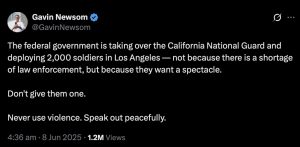
The deployment of 2,000 National Guard soldiers to Los Angeles, with the spectre of Marine involvement looming, has turned a local protest into a national spectacle. California Governor Gavin Newsom minced no words: “They want a spectacle. Don’t give them one.”
He is right. The response from Washington appears less like a legitimate attempt to maintain public order than a deliberate effort to inflame tensions for political gain. The optics of armed soldiers confronting Latino residents are bound to play well with Trump’s base, who have long been fed the narrative of America under siege by “criminal illegal aliens” and “foreign terrorist organisations,” to quote Hegseth’s incendiary language.
But this narrative is profoundly misleading. The majority of those targeted in ICE operations are not drug lords or terrorists but working people — many of whom have lived in the U.S. for years, if not decades. The protests in LA are not some anarchic uprising but a cry of anguish from communities who feel hunted, marginalised, and silenced. The scenes of flash-bangs and rubber bullets being used on American citizens defending their neighbours should trouble anyone who believes in constitutional rights.
It is worth asking: to what end is this escalation being pursued? Is it about immigration — or intimidation?
Donald Trump has always viewed immigration not merely as a policy challenge, but as a wedge — a reliable rallying cry to unite his base and polarise his opponents. But now the line is disintegrating. Sending troops to Democratic strongholds plays directly into the president’s broader culture war strategy. The message is unsubtle: this is what happens when you challenge me.
The fact that the National Guard was federalised — taken out of the control of California’s own governor — deepens the constitutional unease. It undermines states’ rights, long a Republican shibboleth, and it sets a troubling precedent for federal overreach. If the president can deploy troops to crush protests under the vague pretext of “rebellion,” what checks remain on executive power?
There is also a moral dimension. At the heart of this confrontation lies a contradiction: the United States, a nation built on immigration, now uses military force to chase migrants and suppress dissent. What does it say about the health of a democracy when the government turns its guns inward, not to protect the nation but to punish its own people for speaking out?
Trump’s decision to militarise the situation in Los Angeles may serve him in the short term. It will dominate the news cycle. It will create the impression of decisive leadership. It will energise his most loyal supporters. But the long-term cost — to America’s social fabric, to its democratic norms, and to its global image — may be incalculable.
If a nation truly respects the rule of law, it must enforce it with restraint. If a government truly believes in freedom, it must allow space for dissent. And if a president truly wishes to lead, he must see citizens not as threats but as partners.
Instead, Donald Trump has shown once again that he sees political opponents and vulnerable communities as mere props in his ongoing pantomime of power.
Main Image @nicksortor via X



