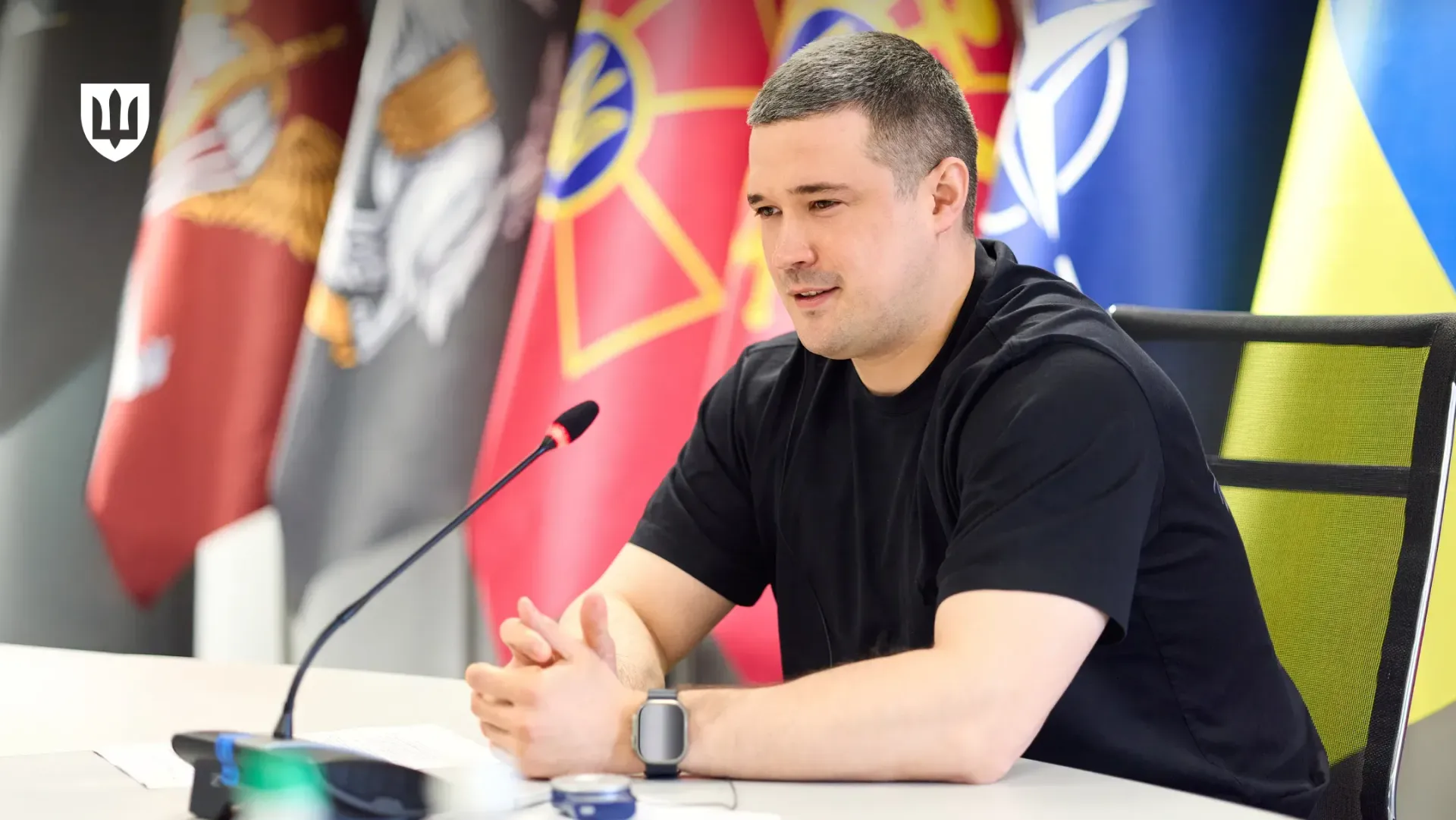
President Volodymyr Zelenskyy has yet to decide whether Mykhailo Fedorov will remain Ukraine’s defence minister, placing one of the country’s most prominent government reformers at the centre of a broader political reorganisation.
Ukraine’s latest government reshuffle has developed into a test not only of Defence Minister Mykhailo Fedorov’s political future, but also of the relationship between presidential authority, civilian defence administration and the Armed Forces during wartime.
President Volodymyr Zelenskyy said on Wednesday, 15 July, that he would meet Fedorov and the leadership of the Armed Forces before deciding whom to nominate as defence minister in the new government.
The president indicated that relations between the Defence Ministry and the military command would form part of the discussion. Other priorities include reforming Ukraine’s territorial recruitment centres, strengthening air defence and expanding domestic arms production.
The uncertainty follows the departure of Prime Minister Yulia Svyrydenko and the resulting resignation of the Cabinet. The reshuffle has placed the Defence Ministry under particular scrutiny because of the operational and industrial programmes currently being managed by Fedorov. Ukraine’s parliament is expected to consider the composition of the replacement government as the country continues to face Russian attacks, manpower shortages and pressure on its air-defence resources.
Fedorov has served as defence minister for only six months. He was appointed on 14 January 2026 after receiving the support of 277 members of the Verkhovna Rada, following several years as Ukraine’s minister responsible for digital transformation.
His previous work made him closely associated with the Diia digital public-services platform, the Army of Drones programme and the Brave1 defence technology cluster. These initiatives helped to connect government agencies with private Ukrainian developers of drones, electronic warfare systems and other military technologies.
Fedorov’s transfer to the Defence Ministry was presented as an attempt to apply the methods developed in Ukraine’s technology sector to the administration of a large wartime institution. His programme has concentrated on military digitalisation, drone procurement, battlefield information, defence production and efforts to disrupt Russian logistics with comparatively inexpensive systems.
The minister has also placed air defence at the centre of his discussions with Ukraine’s international partners. In June, he identified Patriot interceptors and other air-defence resources among Ukraine’s three most urgent military requirements.
Supporters of Fedorov argue that replacing him after six months would interrupt reforms before they have had time to become embedded in the ministry. Critics have pointed instead to the continued difficulties surrounding mobilisation, recruitment centres and personnel management.
These problems cannot be attributed to a single minister. They involve legislation, the military command, regional administrations and the institutions responsible for recruitment and law enforcement. Nevertheless, the failure to resolve them has become part of the political discussion surrounding Fedorov’s possible reappointment.
The immediate question is whether Fedorov retains sufficient support within the presidential administration, the Armed Forces and parliament.
Under Ukraine’s constitutional system, the president submits the candidate for defence minister, but the appointment must be approved by the Verkhovna Rada. A decision by Zelenskyy to retain Fedorov would not therefore guarantee that he remains in office.
Reports from Kyiv suggest that some parliamentarians have raised objections to the minister, while opposition deputies and figures connected with Ukraine’s defence technology community have argued for continuity. The parliamentary arithmetic surrounding a possible reappointment remains uncertain.
Several outcomes remain possible. Zelenskyy could nominate another candidate and offer Fedorov a different government position. He could nominate Fedorov and leave parliament to decide his future. Alternatively, Fedorov could remain defence minister while the presidency attempts to define more clearly the relationship between the ministry and the military command.
The last possibility would not necessarily resolve the underlying institutional question.
Responsibility for Ukraine’s defence is divided between the president, the Defence Ministry, the commander-in-chief and the General Staff. The president serves as supreme commander-in-chief. The ministry is responsible for policy, budgets, procurement and civilian administration, while the commander-in-chief and General Staff direct military operations.
The arrangement requires constant co-operation. Disputes can arise when political and military leaders differ over mobilisation, weapons procurement, battlefield priorities, personnel appointments or the allocation of resources.
Ukrainian political commentary has repeatedly referred to tensions between Fedorov and Commander-in-Chief General Oleksandr Syrskyi. The details of any disagreements have not been publicly established by either official. Zelenskyy’s decision to consult both the minister and the military leadership nevertheless indicates that relations between the institutions form part of his deliberations.
Fedorov’s public standing adds a political dimension to the decision. His years at the Ministry of Digital Transformation gave him a profile unusual for a Ukrainian cabinet minister. His association with digital government, drones and military technology has attracted support among younger Ukrainians, volunteers and parts of the technology industry.
There has also been speculation that Fedorov could eventually establish an independent political project. No public evidence shows that he has created such an organisation or formally declared political ambitions. The speculation nevertheless illustrates how the popularity of senior wartime officials can influence personnel decisions inside a highly centralised political system.
Ukraine has encountered a comparable issue before. General Valerii Zaluzhnyi developed considerable public recognition while serving as commander-in-chief and was replaced by Syrskyi in February 2024. Zelenskyy said at the time that the Armed Forces required changes in management and strategy, while Zaluzhnyi subsequently became Ukraine’s ambassador to Britain.
The comparison does not establish that Fedorov will follow the same course. It does, however, show how wartime performance, institutional authority and public popularity can become intertwined in Ukrainian politics.
For Ukraine’s European partners, the principal concern is continuity. Decisions involving arms production, procurement, air defence and military technology cannot depend entirely on the tenure of one minister.
Fedorov has already become an important participant in Ukraine’s expanding defence-industrial relations with Europe. On 18 June, Ukraine and Germany signed arrangements covering anti-ballistic capabilities and the joint production of TerMIT unmanned ground vehicles.
Ukraine is seeking similar partnerships as European governments increase defence spending and attempt to expand production of drones, missiles, ammunition and air-defence equipment.
The next defence minister will therefore assume responsibility for more than Ukraine’s immediate battlefield requirements. The office now manages a growing network of relationships connecting Ukraine’s military needs with European industrial capacity.
Whether Fedorov remains in office or is replaced, the reshuffle will demonstrate whether Ukraine can change its political leadership without interrupting defence programmes, weakening civilian oversight or creating uncertainty among its military and international partners.