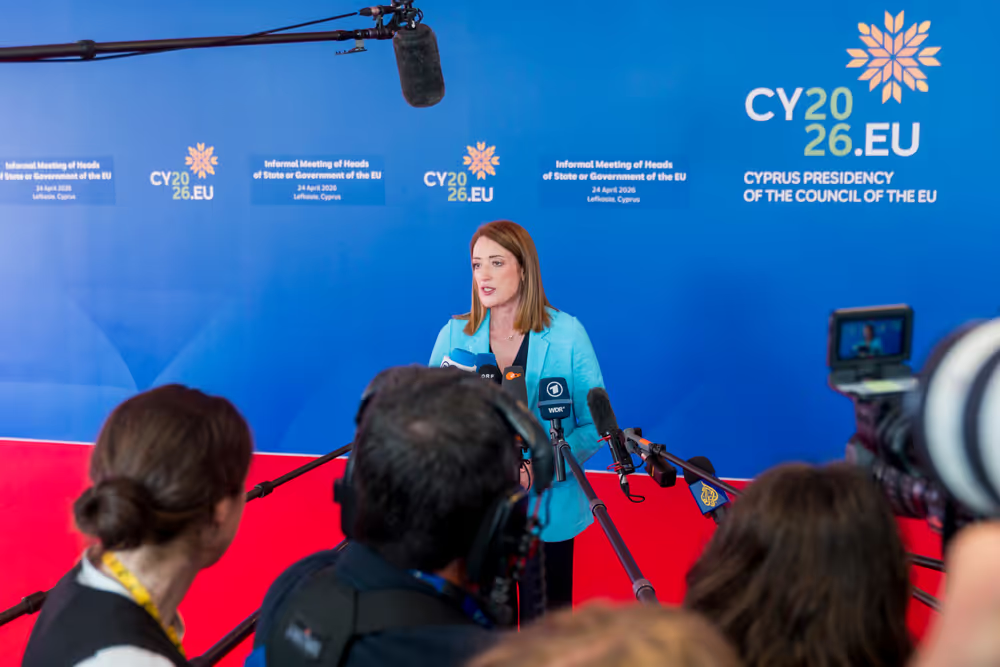
Roberta Metsola has delivered a message that is as obvious as it is uncomfortable: the European Union cannot hope to meet 21st-century challenges with a budget architecture designed for the last century.
Her warning—that “Europe cannot face a new era with an old budget”—should not be dismissed as institutional rhetoric. It is, rather, a blunt diagnosis of a structural weakness at the heart of the European project. For all the Union’s ambitions, its finances remain stubbornly modest, slow-moving, and politically constrained.
The EU budget, typically hovering at little more than 1 per cent of the bloc’s gross national income, was conceived in an era when the principal aims were agricultural stability and regional development. Those priorities still matter. But they now sit alongside demands that would have been scarcely imaginable when the framework was first devised: collective defence investment, technological sovereignty, energy transition, and geopolitical resilience.
Metsola’s intervention reflects a growing recognition in Brussels that the arithmetic no longer adds up. Europe is being asked to do more—much more—without a corresponding willingness among member states to provide the means. The result is a familiar Brussels compromise: a budget expected to stretch ever further while remaining politically palatable to net contributors and beneficiaries alike.
This is not merely inefficient; it is increasingly untenable.
The past decade has demonstrated the limits of Europe’s fiscal caution. The pandemic forced the creation of the NextGenerationEU recovery fund, a temporary departure from orthodoxy that pooled borrowing at the European level. It was a bold step, but one explicitly framed as exceptional. Yet the pressures that justified it—economic disruption, strategic vulnerability, the need for coordinated investment—have not receded. If anything, they have intensified.
Defence is the most immediate example. With war still raging in Ukraine and uncertainty surrounding long-term American commitments, Europe faces mounting calls to invest more heavily in its own security. Commission President Ursula von der Leyen has already urged “massive investments” in defence and industrial capacity. But such ambitions sit uneasily alongside a budget that remains constrained by outdated categories and rigid spending rules.
Competitiveness presents another challenge. Europe’s industrial base is under pressure from subsidised American manufacturing and the scale of Chinese state-backed industry. The response requires sustained investment in innovation, infrastructure, and strategic sectors—precisely the sort of long-term funding that the current budget struggles to deliver efficiently.
Metsola is right, therefore, to frame the issue not simply as one of size, but of structure. The EU budget is notoriously inflexible, with funds often allocated years in advance and disbursed slowly. By the time money reaches its intended destination, the political and economic landscape may already have shifted. As one senior negotiator has observed, the system can take nearly a decade from proposal to final expenditure.
In a world defined by rapid change, such delays are a strategic liability.
Yet recognising the problem is the easy part. The harder question is whether Europe’s leaders are prepared to act on it. Budget reform in the EU is notoriously fraught, requiring unanimity among member states whose interests diverge sharply. Net contributors resist increases; beneficiaries resist cuts. Every proposal becomes a zero-sum negotiation.
There is also a deeper political hesitation. A larger, more flexible EU budget implies a stronger central authority—an idea that continues to provoke unease in national capitals. For some governments, the language of “modernisation” masks a transfer of power that they are reluctant to endorse.
And so the risk is that Metsola’s warning, however well-founded, becomes yet another Brussels refrain: acknowledged, debated, and ultimately diluted.
That would be a mistake. The geopolitical environment in which the EU operates has changed fundamentally. The assumptions that underpinned the budget of previous decades—relative peace, American security guarantees, steady globalisation—no longer hold. Europe now confronts a more fragmented, competitive, and unpredictable world.
To persist with an outdated financial framework in such circumstances is not prudence; it is inertia.
A reformed EU budget need not be limitless, nor should it abandon the principles of fiscal discipline that have long guided the Union. But it must be capable of responding to new priorities with speed and scale. That means rethinking not only how much Europe spends, but how it allocates and mobilises those resources.
Metsola’s intervention should therefore be seen as an invitation to seriousness. Europe cannot indefinitely reconcile grand strategic ambitions with modest, antiquated means. At some point, it must choose: either adjust its budget to match its rhetoric, or scale back its ambitions to match its budget.
The present course—straining to do both—is unlikely to endure.
Main Image: © European Union 2026 – Source : EP
Click here for more News & Current Affairs at EU Today
Click here to check out EU TODAY’S SPORTS PAGE!
___________________________________________________________________________________________________________________