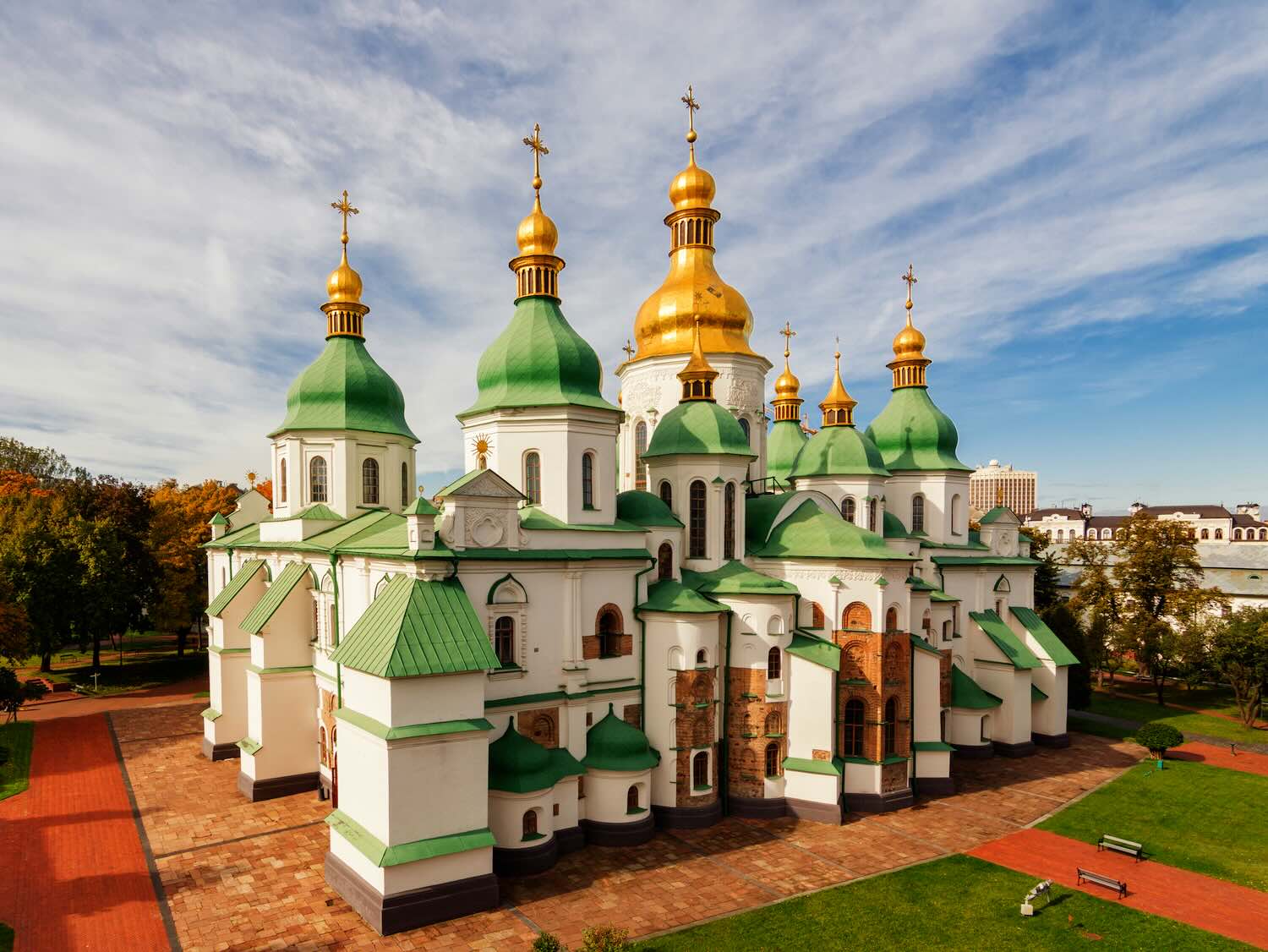
Kyiv’s Saint Sophia Cathedral, one of Ukraine’s most revered religious and cultural monuments and a UNESCO World Heritage Site, sustained damage during a Russian missile strike on the capital in the early hours of 10 June 2025.
Initial reports confirm that the 11th-century cathedral, located in the city’s historic centre, suffered broken stained-glass windows and minor structural impact from nearby explosions. Ukrainian officials have since cordoned off the site to assess the full extent of the damage.
The airstrike, which formed part of a wider attack on multiple Ukrainian cities, occurred shortly before dawn. Though most incoming missiles were intercepted, debris and shockwaves affected civilian infrastructure in central Kyiv, including the vicinity of Volodymyrska Street where the cathedral stands. Residents reported tremors and broken glass in surrounding buildings.
Saint Sophia Cathedral was built during the reign of Grand Prince Yaroslav I the Wise, who transformed Kyiv into a major centre of Orthodox Christianity. The cathedral became a focal point of religious, cultural, and political life in Kyivan Rus—the medieval polity regarded as a foundational predecessor to modern Ukraine. Yaroslav himself is buried within the cathedral, making it not only a religious site but also a dynastic mausoleum and a key symbol of early Eastern Slavic statehood.
The cathedral’s importance is not confined to Ukraine. Its mosaics, frescoes, and architectural features are considered among the finest surviving examples of Byzantine-influenced ecclesiastical art outside Constantinople. Recognised by UNESCO since 1990, the building is also emblematic of Ukraine’s historic ties to European and Christian civilisation.
The Ministry of Culture and Information Policy of Ukraine issued a statement describing the incident as “a deliberate attack on cultural heritage” and confirmed that emergency conservation teams have been deployed. Authorities are working with international heritage organisations to evaluate the damage and begin planning stabilisation measures.
President Volodymyr Zelenskyy addressed the strike in his nightly briefing, stating: “The bombing of Saint Sophia is a strike not only against Ukraine but against the entire civilised world. It is an attack on our past, our identity, and our right to exist as a sovereign nation.”
Russia has not acknowledged any direct targeting of Saint Sophia Cathedral. As in previous incidents involving damaged cultural sites, Russian officials maintain that strikes are aimed exclusively at military infrastructure. Ukrainian authorities and international monitors dispute this, citing patterns of attacks on locations with no military presence.
The strike has also reignited long-standing historical tensions. The Russian Federation continues to promote the narrative that modern Russia is the sole heir of Kyivan Rus, frequently downplaying or erasing the distinct historical and cultural lineage claimed by Ukraine. This claim is central to the Kremlin’s broader ideological framing of the war, in which Ukraine is portrayed as an artificial state occupying territory that, in the Russian view, rightfully belongs within the “Russian world”.
Historians broadly reject these assertions, noting that Kyivan Rus was a diverse and decentralised polity centred in Kyiv, with strong trade and religious ties to Byzantium and Europe, and that modern Ukraine has a continuous cultural and linguistic identity distinct from that of Russia.
In this context, the damage to Saint Sophia Cathedral carries both symbolic and political weight. It underscores the broader concern that the war is not only about territorial control but also about cultural erasure. The targeting—whether direct or incidental—of a monument so closely tied to Ukrainian and European heritage serves to reinforce Kyiv’s argument that Russia’s objectives extend beyond military aims to an assault on national identity itself.
Access to the interior of the cathedral has been suspended pending further structural assessments. The full extent of the damage will likely take weeks to determine, though early reports suggest no irreparable destruction to the cathedral’s most significant interior artwork.
As the war continues, the incident at Saint Sophia has become another marker in a growing list of attacks on Ukrainian cultural heritage. For many Ukrainians, it is further evidence that the Russian invasion is not merely a political or military confrontation—but a civilisational one.
Read also:
Russia Launches Mass Drone and Missile Attack on Kyiv and Odesa in Overnight Assault