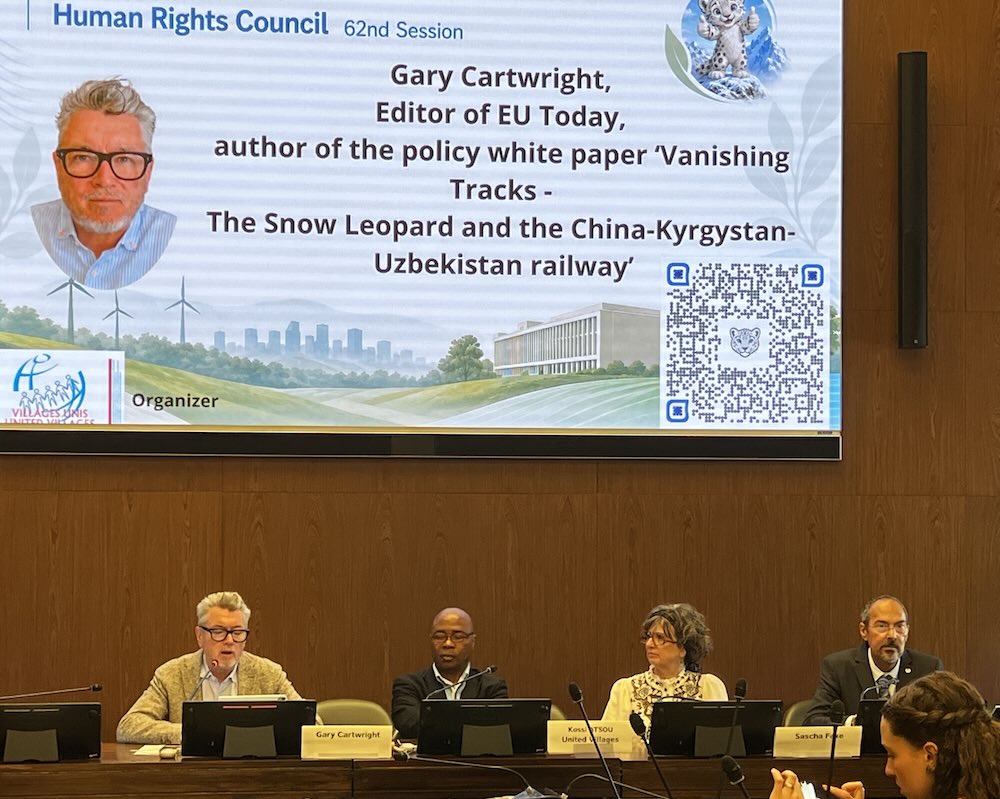
A UN Human Rights Council side-event in Geneva placed the snow leopard at the centre of a wider debate on climate risk, high-mountain ecosystems, human rights and the China-Kyrgyzstan-Uzbekistan railway.
The snow leopard, rarely seen even by those who live in its mountain habitat, was brought into the diplomatic space of the United Nations Human Rights Council this week as a symbol of a much larger question: can major infrastructure projects in Central Asia proceed without damaging ecosystems on which both wildlife and people depend?
The side-event, held on 2nd July during the 62nd session of the UN Human Rights Council at the Palais des Nations in Geneva, examined the relationship between climate change, ecological connectivity, human rights and transboundary infrastructure in high-mountain regions.
Its focus was the snow leopard and the China-Kyrgyzstan-Uzbekistan railway, the long-planned CKU corridor intended to improve transport links across Central Asia. The discussion was not framed as an argument against development. Rather, speakers asked whether a project of this scale can be built responsibly if its environmental consequences are not subject to full public scrutiny.
 The event, titled The Snow Leopard and Transboundary Linear Infrastructure in High-Mountain Ecosystems: Climate Risks, Ecological Connectivity and Human Rights, was organised by United Villages, with CAP Liberté de Conscience and Global Human Rights Defence as partners. Thierry Vallé, President of CAP Liberté de Conscience, moderated the session.
Speakers included Frank Schwalba-Hoth, former Member of the European Parliament and co-founder of the German Greens; Gary Cartwright, Editor of EU Today and author of the policy white paper Vanishing Tracks – The Snow Leopard and the China-Kyrgyzstan-Uzbekistan Railway; and Sascha Faxe, former Member of the Danish Parliament and former member of the Parliamentary Assembly of the Council of Europe.
The choice of subject was deliberate. The snow leopard is not merely an endangered animal whose image lends emotional force to a conservation campaign. In mountain ecosystems, it performs a structural role. As an apex predator, it helps regulate prey species such as Siberian ibex and argali. That balance affects vegetation, soil stability, water systems and, ultimately, the communities that rely on mountain watersheds.
Gary Cartwright told the Geneva audience that the fact such a discussion was taking place at the Human Rights Council showed how the debate had changed.
“Twenty or 30 years ago, this conference, a conference about the welfare of snow leopards, would have probably involved one conservationist talking to another conservationist,” he said. “Today, we’re discussing the issue in the context of human rights. This is no accident. It’s because we’ve finally begun to understand something that indigenous communities have known for many centuries. People and nature are inseparable.”
He added: “If we destroy our ecosystems, we eventually damage human health, human security, human prosperity and, ultimately, human rights.”
That argument ran through the session. The snow leopard’s disappearance would not be a single-species loss. It would point to wider ecological failure. Cartwright described the animal as “one of nature’s architects” and a keystone species, explaining that when apex predators disappear, the consequences move through the whole food chain.
Without predators, prey populations can expand or shift in damaging ways. Overgrazing can strip fragile high-mountain vegetation. Once vegetation is removed, soil erosion accelerates, slopes become less stable and watersheds decline. In Central Asia, where mountain water systems support human settlement far beyond the immediate habitat of the snow leopard, that is not an abstract conservation matter.
“Protecting the snow leopard isn’t really about saving one beautiful animal,” Cartwright said. “Ultimately, it’s about protecting ourselves.”
The CKU railway was presented as a test case for this wider principle. Kyrgyzstan needs investment. Central Asia needs better transport links. No speaker disputed that. The concern was whether the railway is being advanced with sufficient attention to habitat fragmentation, wildlife corridors, construction disturbance, access roads, mining pressure and the rights of local communities to environmental information.
“The question isn’t whether the railway should exist,” Cartwright said. “The question is whether it’s being built in a way that protects one of the world’s most valuable mountain ecosystems.”
A central issue raised in Geneva was the apparent absence of a comprehensive environmental impact assessment for the Kyrgyz section of the railway in a form that is publicly available and open to independent scientific review. If such an assessment exists, speakers argued, it should be accessible to those affected by the project and to specialists capable of evaluating its consequences.
Environmental impact assessments are often treated as technical documents. In this case, the speakers argued, they are closer to a democratic safeguard. They determine whether wildlife corridors remain open, whether breeding populations are isolated, whether access roads increase poaching, whether local communities understand what is being built around them and whether mitigation measures are credible.
Frank Schwalba-Hoth, speaking by video from Brussels, recalled his earlier work on environmental awareness in former Soviet states and Central Asia. He linked the discussion to the development of European environmental impact assessment standards during his time in the European Parliament.
He said humans have a responsibility when intervening in the natural environment of species such as the snow leopard, and argued that international norms on environmental impact assessment should be a guiding principle for transport projects affecting Central Asia.
For Sascha Faxe, the snow leopard was both a conservation issue and a visible expression of a broader political failure. She said the CKU railway raised questions about how societies understand their relationship with the natural world.
“We used to say that no man is an island,” she told the conference. “But in reality, an island is not even an island. All of life is connected.”
Faxe argued that modern infrastructure decisions are still largely shaped by a human-centred view of the planet, in which other forms of life are treated as resources. From that perspective, the CKU railway can be described in familiar economic terms: growth, connectivity, mineral access, reduced dependence on existing routes and new commercial opportunities.
But from what she called an ecological or bio-centred perspective, the calculation changes. High-mountain ecosystems are slow to recover, if they recover at all. Construction in such terrain is not limited to rails. It brings tunnels, bridges, roads, machinery, waste, noise, workers, supply chains and permanent access into landscapes that may previously have been difficult to reach.
Faxe referred to the scale of the project, including planned tunnels and bridges, and said the railway could become “a life-changing project for the mountains” if the living systems around it are not properly considered.
She also warned that transport corridors can be followed by further pressure. Railways do not only move passengers and goods. They can open remote areas to mining, extraction and industrial activity. In a region where rare earths, metals and other resources are of strategic interest, that secondary impact may prove as important as the railway itself.
“The absence of environmental assessments,” Faxe said, was “deeply problematic”. She also criticised what she described as a lack of transparency and public participation, arguing that the issue had to be viewed through standards of good governance and international legal order.
The debate then moved from ecology to EU leverage. Faxe noted that Kyrgyzstan benefits from the European Union’s GSP+ trade preference scheme, under which selected countries receive preferential access to the EU market in return for implementing international conventions on human rights, labour rights, environmental protection and good governance.
Her argument was that the EU should not treat those standards as decorative. If a beneficiary country proceeds with a major infrastructure project that raises serious questions over environmental protection and public participation, Brussels has a policy tool available.
“In my opinion, the EU ought to use this position and act immediately,” she said. Failure to respond, she argued, would risk signalling that the requirements attached to trade preferences are flexible when major strategic projects are involved.
An EU representative present at the discussion said the Union follows implementation of GSP and GSP+ obligations in beneficiary countries, maintains dialogue with governments and local authorities, and raises concerns where necessary. The intervention also pointed to the forthcoming expansion of the GSP+ framework from 27 to 32 conventions, with more emphasis on climate action, and referred to the EU’s biodiversity strategy and One Health approach.
Cartwright said the European Commission had acknowledged the Vanishing Tracks white paper and had distributed it to EU missions across Central Asia. He described that response as encouraging and said it showed that the issue had entered a wider policy conversation.
The Geneva discussion did not produce a formal resolution. That was not its purpose. Its significance lay elsewhere: in placing the snow leopard, and the mountain systems it represents, inside a human rights forum rather than leaving it confined to conservation circles.
The final message was that environmental damage in remote mountain regions is not remote in its consequences. It affects water, climate resilience, livelihoods, public participation, accountability and the credibility of international standards.
As Cartwright put it, “History won’t judge us by the roads we build or the railways we construct. It’ll judge us by whether we were wise enough to build them responsibly.”
New EU Today white paper examines CKU railway’s ecological impact on snow leopard range