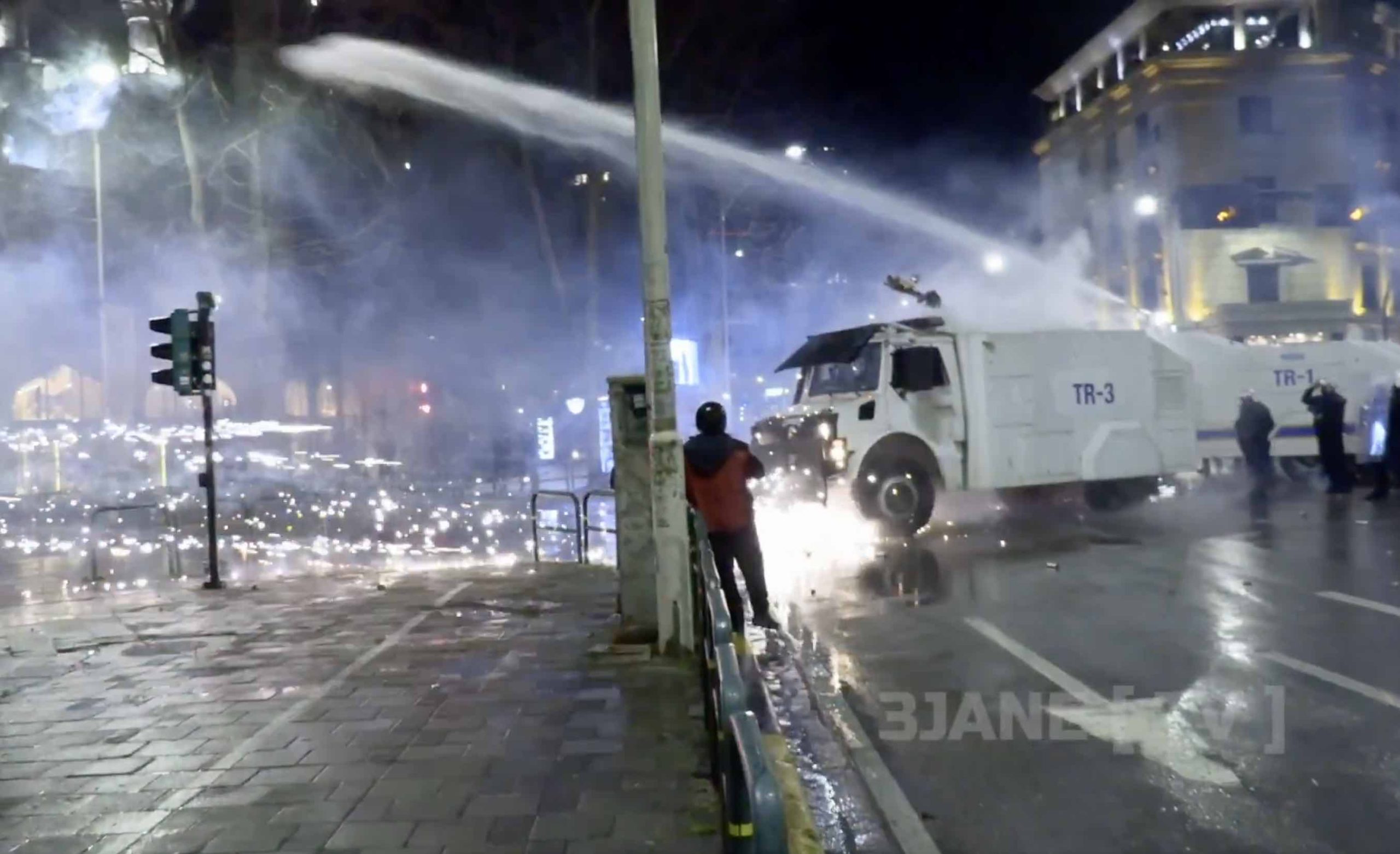
On a winter evening in Tirana, Albania, the choreography of Balkan politics returned to a familiar script: smoke drifting across government buildings, sirens echoing off concrete facades, and young men in scarves lobbing fireworks and petrol bombs towards riot shields.
The scenes, though dramatic, were less surprising than they appeared. Albania’s unrest is not merely a protest; it is an argument — about corruption, power and whether the European Union’s promise still carries weight.
Police fired tear gas and water cannon after opposition supporters gathered outside Prime Minister Edi Rama’s office, demanding his government’s resignation. Demonstrators hurled projectiles as tensions spilled into violence.
The immediate spark was a corruption investigation involving Deputy Prime Minister Belinda Balluku, accused by prosecutors of interfering in major public tenders and favouring companies in infrastructure projects — allegations she denies.
But anyone who has watched Albanian politics over the past three decades understands that this is only the surface disturbance. The deeper tremor is institutional mistrust.
A country permanently between elections and investigations
Albania has spent much of its post-communist life oscillating between two forces: democratic aspiration and political tribalism. Elections rarely settle arguments; they postpone them. When one side governs, the other mobilises the street. And when courts act, politicians accuse them of conspiracy.
The opposition Democratic Party framed the protests as a moral revolt. Thousands chanted “Rama, go away” and called for jail sentences, while party leader Sali Berisha declared the prime minister’s “days are numbered”.
Rama, meanwhile, has taken a line increasingly common among embattled leaders worldwide: judicial activism. He has complained about overreach by prosecutors and courts, particularly pre-trial detentions.
The irony is striking. For years, the European Union demanded precisely this — an independent anti-corruption judiciary. Now that prosecutors appear willing to investigate the political elite, the political elite objects.
An anti-corruption court has already suspended Balluku, and prosecutors want parliament to lift her immunity so she can be arrested.
Whether that happens will test Albania’s democratic credibility more than any election result.
The EU factor — and its fading magic
The European Union still hovers over Albania’s politics like a distant authority figure: invoked constantly, obeyed selectively.
Tirana hopes to join the bloc by 2030, but Brussels insists the country must improve its fight against crime and corruption.
For years, EU accession functioned as the great stabiliser of Balkan politics — a promise that reforms would be rewarded and that prosperity lay at the end of bureaucratic patience.
Yet enlargement fatigue in Western Europe has blunted the incentive. For many Albanians, EU membership has begun to resemble a horizon: always visible, never closer.
The consequence is profound. When a political system believes external approval will never quite arrive, reform becomes theatre. Laws are passed; practices remain.
Why corruption matters differently here
To outsiders, the accusations against Balluku may resemble standard European scandal — procurement manipulation, public contracts, political allies. In Albania, however, corruption carries a different emotional charge.
Infrastructure tenders are not abstract policy. They determine roads, ports and energy projects in a country still struggling with uneven development. The state is both employer and investor; therefore corruption is not merely illegal — it is personal.
In Western Europe, corruption erodes trust. In the Western Balkans, it shapes daily life: jobs, licences, permits and access to opportunity. This explains why protests quickly escalated beyond partisan supporters. A corruption scandal becomes a referendum on fairness itself.
A fourth mandate, a thinner legitimacy
Rama’s Socialist Party secured a fourth consecutive term last year and retains a comfortable parliamentary majority.
But longevity in Balkan politics is rarely stabilising. It breeds two opposing perceptions: competence among supporters and entrenchment among critics.
The government points to economic growth, tourism expansion and urban redevelopment in Tirana. The opposition points to emigration — particularly among young Albanians — as evidence that optimism remains fragile.
Indeed, perhaps the most telling political statistic is not polling but departure. When a country’s brightest leave, protests become the political expression of those who remain.
Europe’s quiet concern
For Brussels, the unrest is worrying not because Albania is uniquely unstable, but because it is representative. The EU’s enlargement strategy depends on demonstrating that reform delivers tangible results. Violent street clashes triggered by corruption allegations suggest the opposite.
The Western Balkans remain Europe’s geopolitical blind spot: too close to ignore, too complicated to absorb quickly. Every episode of instability invites outside influence — Russian diplomacy, Turkish investment, Gulf financing — and reminds European policymakers that enlargement is not charity but security policy.
What happens next?
The immediate future hinges on a procedural question: parliamentary immunity. If lawmakers refuse to lift it, the opposition will claim a cover-up. If they do, the government risks internal fracture. Either way, the streets may again become Albania’s court of appeal.
The protest images — flames beside police vehicles, riot helmets under fireworks — were dramatic. Yet they were also familiar, echoing scenes from 1997’s collapse, 2011’s demonstrations, and countless smaller confrontations in between.
Albania is not failing. It is negotiating with itself — between patronage and law, loyalty and institutions, memory and ambition.
Europe, however, faces its own negotiation. If the EU cannot convincingly anchor reform in candidate states, it risks creating permanent waiting rooms: countries democratic enough to hope, but not stable enough to rest.
The clashes in Tirana therefore matter far beyond Albania. They reveal that enlargement is not stalled by bureaucracy alone. It is stalled by belief, and belief, once eroded, is harder to rebuild than any bridge funded by a public tender.
Click here for more News & Current Affairs at EU Today
Click here to check out EU TODAY’S SPORTS PAGE!
_____________________________________________________________________________________________________________________