The United Kingdom’s Supreme Court has ruled that the terms “woman” and “sex” in the Equality Act 2010 refer to biological sex, and not gender identity, in a judgment that redefines the legal parameters of sex-based protections.
The unanimous decision, delivered by Lord Hodge on Wednesday morning, clarifies that individuals who identify as transgender women, including those holding a Gender Recognition Certificate (GRC), are not legally defined as women under the Act.
“The unanimous decision of this court is that the definition of the terms ‘woman’ and ‘sex’ in the Equality Act 2010 refer to a biological woman and biological sex,” Lord Hodge stated.
However, he added that the judgment should not be interpreted as a triumph for one section of society over another.
The ruling stems from a legal appeal brought by the campaign group For Women Scotland (FWS), which had contested the Scottish Government’s interpretation of who qualifies as a woman in the context of public appointments and statutory representation. The Scottish Government had previously argued that a person living as a woman and holding a GRC should be considered female under the law.
Legal Background
The case originated in 2022, when FWS challenged a Scottish Government initiative to increase female representation on public boards. The original legislation allowed those “living as women” to be included. The Court of Session in Edinburgh initially sided with FWS, finding the Government had exceeded its legislative competence by expanding the definition of “woman” to include transgender individuals.
Following this decision, revised statutory guidance stated that trans women with a GRC should be counted as women. FWS launched a fresh legal challenge, arguing the Scottish Government was again acting beyond its powers. In 2022, Lady Haldane ruled that the legal definition of sex was not limited to biological sex. That decision was upheld by the Inner House of the Court of Session, prompting FWS to bring the matter before the UK Supreme Court.
At the centre of the case was whether the term “woman” in the 2010 Equality Act could be interpreted to include those who had legally changed gender. The Scottish Government argued in favour of this broader interpretation, while FWS insisted that sex-based rights and protections must remain grounded in biological sex.
Supreme Court Findings
Lord Hodge stated that although transgender people enjoy specific legal protections under the protected characteristic of “gender reassignment,” this does not alter the fundamental meaning of “sex” under the Equality Act.
He explained that transgender people are protected from direct and indirect discrimination, as well as harassment, in their acquired gender, regardless of whether they possess a GRC. However, these protections do not extend to redefining the legal meaning of sex for the purposes of other protected characteristics.
“The Equality Act 2010 gives transgender people protection not only against discrimination through the protected characteristic of gender reassignment, but also against direct discrimination, indirect discrimination and harassment in their acquired gender,” he said. “Those statutory protections are available to transgender people, whether or not they possess a gender recognition certificate.”
Reactions
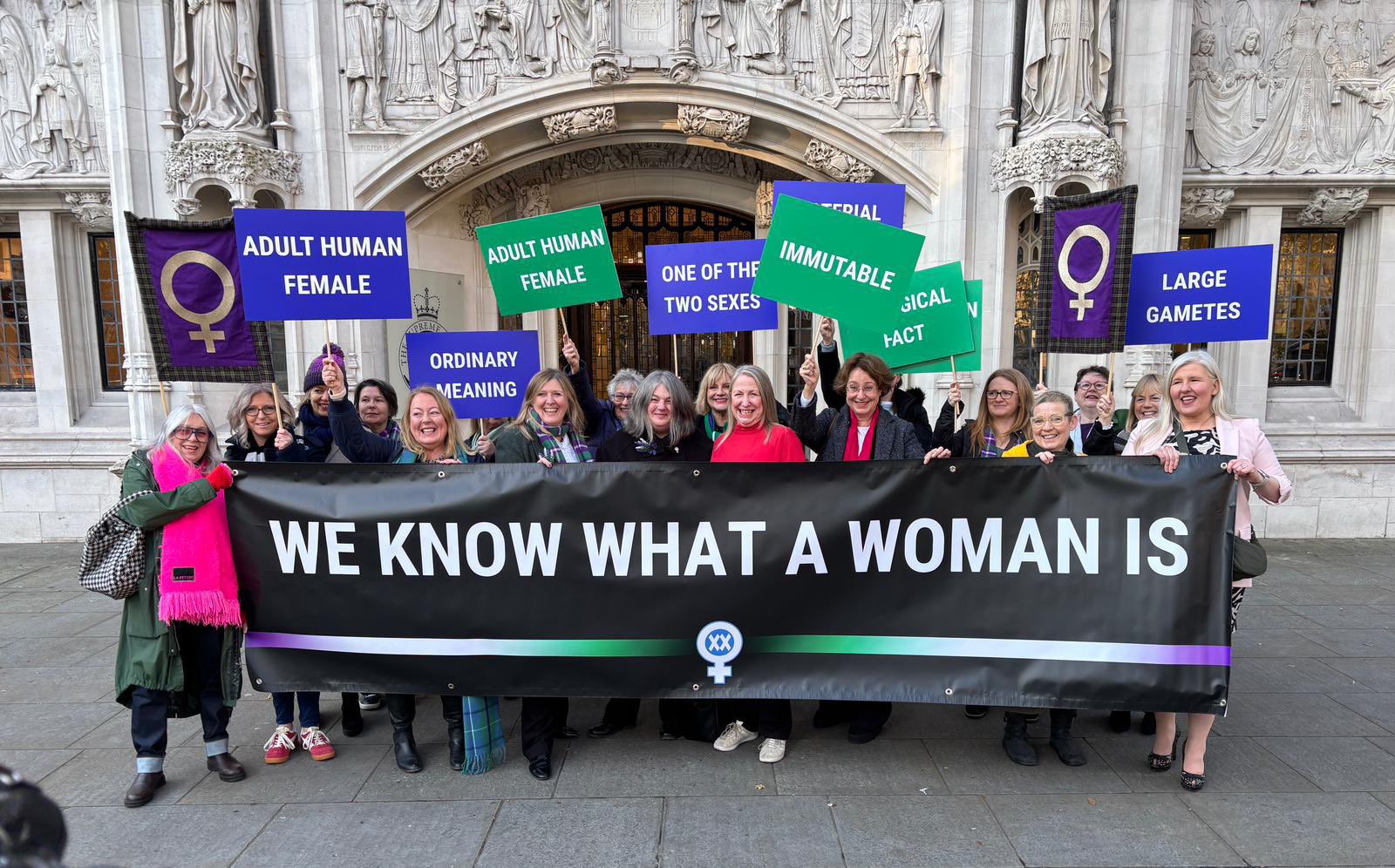
Outside the court, members of FWS and other gender-critical groups gathered in anticipation of the ruling. Campaigners posed with placards near the statue of suffragette Millicent Garrett Fawcett in Parliament Square, some holding signs reading “Women: Adult Human Female”.
Speaking after the judgment, FWS described the ruling as a decisive moment for women’s rights. “We are absolutely jubilant,” the group said in a statement. Sex Matters, another gender-critical organisation, also welcomed the outcome. “The court has given the right answer: the protected characteristic of sex – male and female – refers to reality, not paperwork,” it stated.
Scottish Conservative MSP Russell Findlay called the verdict “a victory for women across the United Kingdom and a victory for common sense.”
Wider Context
The ruling comes amid growing legal and political scrutiny surrounding the status of transgender individuals in the UK. It follows several high-profile cases, including one involving nurse Sandie Peggie, who challenged the presence of a trans-identifying doctor in a female changing facility at a hospital in Fife. That case is currently subject to an employment tribunal.
The Supreme Court’s judgment is expected to have significant implications for the application of sex-based rights and single-sex exemptions in law, including in sectors such as healthcare, prisons, sport, and public services.
Five justices presided over the case: Lord Reed, Lord Hodge, Lord Lloyd-Jones, Lady Rose and Lady Simler. The judgment effectively rejects the Scottish Government’s position and reaffirms the UK-wide interpretation of legal sex as biological, not acquired.
While the court acknowledged the sensitivities surrounding the issue, it framed the decision as a clarification of statutory interpretation rather than a policy stance.
The ruling does not remove legal protections for transgender individuals but delineates the limits of those protections in relation to sex-based rights under the Equality Act. The Government may now face calls to review the statutory framework to determine whether legislative changes are required in light of the judgment.