
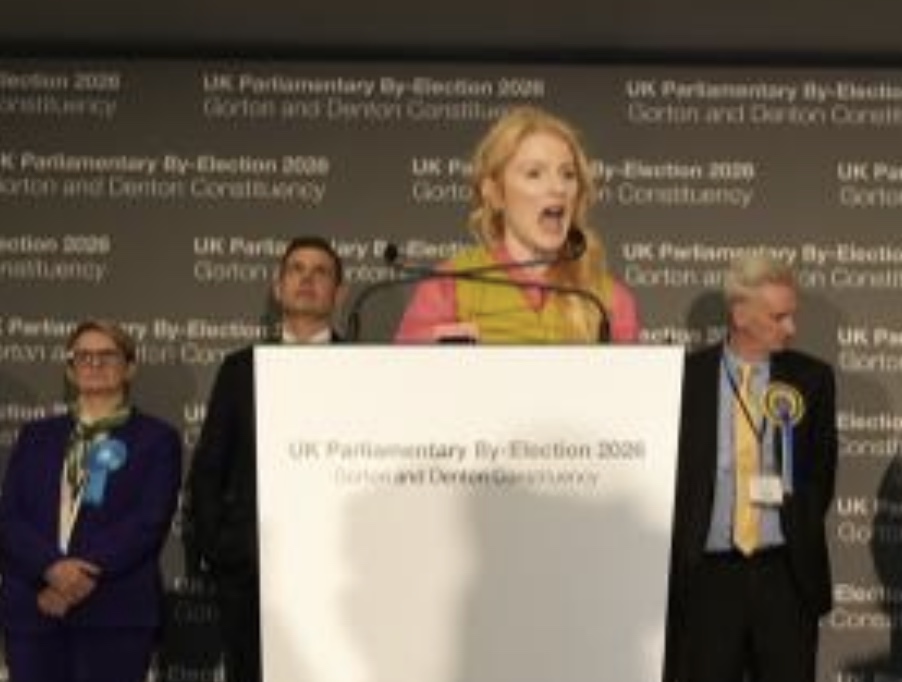
The shock of Gorton & Denton will reverberate far beyond the low red-brick terraces and arterial roads of southeast Manchester.
In a seat that Labour once regarded as unassailable, the Green Party — no longer content with the language of gentle environmentalism but advancing an unabashedly far-left platform — has seized victory in a by-election few at Westminster had marked as a turning point. They should have done.
The vacancy arose after Andrew Gwynne, a long-standing Labour figure, resigned on grounds of ill health. Party managers assumed the contest would be a holding operation: a straightforward defence against an insurgent Reform UK machine and an energetic but historically peripheral Green challenge. Instead, the electorate delivered a rebuke. On a turnout of 47.62 per cent — slightly below that of the last general election but robust by by-election standards — voters sent a message as clear as it was uncomfortable.
For Labour, the result is doubly disquieting. First, because Gorton & Denton was not meant to be competitive territory for the Greens. Second, because the loss exposes a vulnerability on the party’s left flank at a moment when its leadership has sought to project moderation and fiscal discipline. The Greens’ campaign, rooted in rent controls, expansive public ownership and a rhetoric that blurred the line between climate activism and class struggle, found fertile ground among younger voters and disillusioned Labour loyalists alike.
It would be facile to dismiss this as a mid-term protest. By-elections often serve as lightning rods for grievance. Yet there is a pattern emerging in urban Britain: a cohort of progressive voters impatient with what they perceive as Labour’s caution, and willing to experiment with alternatives that promise a more radical break with economic orthodoxy. In university wards and among renters squeezed by rising costs, the Greens have become not merely a conscience but a contender.
More troubling still are the reports that accompanied polling day. Observers described “concerningly high” levels of so-called “family voting”, a practice whereby one voter accompanies another into the booth. In communities where extended family structures remain strong, such escorting may be presented as assistance. Yet British electoral law is unequivocal: the ballot is secret and individual. The suggestion that voters were guided — or pressured, or possibly paid — behind the curtain casts a long shadow over proceedings.
To be clear, there is as yet no formal finding of wrongdoing. Allegations are not proof. But the very perception of compromised secrecy corrodes confidence. In an era when faith in democratic institutions is already fragile, local authorities and the Electoral Commission must be swift and transparent in establishing the facts. If malpractice occurred, it must be confronted; if it did not, that too should be demonstrated beyond doubt. Democracy depends not only on fairness but on the visible assurance of fairness.
For Reform UK, finishing second in a contest framed by some as an opportunity to capitalise on working-class disaffection is a something of an indictment. The party’s leader, Nigel Farage, has built a career on identifying the fault-lines of British politics before others dared to name them. Yet in Gorton & Denton his party appeared directionless, its message blunted and its local organisation thin.
There is a broader question about composition as well as strategy. Reform UK has, in recent months, welcomed a procession of former Conservative MPs and activists into its ranks. Experience can be an asset. But to many voters the influx looked less like renewal than recycling — a parade of familiar faces seeking refuge after electoral rejection. The anti-establishment brand loses potency when its standard-bearers are veterans of the very system they decry.
Farage must now decide whether Reform is to be a vehicle for personal charisma and grievance politics or a serious party with deep roots and credible policy. Populist energy alone rarely suffices in local contests, where ground campaigns and community ties matter. In southeast Manchester, it was the Greens who knocked on doors with missionary zeal, while Reform struggled to convert online enthusiasm into ballot-box success.
Labour, meanwhile, cannot take comfort from Reform’s failure. The greater threat in metropolitan seats may not come from the right but from a left unpersuaded by incrementalism. If the Greens can translate activist networks into parliamentary representation here, they will attempt the same in Bristol, Brighton and parts of London. The arithmetic of first-past-the-post still favours larger parties, but fragmentation on the progressive side could complicate future contests.
Indeed, party strategists in Westminster are already speculating about what comes next. In cities such as London and Birmingham — where demographic change, youthful electorates and pronounced housing pressures combine — it is highly likely that the Greens will look to broaden their slate of candidates to reflect the communities they seek to mobilise. That well almost certainly include selecting more Muslim candidates in wards and constituencies with significant Muslim populations, a move designed both to signal inclusivity and to compete directly with Labour’s long-standing support in those areas.
Such a strategy would not in itself be remarkable; all major parties seek candidates who resonate locally. But in the current climate, identity and ideology are increasingly intertwined. If the Greens succeed in presenting themselves as the authentic voice of socially conservative yet economically radical urban voters — particularly on issues such as foreign policy, civil liberties and public services — Labour could find parts of its metropolitan coalition under sustained pressure.
The by-election also underscores the changing nature of political identity. Environmentalism, once a cross-party concern, has fused with a broader critique of capitalism among a segment of the electorate. Housing, transport and climate are presented not as discrete policy areas but as symptoms of a single systemic malaise. Whether that diagnosis commands majority support nationally is doubtful. Yet in pockets of urban Britain it resonates powerfully.
Turnout at 47.62 per cent suggests engagement, but also absence. More than half the electorate did not participate. In that silence lies both risk and opportunity. Parties that can mobilise the disengaged — credibly, lawfully and with respect for the sanctity of the ballot — will shape the next phase of British politics.
Gorton & Denton may not alter the balance of power at Westminster overnight. But it offers a glimpse of currents beneath the surface: a Labour vote no longer monolithic, a Reform project in need of reinvention, and a Green movement emboldened to press its advantage. If established parties ignore the warning, they may find that what began as a local upset becomes a national habit.
Click here for more News & Current Affairs at EU Today
Click here to check out EU TODAY’S SPORTS PAGE!
_____________________________________________________________________________________________________________________

