
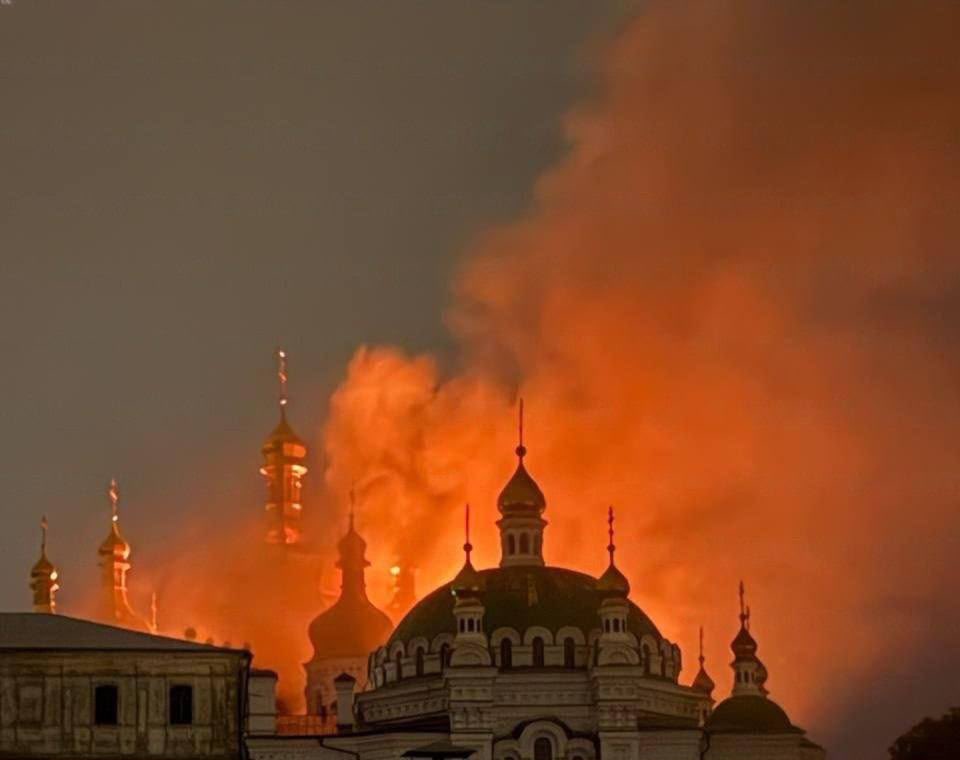
Moscow’s latest attack killed civilians, hit Ukrainian cities and damaged one of Kyiv’s most important religious sites, raising fresh questions for Europe over air defence, accountability and cultural protection.
Russia’s latest mass attack on Ukraine has pushed the war’s civilian and cultural cost back to the centre of Europe’s security debate, after strikes hit Kyiv and Kharkiv and caused damage at the Kyiv-Pechersk Lavra, one of Ukraine’s most important religious sites.
Ukrainian authorities reported deaths and injuries following overnight missile and drone attacks, while officials in Kyiv said a fire had broken out at the Dormition Cathedral complex within the Kyiv-Pechersk Lavra. Ukraine’s Foreign Minister, Andrii Sybiha, called for a response from UNESCO and international partners following the strike on the historic religious site.
By striking the Kyiv Pechersk Lavra, one of the greatest holy sites of Christianity, Putin has forever put his name on the list of history’s worst barbarians.
He should be damned for centuries. And he will lose this war.
From the Horde in the 13th century to the Nazis and… pic.twitter.com/yatMafK68E
— Andrii Sybiha 🇺🇦 (@andrii_sybiha) June 15, 2026
The Lavra is not a symbolic backdrop. Together with Saint Sophia Cathedral and related monastic buildings, it forms part of a UNESCO World Heritage property in Kyiv. Damage there therefore turns another Russian strike into a wider test of whether Europe treats attacks on Ukrainian cultural heritage as part of the war’s strategic reality, not as collateral detail.
Russia’s war on Ukraine’s memory
For Ukrainians, the immediate issue is human loss. Russian attacks continue to fall on homes, rescue workers, energy systems and city districts far from the front line. The cultural dimension does not replace that reality. It adds to it.
The Kyiv-Pechersk Lavra is bound up with Ukrainian religious, historical and national identity. Any attack affecting the site carries political meaning because Russia has repeatedly framed its war in civilisational terms while striking the institutions, cities and archives through which Ukraine’s own history is preserved.
That is why Sybiha’s appeal to UNESCO matters. It places the strike not only in the category of military aggression, but also in the category of cultural accountability. Europe has spent decades building legal and diplomatic language around the protection of heritage in war. Ukraine is now asking whether that language will be matched by consequences.
A European responsibility
The European angle is not abstract. Ukraine is a candidate country for EU membership. Its cultural heritage is increasingly being treated in Brussels not as a distant national matter, but as part of Europe’s wider historical and political space.
If Russian strikes can repeatedly threaten sites of international importance without a stronger response, the message is damaging. It suggests that Europe’s protection of heritage depends less on law than on whether the aggressor can be deterred.
This is also an air-defence question. Ukraine remains the country intercepting Russian missiles and drones under direct attack, often with limited stocks and little margin for error. Cultural protection, in this war, is inseparable from the supply of air-defence systems and interceptors. A cathedral, a museum, a power plant and an apartment block may all depend on the same shortage of defensive capacity.
For European governments, that creates an uncomfortable policy link. Statements of solidarity with Ukrainian heritage carry less weight if Ukraine is left without enough means to protect the cities where that heritage stands.
Accountability beyond statements
There is also a legal and diplomatic track. UNESCO has documented damage to cultural sites in Ukraine since Russia’s full-scale invasion. Kyiv’s latest appeal will add pressure for clearer international attribution and for cultural damage to be treated as part of the broader record of Russian war conduct.
Moscow routinely denies targeting civilians. But the pattern of damage across Ukrainian cities has made such denials increasingly difficult to separate from the political reality of the war. When repeated large-scale attacks hit civilian areas and culturally significant sites, Europe’s response cannot be limited to expressions of concern after each event.
The practical options are familiar: sanctions enforcement, air-defence support, documentation of cultural damage, support for emergency restoration, and legal work that preserves evidence for future accountability. The harder question is political will.
Russia’s latest attack shows that Ukraine’s cultural survival is not a secondary issue to be addressed after the war. It is one of the fronts on which the war is already being fought.

