
Dear Mr. Ostrovsky:
I have your reply to my email to your Editor-in-Chief, Ms. Minton Beddoes and Mr. Matthew Valencia, your “By Invitation” Editor. You have mischaracterized my point and also contradict your other writing.
The matter is too important to let stand, so I write for the record. I copy Ms. Minton Beddoes and Mr. Valencia, and also your Deputy Editor, Mr. Edward Carr, and to your Ukraine correspondent, Oliver Carroll. The text of my original email follows below, and then your email response. A copy of this communication is also attached.
I don’t suggest The Economist consciously promoted what it knew to be Kremlin narratives. But Melnichenko’s essay reflects one of the most refined Russian influence methodologies I have encountered in the media space in decades. You presented the essay as the reflections of a prominent Russian “industrialist” whose views deserved careful consideration. You saw Melnichenko himself and his message as the principal story. You missed the point of the message, not recognizing the misdirection in all its most pristine forms.
.
You’re part of history. And of course, it isn’t just a matter of media influence. In the 1920’s, Moscow targeted Russian émigré opponents of the Bolshevik regime by creating an entirely fictious underground opposition organization in the USSR to lure them back to the Soviet Union. It worked. It was called Operation “Trust.” Its arsenal was . . . words.
Then we had Moscow’s coup in spiking the news about Stalin’s genocidal starvation of Ukraine the 1930s. Walter Duranty, The New York Times‘ Moscow correspondent and dean of the Moscow press corps, denied it in his reporting. A year before winning his Pulitzer, he had told a U.S. Embassy official in Berlin, that his dispatches were written “in agreement with the New York Times and the Soviet authorities” and reflected Moscow’s official line, not his own. The prize was awarded anyway.
Fast-forward to Fiona Hill’s 2004 New York Times Op-ed that I had mentioned. Fortunately, since then she has better understood. That’s not always, or even often, been the case. And the damage was done. Before, between, and since, there have been countless other such operations.
It’s the old adage: rake your hot coals with someone else’s hands — better still if the unwitting hand believes it has done something commendable. The world-renown British historian, the late Professor Robert Conquest, pithily called this the consequence of “mind slaughter.”
Melnichenko’s essay, and its placement in The Economist, is infinitely more refined. It’s meticulous, restrained, clinical — a subliminal reality reversal delivered without bombast. Readers are encouraged to fear the consequences of holding Russia fully accountable for the most egregious acts of international criminality, including, unstated but implied, its expanding predation in the rest of Europe.
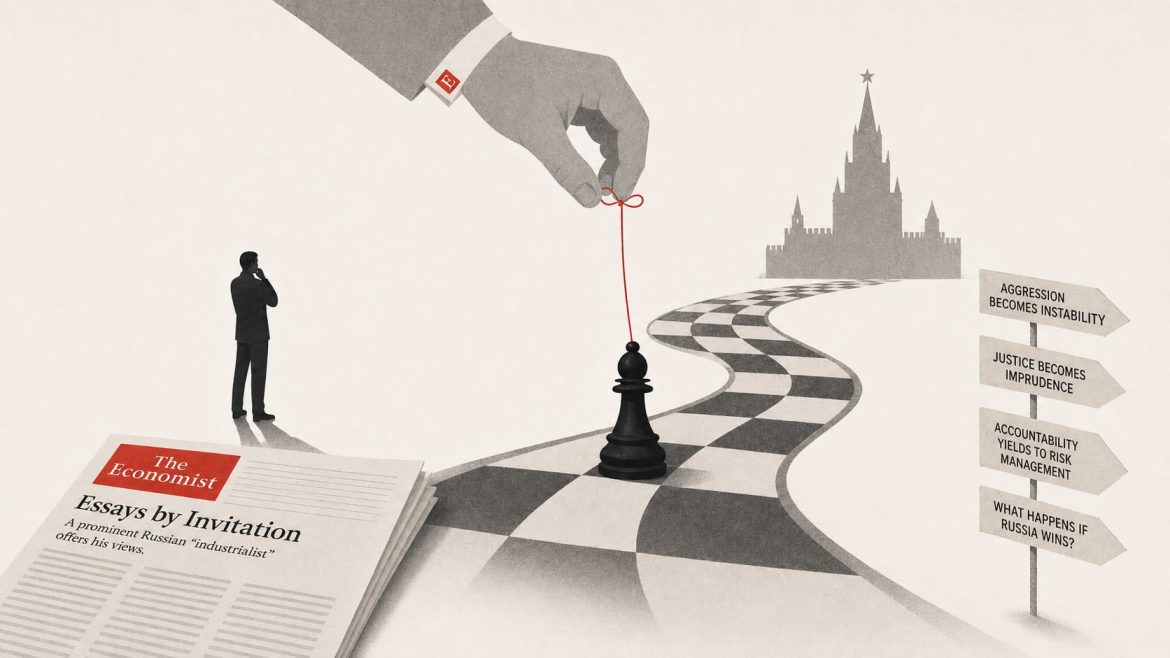
The purpose isn’t to persuade that Russia is innocent. It’s to persuade that demanding accountability is too dangerous — that Russia is only being defensive, and its “security interest” must be honored or bad things will happen. Responsibility recedes; consequence advances. Aggression becomes instability. Justice becomes imprudence. Accountability yields to risk management. But good things can happen too, if only the West backs off.
None of this requires factual fabrication. Readers leave believing they’ve encountered a sober, balanced argument, when in fact they’ve been guided toward a different hierarchy of strategic and moral priorities. The aggressor’s strategic anxieties become the readers’ strategic anxieties. “What happens if Russia wins” is quietly flipped into “what happens if Russia loses.”
The issue
Russia is waging the largest, longest, bloodiest war of aggression since WWII, a war where Hitler’s purpose was the conquest and colonization of Ukraine. Ukraine paid the highest price of any nation for the ensuing “rules-based international order.” Russia shattered it and demands a carve-out in the name of “sovereignty” (that same order’s central pillar) as it wages an openly-declared genocidal war against the same Ukrainian nation. It’s worse than that: Russia declared decades ago that its purpose was the destruction of that order, using Ukraine as the fulcrum. In July 2022, Putin declared: “This [special military] operation means the beginning of a radical breakdown of the US-style world order.”
Where’s your own recognition of the 8 yrs of war preceding 2022, and what that tells us? Less than two years after receiving MFN status and WTO membership, Russia invaded and annexed Ukraine’s Crimean Peninsula — larger than Israel, 2/3 the size of Taiwan, and almost the size of Belgium. It invaded Ukraine’s east “on invitation,” displacing millions, and killing, abducting, torturing untold scores of thousands. Russia’s murdered 298 innocents on Malasia Flight MH17, closed the Kerch Strait, blockaded Ukrainian ports in the Sea of Azov, attacked the Ukrainian Navy, occupied Ukrainian gas rigs and Ukraine’ territorial waters and exclusive economic zone, equal in area to South Korea. It sank freedom of navigation and the Law of the Sea. Through it all, Russia simply . . . lied. And now, angst over the “rules-based international order?” And what of Russia’s rampage through Europe?
Yet the essay simply casts the West and Ukraine as the culprits and argues that pressing Russia further — defeating it, isolating it, letting it dissolve as empires eventually do — would be a catastrophe. The sign off is clear: “The choice before the world… is between two kinds of future: one in which major powers again learn to respect each other’s sovereignty, and one in which each attempts to reduce the others to objects of management… The most important thing is that we step back from the abyss.”
That is not a business essay. It is a foreign-policy argument, delivered by a man with an obvious stake in its outcome, dressed as detached analysis. That is craft. If Melnichenko genuinely wants an international order robust enough to protect his own assets, the essay should have argued for a return to the status quo ante 2014.
Melnichenko’s credibility
The essay is described as “a remarkable intervention from an insider living in Moscow who understands the risks of speaking out in Vladimir Putin’s Russia.” Your promotion repeatedly elevates Melnichenko as “the man who would change Russia,” that “the change he wants would amount to an end to one-man rule,” and that “implicitly, he wants Mr. Putin to relinquish one-man rule.” If he is genuinely afraid, why do you so assiduously ascribe to him a purpose that will lead to defenestration?
And the title: “Why a broken Russia is bad for the world.”
Not “Why the War Is Wrong.” Not “Why Russia Should Withdraw.” Not “Russia, Like Nazi Germany, Should Repent.” Melnichenko knows exactly what any of those titles would cost him.
You downgrade my objection to mere “scepticism,” attributing the essay’s “vagueness” to Melnichenko’s knowledge of the “repressive nature” of Russia’s regime. Vagueness isn’t fear, it’s stealth. He moved his capital and his family back to Russia after 2022. He has made his peace with the system and now argues its case in an outlet the West still trusts — service rendered comfortably from inside the systema, not in spite of it.
In an earlier Financial Times interview, Melnichenko said, “Trying to work out who is guilty and not guilty is very dangerous.” “It doesn’t matter who started it.” Russia’s openly-declared, exterminationist war against Ukraine is reduced to “a global mistake.” His line that it’s “pointless to talk about good and evil” earns a pass from the Kremlin, not a knock on the door.
The editorial frame
You invite readers to consider whether Melnichenko might become an “architect of change,” whether he represents a new generation of Russian pragmatists, whether he is “putting his head above the parapet.” These are editorial judgments, not factual errors. But they frame the reader’s encounter with the essay before its argument even begins.
Had The Economist introduced the essay as a case study in Russian influence methodology — how careful omission, passive language, appeals to stability, and selective historical analogy redirect moral attention without a single outright falsehood — it would have done a genuine public service. Instead, the editorial architecture authenticates the messenger and pre-loads the premises from which readers are meant to reason.
The essay did not appear alone. Its 3,000 words arrived with 8,550 more words of companion editorials, an advertised sixty hours of interviews, a podcast, and additional video — consistently describing the author not as a sanctioned oligarch profiting from a war but as a “pragmatic” industrialist. That is not neutral placement. It is promotion and welcome, an extension of Alaska’s red carpet . . . but with intellect.
You wrote that Melnichenko’s “call could resonate in a country where wars gone wrong… have led to campaigns by industrialists for political change.” That country is Russia. The Economist is not a Russian publication, and you are not writing for a Russian audience. Melnichenko doesn’t need you for that. Your target and Moscow’s target are the same Western business and policy readership. The message The Economist is delivering to Russia is confirmation of its credulity.
Reversing the historical record
Russia’s need for “sovereignty” is the essay’s lament, when “sovereignty” is the very thing that Russia has appropriated to itself to hyperbolic levels while dynamiting it elsewhere. It’s the license for doing so. Remember Alexander Litvinenko and miniature nuclear warfare on your soil? Numbing repetition burrows it deep into our brain, pushing aside pesky questions.
If the head of Thyssenkrupp, one of Germany’s industrial giants that supplied the Nazi war machine, had described the “Jewish question” as a matter of German “security,” would you have given him space and a promotional ecosystem to make that case to your readers? “Industrialists” such as that were on the dock in Nuremberg, some were executed.
After the war, no one published a German industrialist’s essay arguing that German “sovereignty” and “predictability” were what the world most urgently needed, war crimes unmentioned. What if today (paralleling Russia) a former Gestapo officer was ensconced in Berlin, revitalized a resurgent Germany, reintroduced the swastika, glorified Hitler and its Nazi past, and invaded Denmark, Holland or Czechia mouthing that they are “threats?”
Melnichenko inverts the analogy. He invokes Germany and Japan as models for Russia’s reintegration but drops what came first for both: a genuine reckoning. Constraints on an aggressor’s sovereignty — constitutional reform, war-crimes prosecutions, reparations, arms limits — were never violations of the postwar order. They were that order, and how it deals with a state that tries to break it. Sovereignty followed accountability; it did not substitute for it. You won’t find that distinction in his essay, and you didn’t supply it either.
Every scenario Melnichenko sketches for “post-war Russia” treats any constraint on Moscow as an injustice for the West to atone for — never as the ordinary, historically consistent cost of having started a war of conquest. He asks the West to grant Russia the outcome of a reckoning it has not undergone, while it still refuses the terms of that reckoning.
Ukraine disappears
Melnichenko writes with precision on economics, sanctions, and systems theory. Only when the subject turns to Russia’s accountability does the language go passive and abstract — the atrocity never denied, simply renamed until it stops sounding like one. Excepting a single word, that Russia “acted,” there is no verb. “Invaded” would be one. He discusses “post-war Russia” as though the map has already been redrawn and settled.
You counter my earlier point by quoting his line that “Ukrainian sovereignty is real.” That sentence is the setup, not the concession: it is immediately followed by treating Russian and Ukrainian sovereignty as symmetrically at risk . . . in a war Russia started. From there the discussion shifts to Russia’s sovereignty, Russia’s future, Russia’s fragmentation, Russia’s place in the international system, Russia’s predictability, Russia’s security, Russia’s reintegration. Instead of asking what justice and the international order require after aggression, our mind is steered into asking what prudence requires for Russia. Ukraine disappears, and the reader scarcely notices the handoff. The tip toe away from Ukraine is not accidental. It’s one of the essay’s achievements. Your concern is never the global consequences of the West’s fecklessness or continued capitulation to Russia’s nuclear blackmail. Business is the background siren song.
Russian conquest of Ukrainian land and its humanity — roughly the size of South Korea, or Austria and Switzerland combined — is airily accepted as a fait accompli, the result of an apparatchik’s paper shuffle. It’s even integrated into Russia’s “constitution.” That’s not a victim’s “sovereignty.”
Freedom House rates that territory at minus 1. North Korea is rated plus 3. Ukrainians are murdered, forcibly “re-educated,” tortured, and subjected to enforced Russification; their children have been trafficked, in some cases through online auctions, sexually abused, and militarized. Russia itself has stated that some 700,000 have already been deported, some as far as 3,000 miles, to its Far East and to North Korea. Elsewhere in Ukraine, civilians are targeted directly and continuously. POWs are sadistically tortured and beheaded. “Your task is to wipe the Ukrainian nation off the face of the earth,” reads the wallet card issued by the Russian Orthodox Church to troops. “The genocide of these cretins is due and inevitable.” “No one should be left alive in Ukraine” was the recent headline of the Kremlin’s official mouthpiece.
Genocide scholars, not a community known for reckless labeling, have pointed to the slaughter, combination of dehumanizing state rhetoric, systematic child deportation, and destruction of Ukrainian civic and cultural institutions as meeting the legal hallmarks of genocidal intent, not merely wartime brutality.
Melnichenko files all of it under “tragedy.” The war is not “against” Ukraine, it is “in” Ukraine.
“Security interests” as a license
You wrote to me, presenting it as settled analysis rather than a restatement of a running Kremlin excuse, that Putin “invaded Ukraine in order to crush its sovereignty in the name of Russia’s security.” That sentence doesn’t report Russia’s stated prevarication — it adopts it, and in doing so sustains the fiction that a state which has expanded by force for centuries is, uniquely and abruptly, only defending itself.
Russia does not lack strategic depth. It is the largest country on earth, straddling a third of Asia and enveloping 40% of Europe, and with a border longer than the equator. “Security interest,” in this context, is not an explanation for Russian conduct — it is permission for it. The campaign in Ukraine targets a people and a national identity, not a border. Intoning Russian “security concerns,” is a cognitive laundering operation, reversing cause and effect, retooling the aggressor as the victim, and masquerading conquest as grievance. The astonishing fact is not that Russia propagates this mythology, but that you repeat it.
Ukraine surrendered the world’s third-largest nuclear arsenal in 1994, under joint Russian and American coercion. It was in exchange for security assurances Russia itself signed and then discarded. Russia used the stability the world extended it to rebuild the military that subsequently invaded Ukraine. Melnichenko now asks the world to repeat that same accommodation, under the same rhetoric of imminent catastrophe. We have already run this experiment.
“NATO,” perhaps? “Today, only one country decides whether Ukraine will join NATO. That is Russia,” chortled a Russian Air Force blogger.
The nuclear choke collar
Melnichenko issues no direct threat, but the argument is coercive throughout: “a complex system containing enormous amounts of energy does not forgive miscalculation or arrogance.” Pressing Russia too hard, he warns, “rests on a false assumption: that a complex system can be pushed to the edge and stopped precisely where it is politically convenient.” Translated: sustained pressure produces irreversible consequences; accommodation lets the world “step back from the abyss.” The essay never asks what would restrain Russia from further aggression once that accommodation is granted. It asks only that readers regard the alternative as catastrophic. This is nuclear blackmail in a lab coat — and Russia is a single nuclear power confronting a Western alliance that includes three.
Melnichenko performs, for a Western business readership, a role close to the one Kirill Dmitriev performs for Steve Witkoff: the businesslike interlocutor for whom commerce is the cover story. Witkoff himself came away from talks with Dmitriev describing “very compelling commercial opportunities” that could “give real stability to the region.” That is the register Melnichenko writes in — a salvific investment pitch in lieu of kilo tonnage.
The alternatives he sketches to an accommodated Russia — anarchy, humiliation, subordination to China, a second North Korea, outright fragmentation — revives the apoplexy that gripped the West about a Soviet collapse. That empire simply deflated once Ukraine renewed its independence without the chaos Washington feared. Empires are bad. They’re “destabilizing.” Brzezinski was clear: “without Ukraine, Russia ceases to be an empire.” Never mind that that’s good. The Economist allows the apoplexy a makeover
The essay’s operative instruction, beneath the repeated invocation of “sovereignty,” is that Russia must be permitted to do as it wishes. The reward is “predictability,” not friendship, not justice: “the choice for external players is not between a friendly Russia and a hostile one… It is between a Russia whose behavior is predictable and one whose trajectory is unknown… predictability is more important than sympathy.” A “predictable” Russia, on these terms, is one that keeps Ukrainian territory, continues the war at lower intensity, faces no tribunal, and rebuilds its military on schedule for the next round.
Where this leaves the matter
Your letter closes by noting that “the war has come home” to Russia, and that this is “hardly a coup” for Moscow. The first observation doesn’t establish the second — they are separate ledgers. Fuel queues from Ukrainian drone strikes are a genuine problem for Russia. A sympathetic, largely unchallenged platform in The Economist for Russia’s inversion of cause and effect is a strategic achievement for Moscow, whatever view The Economist takes of it.
In 1997, when Russia was already signaling its intention to extinguish Ukraine as the stumbling block to it destroying the “international order,” the Carnegie Foundation for International Peace published a warning that Russian-led reintegration of the former Soviet space would largely depend on the role Ukraine was permitted, or compelled, to play. That warning went unheeded for a generation, at a heinous cost that will come to the rest of the world if the “messaging” continues to find a respectful platform in publications the West still trusts.
The essay was written by invitation of The Economist, allowing a collaborator’s argument the appearance of impartial, business-minded advocacy against further resistance to Russia. It’s a brief for a predatory state, laundered through systems theory. If The Economist genuinely did not see this when it prepared its campaign, it may be rather to its credit. It can also take some comfort: Melnichenko did not pull a fast one over an internationally acclaimed institution. He didn’t even write it.
Sincerely,
VICTOR RUD
Chair, Committee on Foreign Affairs, Ukrainian American Bar Association
Board Member, International Supervisory Board, Holodomor Genocide Museum, Kyiv
Board Member, Centre for Eastern European Democracy

