
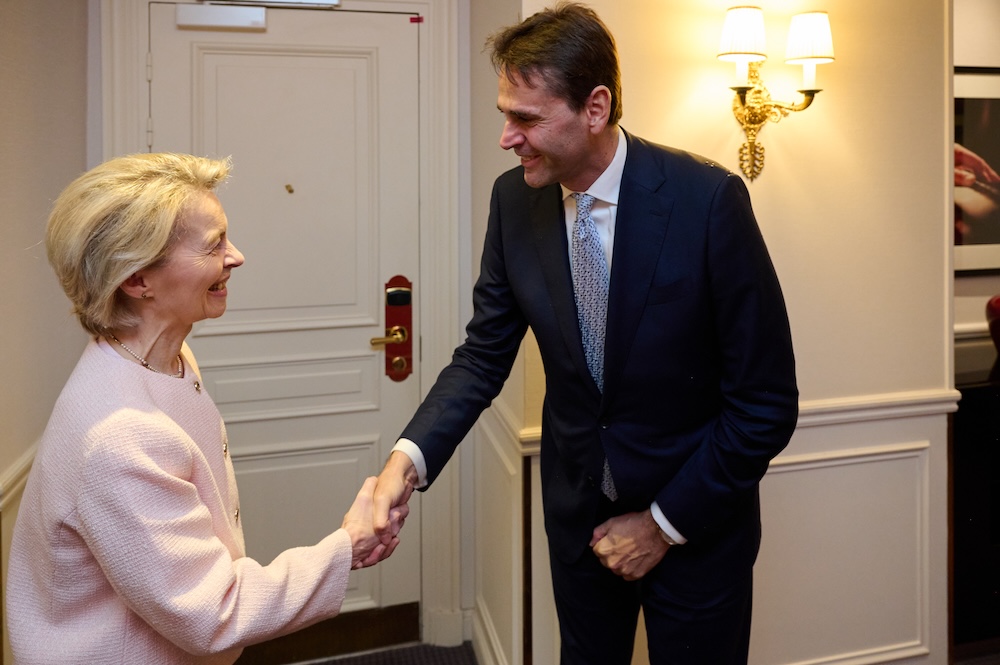
ASML chief executive Christophe Fouquet has given Brussels an early indication of the political difficulty facing its new technology sovereignty agenda: Europe’s largest strategic technology company supports the direction of travel, but not necessarily the method.
Fouquet said he backed most of the European Commission’s recent proposals to strengthen Europe’s technological independence. However, he cautioned against Commission involvement in steering or closely monitoring strategic projects eligible for state aid, arguing that such initiatives should be led by industry rather than directed from Brussels.
The intervention matters because ASML is not a marginal player in Europe’s technology debate. Based in the Netherlands, the company is the world’s leading supplier of advanced lithography equipment used in semiconductor manufacturing. Its machines are essential to the production of the most advanced chips, making ASML one of Europe’s few companies with clear strategic weight in the global technology contest.
The Commission’s technology sovereignty package, presented on 3 June, is intended to strengthen Europe’s digital autonomy and reduce dependence on foreign suppliers in critical technologies. It includes two legislative proposals, Chips Act 2.0 and the Cloud and AI Development Act, alongside an Open Source Strategy and a Strategic Roadmap for Digitalisation and AI in Energy.
The policy direction reflects a wider European concern that the bloc remains too dependent on non-European providers for semiconductors, cloud infrastructure, artificial intelligence systems and other digital technologies. The issue has become more urgent as competition between the United States and China affects supply chains, export controls, data governance and access to advanced computing capacity.
For Brussels, the package is part of a wider attempt to move from regulation alone towards industrial capacity. The Commission says the measures are designed to widen choice for European businesses, public administrations and citizens, while supporting the ambition to make Europe an “AI continent”. It also wants to encourage demand for European-made chips and local cloud services.
Fouquet welcomed that demand-driven approach. That is an important point. One criticism of previous European technology initiatives has been that they focused heavily on rules, compliance and public funding, while paying less attention to whether European customers would actually buy European technology at scale. If demand is weak, public money alone cannot build durable industrial leadership.
The dispute lies in the question of control. According to comments reported on 5 June, Fouquet argued that the Commission should not try to direct strategic technology projects from the centre. From an institutional perspective, the use of state aid creates a case for monitoring, coordination and oversight. From the perspective of a company such as ASML, excessive direction risks slowing projects, adding bureaucracy and weakening the link between public support and market need.
This is a familiar tension in European industrial policy. The EU wants to compete with the United States and China, both of which operate with large markets, deep capital pools and strong state support in selected sectors. Yet the EU must also work through a complex structure of member states, state-aid rules, regulatory procedures and political compromises. The more strategic a sector becomes, the stronger the temptation for institutions to define priorities centrally.
The semiconductor sector illustrates the difficulty. Europe has world-class strengths in parts of the supply chain, including ASML’s lithography technology. But it remains weaker in large-scale chip manufacturing, advanced AI chip design and some parts of cloud infrastructure. Closing those gaps will require investment, skilled labour, energy capacity, faster permitting, procurement demand and cooperation between governments and companies.
Fouquet’s message is therefore not a rejection of European technology sovereignty. It is a warning that sovereignty cannot be built by administrative control alone. If strategic projects are shaped mainly by institutional preferences, they may struggle to match commercial reality. If industry is left entirely to the market, Europe may remain dependent on foreign infrastructure and supply chains in sectors that governments now regard as critical.
The Commission’s challenge is to find a balance between public direction and private execution. In practice, that means setting clear strategic goals, reducing fragmentation between member states, using public procurement to create demand, and avoiding approval structures that delay investment. It also means accepting that companies will resist policies that appear to put officials too close to operational decisions.
For EU policymakers, ASML’s response should be treated as an early test of whether the new package can command support from the very companies it is meant to strengthen. Europe’s technology sovereignty agenda will depend not only on legislation, but on whether industry believes the framework will help it scale, compete and sell.
The debate is likely to continue as the proposals move through the EU legislative process. The central question is not whether Europe should reduce critical dependencies. There is broad agreement in Brussels that it should. The more difficult question is whether the EU can do so without creating another layer of procedure that slows the companies it needs most.

