
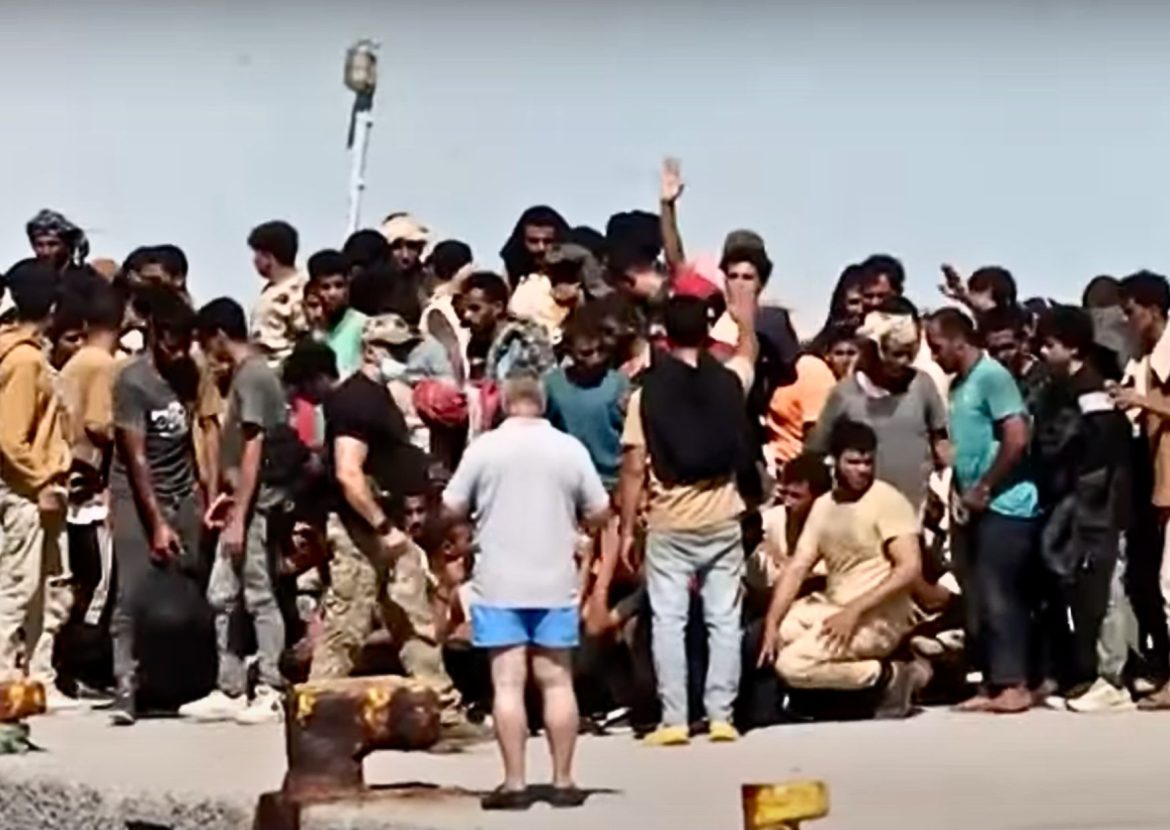
Greece has suspended the processing of asylum applications for individuals arriving by sea from North Africa, following a significant increase in migrant landings on its southern islands, particularly Crete and Gavdos. The measure, announced by Prime Minister Kyriakos Mitsotakis on Wednesday, applies initially for a period of three months.
The suspension comes in response to a growing number of arrivals, with over 7,300 migrants recorded this year via sea routes from northeastern Libya—a marked increase from approximately 5,000 in the whole of 2024. According to the Hellenic Coast Guard, the latest incident involved the rescue of some 520 migrants off the island of Gavdos early Wednesday, who were later transferred to the mainland port of Lavrio.
The government attributed the rise in sea crossings to intensified activity along smuggling routes from eastern Libya. Most recent arrivals are reported to be nationals of Sudan, Egypt, and Bangladesh, with many travelling aboard overloaded fishing trawlers. Greek authorities have responded by reinforcing patrols in the southern Aegean and deploying two naval frigates near Libyan territorial waters.
“With legislation that will be submitted to Parliament tomorrow, Greece will suspend the examination of asylum applications, initially for three months, for those arriving in Greece from North Africa by sea,” Mitsotakis told lawmakers.
The announcement followed a failed diplomatic mission to Libya, where EU Commissioner for Home Affairs Ylva Johansson and ministers from Italy, Malta, and Greece were declared persona non grata and denied entry to Benghazi by the eastern Libyan authorities. The delegation had planned discussions aimed at strengthening cooperation on migration management.
Tensions between Greece and Libya have persisted since a 2019 maritime agreement between Turkey and the Tripoli-based government, which Athens does not recognise. The recent setback in diplomatic engagement further complicates efforts to curb irregular crossings in the central Mediterranean.
Greek officials report that reception facilities on Crete have reached full capacity in recent days, handling approximately 500 new arrivals daily. Makeshift shelters are being used to house migrants while they await transfer. The latest group disembarked at Lavrio port, assisted by service vessels after being moved overnight on a bulk carrier.
“The Greek government sends a message… the passage to Greece is closed, and sends a message to all smugglers and all their potential clients that the money they spend is completely wasted,” Mitsotakis said.
Authorities are expected to return to Libya those migrants who entered the country irregularly, although the operational and legal framework for such returns remains unclear amid the ongoing diplomatic impasse. Humanitarian organisations have raised concerns about the implications of suspending asylum procedures, particularly for vulnerable individuals in need of protection.
Greece has faced criticism in the past over its treatment of migrants and asylum seekers, including accusations of pushbacks at sea—claims the government denies. The latest policy shift marks a hardening of the country’s approach to migration, framed by officials as a necessary response to exceptional circumstances.
In coordination with Frontex, the European Border and Coast Guard Agency, Athens has increased aerial surveillance and maritime patrols in the southern approaches. Officials acknowledge, however, that the region’s vast maritime area makes full coverage difficult.
The Ministry of Migration and Asylum has not disclosed the exact number of migrants currently being held on Crete or the full capacity of existing reception infrastructure. Transfers to the mainland are expected to continue in the coming days as arrivals persist.
While the three-month suspension is being presented as a temporary emergency measure, its potential extension or institutionalisation has not been ruled out. European Commission officials have yet to issue a formal response to the Greek decision.
The developments place additional pressure on the EU to accelerate talks on a common migration and asylum policy, and to clarify its position on cooperation with the divided Libyan state, where rival authorities continue to control different regions.
In the meantime, the port of Lavrio has become the focal point of mainland processing operations. Migrants arriving there undergo medical checks and registration before being transferred to secure holding facilities near Athens, pending further administrative action.
Read also:
Commission’s Halfway Review of EU Migration Pact Reveals Persistent Implementation Gaps

