
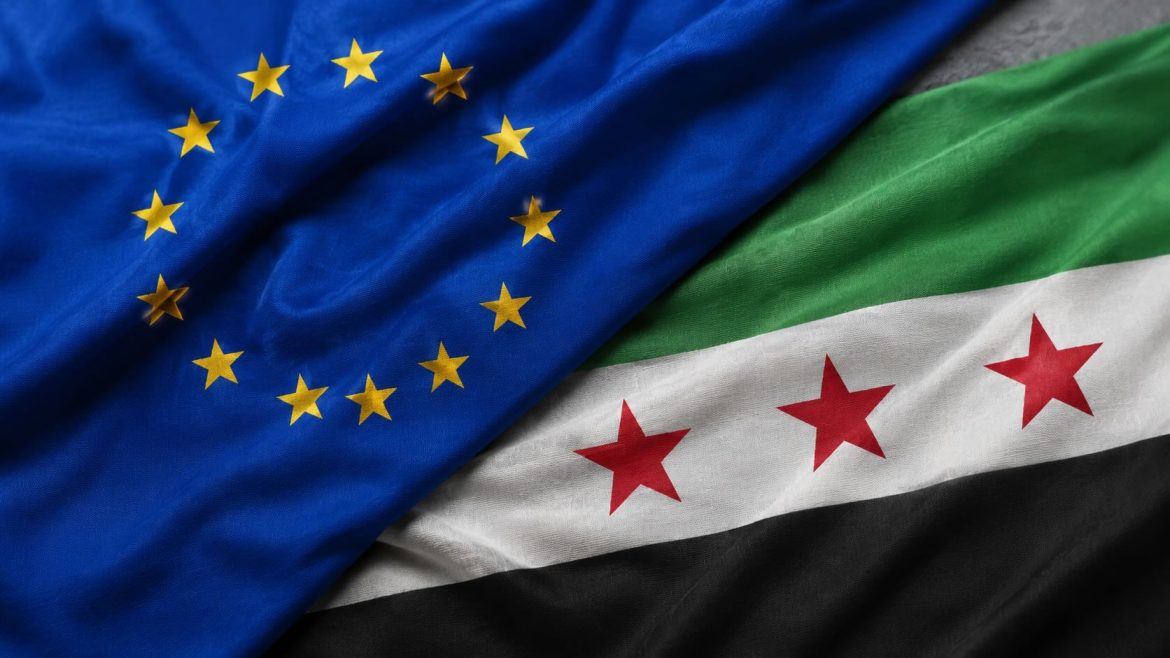
Brussels has renewed targeted sanctions against figures linked to the former Assad regime, while removing several Syrian state bodies from its blacklist as it seeks to support limited re-engagement with Damascus.
The European Union has extended sanctions against individuals and entities linked to the former regime of Bashar al-Assad for another year, while removing several Syrian state institutions from its sanctions list in a calibrated shift in policy towards Damascus.
The Council of the EU said on Monday that restrictive measures targeting the former al-Assad regime would remain in place until June 1st, 2027, following its annual review of the sanctions framework. At the same time, seven entities were removed from the EU sanctions list, including Syria’s Ministries of Defence and Interior. The Council said the move was intended to support a strengthening of EU engagement with Syria.
The decision reflects the EU’s attempt to draw a distinction between sanctions aimed at networks associated with the former regime and measures affecting the operation of the Syrian state under the country’s current authorities. It follows a wider easing of restrictions after the fall of Assad in 2024 and the installation of a new government led by President Ahmed al-Sharaa, a development also reported in international coverage of the EU decision.
Brussels has already moved to unwind much of the economic sanctions architecture imposed during Syria’s civil war. According to the EU’s current Syria policy overview, the bloc lifted all economic sanctions on Syria in May 2025, with the exception of measures maintained on security grounds. Earlier this month, the Council also ended the partial suspension of the EU-Syria cooperation agreement, which had been introduced in 2011 after the Assad regime’s repression of protests and subsequent human rights violations.
The latest decision is therefore not a full normalisation of relations. The EU is keeping targeted measures against individuals and organisations it says remain linked to the former Assad system. These measures include asset freezes, travel bans and restrictions on making funds or economic resources available to listed persons and entities.
For Brussels, the challenge is practical as much as political. Syria’s recovery requires engagement with ministries, public institutions and financial channels that had previously been restricted. Yet the EU also wants to avoid giving former regime networks access to resources or legitimacy at a time when Syria’s political transition remains fragile.
The removal of the defence and interior ministries from the sanctions list is significant because both institutions sit at the centre of state authority. Their delisting may allow the EU and member states to engage more directly with Syrian government structures on stabilisation, institutional reform, border management, security-sector questions and administrative recovery. It may also make it easier for international partners to assess needs, support limited reconstruction activity and reopen channels that were blocked by sanctions compliance concerns.
The decision also comes as Syria seeks wider international reintegration. Syrian Finance Minister Yisr Barnieh is expected to attend a closed-door session with G7 finance ministers and central bank governors in Paris, where the country’s economic recovery is due to be discussed. That meeting is being viewed as part of a broader effort to bring Damascus back into international financial and diplomatic channels after years of isolation, according to reporting on Syria’s planned participation in the talks.
Syria’s foreign ministry welcomed the EU’s partial delisting, saying the move would help national recovery, strengthen institutions and support stability. That response underlines the importance Damascus attaches to sanctions relief as it seeks external investment, financial access and reconstruction support.
However, EU policy remains conditional. The Council has framed sanctions relief as support for a peaceful and inclusive transition, socio-economic recovery and reconstruction, rather than as an unconditional reset. The retention of targeted restrictions signals that Brussels intends to keep pressure on former regime-linked figures while testing whether engagement with the current authorities can deliver institutional and political results.
For European policymakers, the Syria file now sits between two objectives that are not always easy to reconcile. One is to prevent Assad-era networks from preserving influence through assets, coercive structures or economic channels. The other is to avoid leaving the Syrian state so isolated that recovery, governance and basic public administration remain blocked.
The latest sanctions decision does not resolve that tension. It marks a further step in the EU’s gradual move from broad economic isolation towards selective engagement, while keeping a legal mechanism in place against those associated with the former regime. For Damascus, the delistings are a sign that engagement is possible. For Brussels, they are a test of whether limited sanctions relief can support transition without weakening accountability.

