
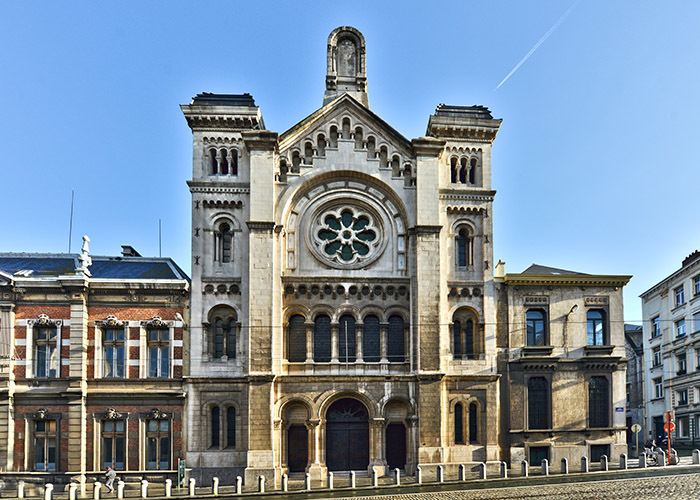
Belgium is deploying soldiers to help protect synagogues and Jewish schools after the attack on a synagogue in Liège and a series of related security incidents elsewhere in Europe.
The measure, announced this week by Interior Minister Bernard Quintin and Defence Minister Theo Francken, will be carried out in cooperation with the federal police and is to be implemented as soon as possible.
The decision follows an explosion at a synagogue in Liège on 9 March, which caused material damage but no injuries. Belgian authorities opened an investigation after the blast, while political concern grew over the security of Jewish institutions in the country. EU Today reported at the time that the explosion damaged the building and immediately raised wider questions about the protection of Jewish communities in Belgium.
According to Belga, the military deployment will cover synagogues and Jewish schools, with operational control remaining with the police. The number of troops was not confirmed in the initial announcement, although the move was presented as a reinforcement measure in response to what ministers described as a real and immediate threat environment. Quintin said the Liège attack had demonstrated that the threat to the Jewish community in Belgium was “very real”.
The Belgian announcement came after further incidents in neighbouring countries. There have been attacks in Rotterdam and Amsterdam, where a fire was started at a synagogue and there was an explosion at a Jewish school, as well as an explosion at the United States embassy in Norway on 8 March. These incidents added to pressure on the Belgian government to strengthen visible protection around Jewish sites.
The decision also fits into an existing domestic political debate over how Belgium should secure vulnerable locations. In December 2025, EU Today reported that the federal government planned to end the routine deployment of federal police officers in Antwerp’s Jewish district, returning 16 officers to Brussels and shifting greater responsibility back to local policing. That proposal triggered objections from Antwerp’s leadership and concern within the Jewish community about a possible gap in protection. At the time, one alternative under discussion was the use of military personnel to support the police at Jewish sites.
The current move therefore represents not a wholly new policy idea, but the activation of an option that had already been under discussion for several months. EU Today also reported in September 2025 that Belgium was considering broader army support for policing tasks in Brussels in response to urban security pressures, showing that the use of soldiers in support roles had already entered mainstream federal security planning.
Legally, the government is relying on Article 111 of the Integrated Police Act. Belga reported that this provision allows the commissioner-general of the federal police to call on military personnel to support police duties. That legal route appears to have been used in part because the issue had become politically contentious inside the coalition. Justice Minister Annelies Verlinden said the decision had not been discussed in advance within the government and questioned both the process and the clarity of the legal framework for soldiers operating in domestic security roles.
That disagreement underlines a broader division inside the federal coalition. Verlinden argued that no minister should act unilaterally and raised doubts about whether the police shortage justifying military support had been clearly established. Prime Minister Bart De Wever nonetheless defended the decision, saying the request for assistance came from federal police leadership and that the measure was compatible with both the law and the coalition agreement.
Pressure for stronger protection has also come from outside government. Political leaders, including MR president Georges-Louis Bouchez and Antwerp mayor Els van Doesburg, called for military personnel to be deployed near Jewish institutions after the Liège attack. The Coordination Committee of Jewish Organisations in Belgium also supported such a move.
For Belgium, the return of soldiers to security duties around Jewish sites is a visible acknowledgement that the threat level has again risen. The immediate trigger was the Liège synagogue attack, but the background is broader: an already tense debate about policing capacity, concern over antisemitic violence, and a recent pattern of incidents affecting Jewish institutions in Belgium and the Netherlands. As EU Today’s earlier reporting on Antwerp and Liège showed, the issue had already been building. The latest decision turns that debate into policy.

