
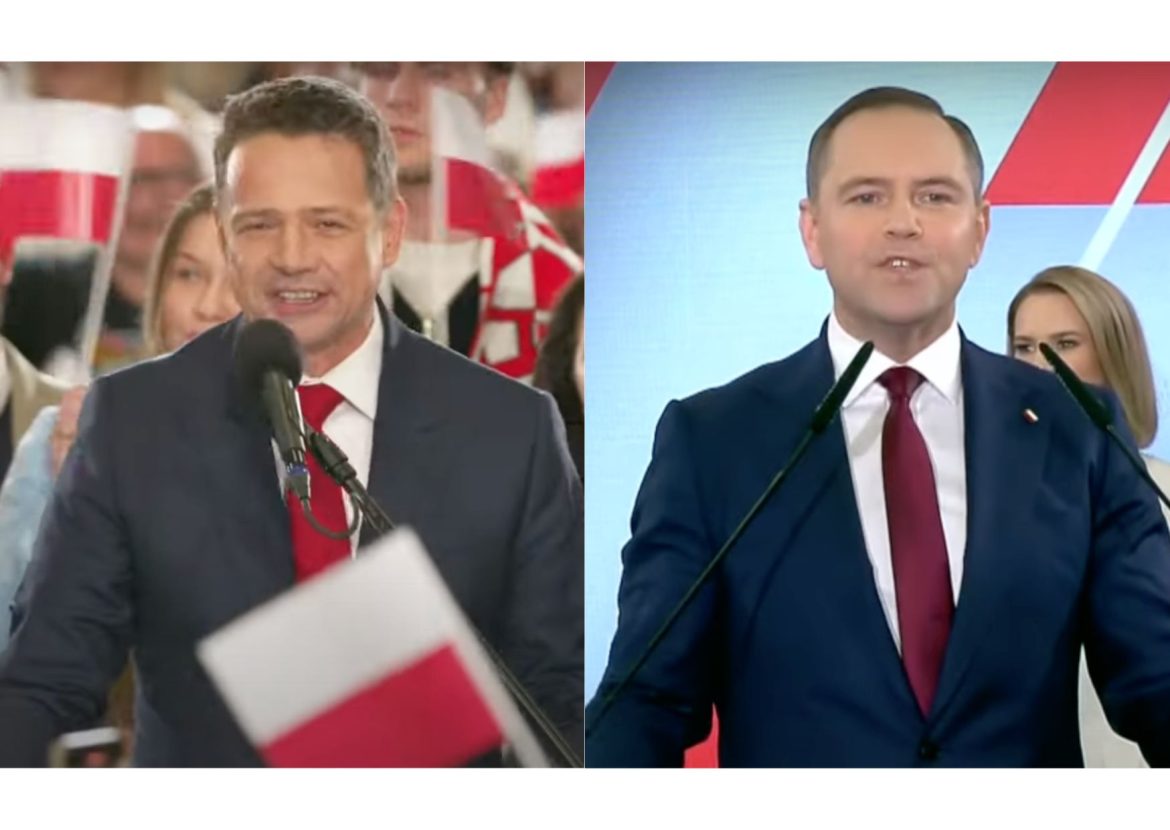
Warsaw, 19 May 2025 — Poland’s presidential election is set for a second-round runoff after centrist candidate Rafał Trzaskowski, the Mayor of Warsaw and nominee of Prime Minister Donald Tusk’s Civic Platform, narrowly led the first round with 31.36% of the vote. He will face Karol Nawrocki, director of the Institute of National Remembrance and candidate backed by the right-wing Law and Justice (PiS) party, who secured 29.54%.
The final results, announced by Poland’s National Electoral Commission on Monday morning, confirm a closely contested race ahead of the 1 June runoff. Voter turnout stood at 67.31%, exceeding the 64.51% recorded in the first round of the 2020 presidential election. The highest participation was noted in Mazowieckie Voivodeship (73.40%), with the lowest in Opolskie (57.64%).
Trzaskowski’s lead was smaller than forecast by pre-election surveys. A POLITICO “poll of polls” had projected him to reach 31%, with Nawrocki expected at 26%. Addressing supporters on Sunday evening, Trzaskowski acknowledged the narrow margin: “I told you eight months ago it would be very close — and it is very close. This result shows how strong and determined we need to be to win the presidential election.”
Nawrocki, in his post-election remarks, thanked voters who “resisted the pressure of propaganda, falsehoods, and lies” and criticised the influence of “Donald Tusk’s state institutions.” His unexpectedly strong showing provides momentum heading into the second round, particularly among Poland’s conservative electorate.
Sławomir Mentzen, leader of the far-right Confederation party and known for anti-Ukrainian rhetoric, came third with 14.81%. Nawrocki immediately moved to court Mentzen’s supporters, saying, “This is the time to save Poland. We both want a sovereign, strong, rich and secure Poland.”
Fourth place went to Grzegorz Braun (6.34%), a far-right MP previously censured for disrupting a Hanukkah celebration in parliament. His support base adds complexity to the runoff calculus. Fifth and sixth were Szymon Hołownia (4.99%) of Poland 2050 and Magdalena Biejat (4.23%) of the Left – both representing factions within the ruling coalition. Adrian Zandberg, from the non-coalition leftist Together party, polled 4.86%.
Together, the candidates opposed to Tusk’s coalition outpolled those aligned with it, raising questions about whether Trzaskowski can build a winning majority. Analysts argue that much will depend on his ability to consolidate votes from centrist and left-wing camps, particularly those of Hołownia, Biejat, and Zandberg. Bartosz Rydliński, a political scientist at Cardinal Stefan Wyszyński University, noted that “we’re going to see pretty much cacophonous signals to all possible voters of other candidates bar Nawrocki.”
Despite being endorsed by Civic Platform, Trzaskowski must now distance himself from the less popular aspects of the Tusk government, which has faced criticism over its handling of inflation, migration policy, and divisions within the ruling coalition. Observers suggest that while Hołownia and Biejat refrained from attacking Trzaskowski during the campaign, their endorsement alone may not be sufficient to ensure their supporters turn out in the second round.
Prime Minister Tusk took to social media following the result, posting: “The game for everything is just beginning. A hard fight for every vote. These two weeks will decide the future of our country. Therefore, not a step backward.”
The presidential role in Poland holds significant influence over foreign policy and legislation through the power of veto. The result of the runoff could impact the future direction of Warsaw’s relationship with Brussels, defence cooperation with NATO, and domestic constitutional reform.
Both candidates are now expected to adjust their campaign strategies. Trzaskowski will likely signal alignment with progressive and centrist forces, including environmental and pro-European constituencies, while Nawrocki is expected to double down on national identity, sovereignty, and traditional values.
The 1 June vote will thus not only determine the next president, but also serve as a test of the governing coalition’s ability to maintain public support amid mounting challenges and a resurgent conservative opposition.
Read also:
Nicușor Dan Holds Lead in Romanian Presidential Run-Off Amid Disputed Claims from Simion

