
For decades, the argument about rising sea levels has centred on the future. How quickly will polar ice melt? How far might oceans expand as they warm? Which cities will need new defences by the end of the century?
Yet a recent study published in Nature suggests the debate may have been starting from the wrong premise entirely. The researchers argue that coastal sea levels across the world are already higher than many scientific assessments assume.
The finding is technical in origin but potentially profound in consequence. The study suggests that inconsistencies between the way sea level is measured globally and how land elevation is measured locally have produced systematic underestimates of coastal water levels. When these discrepancies are corrected, coastal seas appear to sit roughly 20 to 30 centimetres higher than the baseline used in many flood risk models.
At first glance, such a difference might appear trivial. Yet coastal risk is governed by margins measured in centimetres rather than metres. If the starting point of the world’s oceans is already higher than expected, the practical effect is similar to bringing forward decades of projected sea-level rise.
Nowhere could that matter more than in Europe, where several of the continent’s most important cities sit perilously close to the waterline.
Europe’s precarious geography
Europe has long experience of living with the sea. From medieval flood defences along the North Sea to modern tidal barriers protecting major estuaries, the continent has spent centuries engineering its coastline. Yet those systems were designed according to assumptions about how high the water already stands.
If those assumptions prove wrong, the margin of safety may be narrower than believed.
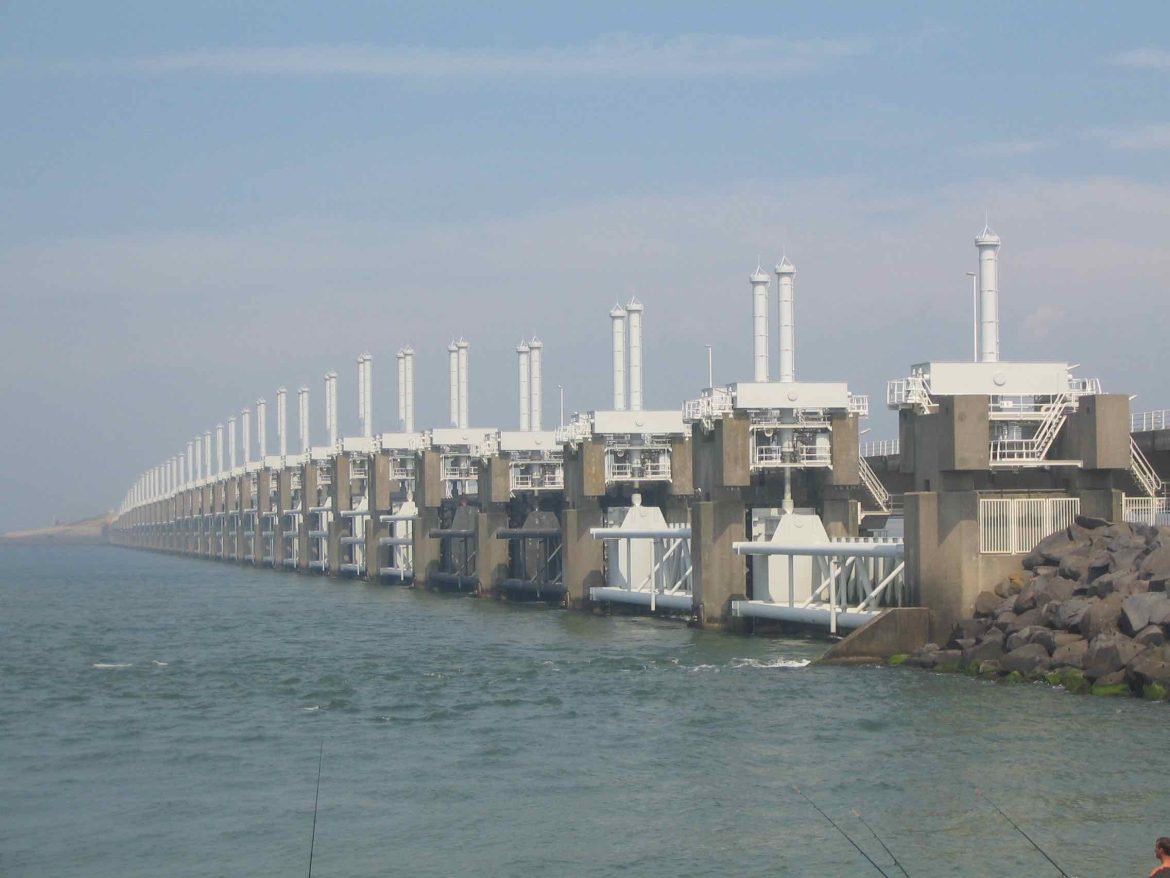
The most obvious case is the Netherlands, where large parts of the country lie below sea level and rely on an intricate system of dikes, pumps and storm barriers. The port city of Rotterdam — Europe’s largest — sits at the mouth of the Rhine–Meuse delta, an area already susceptible to storm surges from the North Sea. Even a modest upward revision in baseline sea levels could alter flood risk calculations used to design protective infrastructure.
Dutch engineers are famously conservative in their safety margins. Yet their models still depend on accurate measurements of relative sea level. If the ocean is already several decimetres higher than assumed, planners may eventually need to revisit the thresholds used to define extreme flooding events.
Further south, another city faces a different but equally precarious challenge. Venice has become the global symbol of slow inundation, its canals regularly spilling into the surrounding squares during seasonal high tides known as acqua alta. Italy’s vast flood barrier system, the MOSE project, was built to shield the lagoon from rising seas and storm surges.
But MOSE was designed using projections of future sea-level rise layered on top of existing baseline measurements. If the underlying baseline proves too low, the system may reach its operational limits sooner than anticipated. Venice already experiences dozens of flooding events each year; an additional 20 or 30 centimetres in the starting point could substantially increase the frequency of barrier closures.
Northern Europe’s vulnerable estuaries
The North Sea coast presents another concentration of risk. Low-lying river deltas and estuaries stretch from Belgium through Germany to Denmark. In Belgium, the historic port of Antwerp sits deep inland along the tidal River Scheldt, yet its elevation leaves it vulnerable to extreme storm surges.
Belgian authorities have invested heavily in coastal defence since the devastating North Sea flood of 1953. However, flood risk assessments still depend on projections derived from baseline sea-level measurements. If those baselines are understated, the statistical frequency of dangerous water levels could shift — meaning that events considered “once in a century” might occur more often.
Germany faces similar concerns in the lowlands surrounding Hamburg. The city lies roughly 100 kilometres from the North Sea but remains exposed to tidal surges travelling up the Elbe estuary. After catastrophic flooding in 1962, Hamburg constructed extensive flood barriers and raised embankments across the city.
Yet the lesson from the new research is that relative sea level — the height of water compared with the land — is what ultimately determines flood risk. Subsidence, sediment loss and human alteration of rivers can all change that balance. If coastal seas are already higher than expected, the margin protecting cities like Hamburg may be thinner than planners believed.
Britain’s capital at the tidal frontier
Across the Channel, Britain faces its own test. The London skyline rises along the tidal Thames, protected by the Thames Barrier — one of the world’s most sophisticated flood defence systems. Completed in the 1980s, the barrier was designed to guard the capital against storm surges from the North Sea.
Engineers always expected sea-level rise to increase the frequency with which the barrier must close. In fact, closures have already become more common than originally predicted. If baseline sea levels are indeed higher than assumed in many global models, it could reinforce the case for accelerating plans to replace or upgrade the barrier later this century.
London is not alone. Along Britain’s east coast, cities such as Hull and King’s Lynn already sit just metres above sea level, protected by extensive drainage systems and flood embankments. A shift of only a few centimetres in the baseline could change the frequency with which tidal waters threaten these communities.
The Baltic and Atlantic frontiers
Elsewhere in Europe, the situation is more complex. Parts of Scandinavia are actually rising due to post-glacial rebound, a geological process in which land slowly lifts after the melting of ancient ice sheets. This upward motion partially offsets rising seas in cities such as Stockholm.
But the opposite occurs along sections of the Atlantic coast where sediment compaction or groundwater extraction causes land to sink. In France, the low-lying approaches to Bordeaux along the Gironde estuary are particularly exposed to tidal flooding.
Even where land is stable, storm surges can amplify sea-level threats. The Bay of Biscay and North Sea both funnel water toward coastal cities during severe weather systems. If the starting point of the ocean is already higher, such surges could reach further inland.
A shift in perspective
None of this means Europe’s coastal defences are suddenly obsolete. Many countries on the continent operate some of the world’s most sophisticated flood protection systems. But the new research raises a subtle and unsettling possibility: that the margins built into those systems may be smaller than previously believed.
Sea-level rise is often discussed as a gradual, predictable process measured in millimetres per year. Yet the new study reminds us that uncertainty can also lie in the present — in the way scientists measure the current relationship between land and sea.
If coastal waters are already higher than assumed, the timeline of adaptation may need to accelerate. Infrastructure designed to cope with conditions expected in 2050 might confront those conditions decades earlier.
For Europe’s coastal cities, the lesson is clear. The future of rising seas may arrive not with a dramatic leap, but with a quiet realisation that the water has been creeping closer all along.
Main Image: By Vladimír Šiman (online) – Own work, CC BY 3.0, https://commons.wikimedia.org/w/index.php?curid=4513210
Click here for more News & Current Affairs at EU Today
Click here to check out EU TODAY’S SPORTS PAGE!
_______________________________________________________________________________________________________________________

