
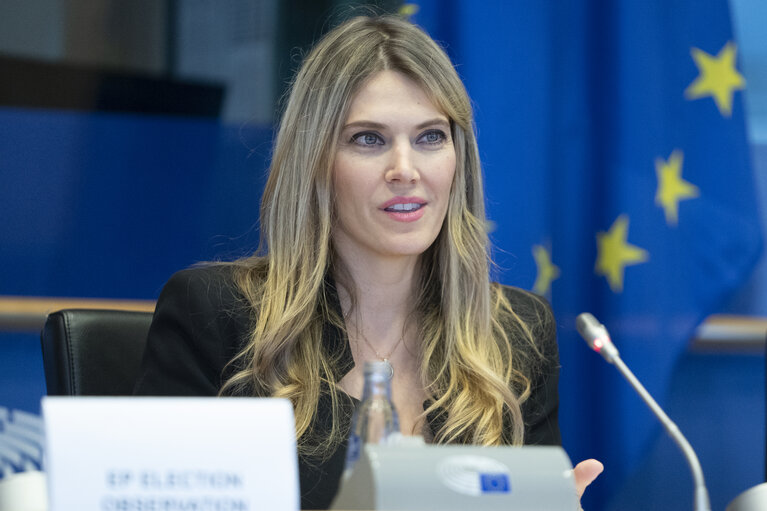
Eva Kaili, the former European Parliament vice-president at the centre of the 2022 “Qatargate” corruption investigation, has accused Belgian authorities of mishandling her case and using leaks to shape public opinion, as a separate fraud inquiry led by the European Public Prosecutor’s Office (EPPO) triggers new arrests in Brussels.
In an interview with Euronews published on 22 December, Kaili said she had been “set up” and argued that “optics were presented as justice” when the investigation became public three years ago. She described her case as a warning to politicians working in EU institutions, saying that once investigators “choose a target” the presumption of innocence can be undermined.
Her comments come after the EPPO and Belgian police carried out searches linked to an alleged fraud and corruption scheme involving EU-funded training for junior diplomats. The EPPO said it was investigating suspected procurement fraud, corruption, conflict of interest and breach of professional secrecy tied to contracts connected to the EU Diplomatic Academy.
Federica Mogherini, the former EU High Representative for foreign affairs and security policy and the rector of the College of Europe, was among those detained in the separate EPPO case. Mogherini and two others were formally accused, then released.
The fresh arrests have placed renewed attention on Belgium’s role in policing alleged wrongdoing linked to EU institutions. Kaili told Euronews she was not surprised that the Mogherini inquiry involved Italian nationals and claimed a narrative was developing that associates southern European countries with corruption. She characterised the newer case as “selective political prosecution”, a description that has not been endorsed by the investigators.
Kaili was arrested in December 2022 after Belgian authorities launched coordinated raids across Brussels and elsewhere as part of an investigation initially led by investigating judge Michel Claise. Prosecutors alleged that foreign states had sought to influence decision-making inside the European Parliament through cash payments. In the early stages, Qatar and Morocco were named in reporting about the case; both have denied wrongdoing.
Belgian police released a photograph of a suitcase containing euro banknotes, which was widely published and became emblematic of the affair. Kaili, her partner Francesco Giorgi and others were detained. The investigation has involved allegations of large-scale cash seizures and claims of an organised influence operation using intermediaries inside the Parliament.
Kaili has consistently denied personal involvement and has rejected a plea deal. In her Euronews interview, she said she had no connection to money found at her home and pointed instead to another former MEP, Pier Antonio Panzeri, who has been described in reporting as a key figure in the inquiry. She also said she had acted under a mandate to engage with Gulf states and cited internal communications as support for that position.
Despite the scale of the 2022 operation, the case has not yet reached trial. Euronews reported that no trial date has been set, and Kaili argued that questions around the lifting of her parliamentary immunity, the timing of leaks, and counter-investigations have affected proceedings. She alleged that investigators and journalists effectively drafted narratives in advance, citing messages she said exist between officials and reporters. Belgian prosecutors did not respond to Euronews’ request for comment, according to the report.
The Qatargate investigation has also faced internal disruption. The Financial Times reported in 2023 that Claise stepped aside over potential conflicts of interest, and that the lead federal prosecutor later left the case to take a different role, developments that complicated the investigation’s trajectory.
In the newer EPPO inquiry, Mogherini resigned as rector of the College of Europe amid the investigation, after the EPPO accused her and two others of wrongdoing linked to the academy’s procurement process. Mogherini and the other suspects have not been convicted of any offence.
Kaili’s case and the EPPO probe are legally separate, but the combination has revived wider questions about governance, oversight and investigative practice in Brussels. With both investigations ongoing, much now turns on whether prosecutors can bring cases to trial and sustain them under judicial scrutiny.

