
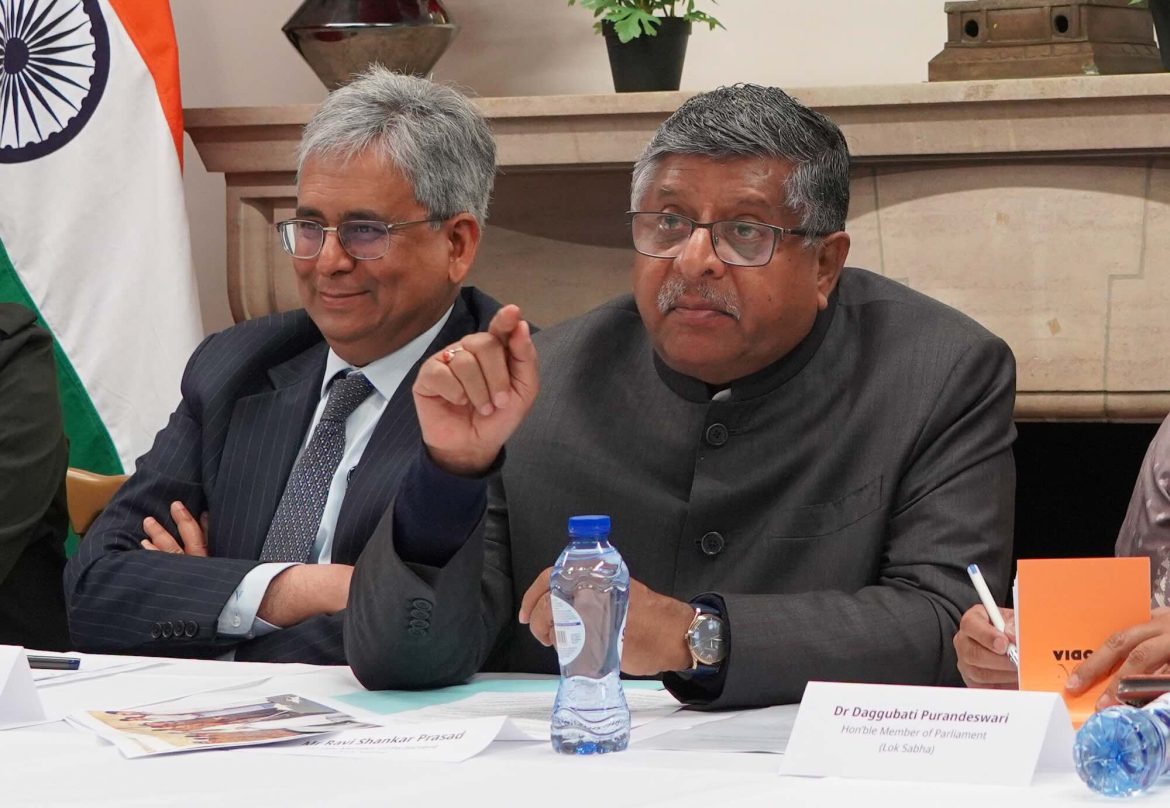
Brussels, 5th June 2025 – Addressing journalists at the Indian Embassy in Brussels, veteran lawmaker and former Minister of Information Technology Ravi Shankar Prasad highlighted India’s achievements in the digital and information technology sectors, describing them as central to the country’s development trajectory and international standing.
Speaking during a press interaction hosted by Ambassador Saurabh Kumar, Mr Prasad offered a detailed overview of the scale and integration of India’s IT capabilities into national governance, financial inclusion, and public services.
“India’s economic development is a model for the world,” Mr Prasad told the audience. “We believe in development with equity and justice. In that, we have used technology in a very, very effective way.”
Citing key metrics, Mr Prasad noted that India now has digital identity cards—Aadhaar—for 1.39 billion of its 1.4 billion citizens. The Aadhaar system captures biometric and demographic data and has been linked with mobile phones and bank accounts to enable efficient, direct-to-citizen service delivery. “We opened 500 million bank accounts for the poor, linked them with Aadhaar and mobile numbers, and began transferring subsidies directly into those accounts at the click of a button,” he explained.
According to Mr Prasad, this digital framework proved vital during the COVID-19 pandemic. “Education, court hearings, and vaccine distribution were all handled digitally. Citizens could book vaccine appointments on their mobile phones, including exact timings and health centres for all doses. No paper, no queues.”
India’s mobile penetration has also reached considerable scale. “We have 1.2 billion mobile phones, of which 950 million are smartphones,” Mr Prasad said. “That’s nearly equivalent to the entire population of Europe. And these phones are not just for calls—they are tools for governance, education, commerce, and healthcare.”
He further pointed to the manufacturing sector: “India is now the second biggest mobile phone manufacturer in the world.” In addition, he said, infrastructure development is being powered by digital integration: “Our highways are now strong enough that fighter jets can land on them. Airports are being constructed, and our space programme continues to advance.”
Mr Prasad also drew attention to India’s status as the global leader in digital payments. “Whether in metropolitan cities or rural markets, digital transactions are now the norm. You’ll see a vegetable vendor accepting payments via QR code in the remotest village. This is not aspirational—it is operational.”
The delegation framed India’s digital transformation not only as a domestic success story, but also as a foundation for global partnerships. “India is a big economy and a massive market,” said Mr Prasad. “From digital technology to mobile manufacturing, from agriculture to space—our progress is real, sustained, and inclusive.”
Ambassador Saurabh Kumar reinforced this message: “The delegation here today showcases the unity and diversity of India’s democratic polity. And the story they bring is not just one of security concerns, but also of economic and technological growth that can offer real opportunities for partnership with Europe.”
Mr Prasad concluded his remarks by reiterating the underlying message: “Growth, equity, and justice—blended with technology. That is the Indian model. And we are committed to taking it further.”
The visit by the Indian delegation comes amid a wider international outreach following recent security incidents in Kashmir. However, the inclusion of India’s digital development agenda in these discussions signals a deliberate effort to shift the narrative from regional conflict to global collaboration, particularly with European institutions and markets.
—————————————————————————————————————-
An all-party delegation of Indian parliamentarians, led by senior BJP MP and former Minister Ravi Shankar Prasad, briefed the Brussels press corps today at the Indian Embassy, focusing on the recent terrorist attack in Pahalgam and India’s subsequent military response, dubbed Operation Sindoor.
—————————————————————————————————————-

