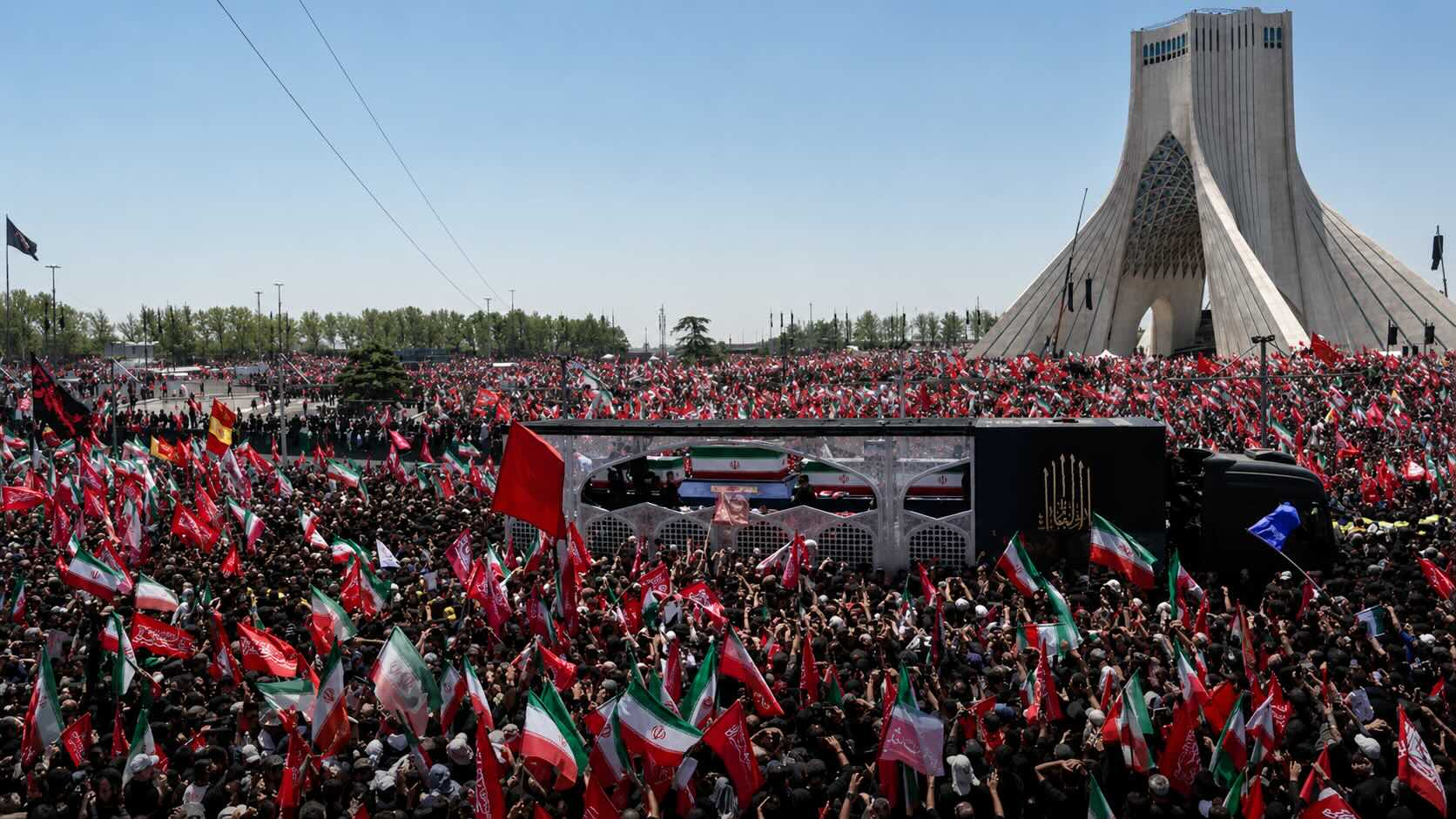
For Europe, the funeral of Ali Khamenei is not primarily a matter of ritual. It is a warning that the Islamic Republic’s leadership transition will be felt well beyond Iran’s borders — in energy markets, maritime security, sanctions enforcement and the wider structure of European foreign policy.
For too long, European capitals have treated Iran as a set of separate files: the nuclear dossier for diplomats, the Strait of Hormuz for navies, and human rights for statements of concern. That approach no longer reflects the strategic reality. Iran’s succession politics, regional leverage and domestic repression are converging into a single problem.
The key question is therefore not whether the ceremony in Tehran was solemn or large. It is what the ceremony was intended to do. The funeral was used to signal defiance towards the United States and Israel, and to turn wartime endurance into negotiating leverage. It was also described as a crucial test of the regime’s ability to project unity after years of conflict, sanctions and protest.
In that sense, the funeral was not an act of closure. It was a public demonstration that the state intended to survive by controlling the narrative of succession.
The absence of Mojtaba Khamenei sharpened that message. He was notably absent from the funeral observances, although he has long been discussed as a possible successor. In a system where formal rules often matter less than informal alliances, security loyalties and symbolic legitimacy, absence is political. It raises the question of whether the regime has settled its succession formula, or whether elite bargaining is still taking place behind closed doors.
For Europe, the implications of that uncertainty are direct. A state that has not resolved the shape of its next leadership is more likely to seek external leverage while its internal order is being negotiated. In Iran’s case, that leverage lies where it has always lain: in the nuclear dossier, regional proxies and, above all, the Strait of Hormuz.
That matters because Hormuz is not a distant chokepoint. It is a European security issue. The Strait handles around one-fifth of global oil transit, and renewed threats and incidents there have already pushed shipping risk higher. Iran has also warned tanker traffic to follow approved routes or face a forceful response, showing how quickly a diplomatic dispute can become a maritime threat.
When vessels are threatened in the Gulf, Europe feels the consequences through higher freight rates, insurance premiums, energy prices and industrial uncertainty.
The European Union has already begun to respond to that reality. On June 8, the EU sanctioned two Iranian individuals and the Hormozgan Provincial Command of the IRGC Navy for disrupting maritime traffic in the Strait of Hormuz. It was the first use of the EU’s freedom-of-navigation sanctions framework in this context.
The significance is not only punitive. It is doctrinal. Brussels is beginning to recognise that Iran’s use of maritime pressure is not a peripheral issue, but a direct challenge to Europe’s economic stability and to the law of the sea.
That logic was reinforced by the G7. Earlier this year, G7 foreign ministers said they were ready to take necessary action to protect global energy supplies and support maritime routes, including the Strait of Hormuz. The point is not that Europe should outsource its policy to Washington or Tokyo. It is that Europe has already entered a phase in which its energy security is being shaped by events in Iranian waters.
The old assumption that Iran is a problem for Middle East specialists no longer reflects strategic reality. Iran is now part of Europe’s inflation problem, shipping problem and security problem.
The regional dimension of the funeral made that clearer. The transfer of mourning to Najaf, where Iraqi officials and Shi’ite religious figures took part, was not only a religious gesture. It was a reminder that Tehran wants the succession moment to be read within a broader Shi’ite and regional political space.
Iran is not merely managing a domestic transition. It is trying to preserve a transnational axis of influence at the very moment its internal authority is being renegotiated.
For Europe, this should alter how the succession is interpreted. A transition in Tehran is often assumed to create an opening for moderation. That assumption is often misplaced. In authoritarian systems, succession can produce the opposite effect: tighter discipline, harder ideological lines and renewed emphasis on external threat.
That tendency is visible in the Iranian political ecosystem surrounding the hardline camp, including figures such as Saeed Jalili and Mahmoud Nabavian. They matter not because they are the only voices on the right, but because they embody a politics in which resistance to the West, internal cohesion and suspicion of compromise reinforce each other.
That politics has a domestic counterpart. The same state that insists on confrontation abroad also insists on tighter control at home: over women’s conduct, internet access, public morality and the boundaries of acceptable dissent.
The logic is consistent. A system that defines itself as being under siege tends to broaden the category of security threats, then uses that category to justify greater social discipline. Europe should not underestimate the connection. An Iran that hardens internally is also more likely to externalise pressure regionally.
This is where the European policy debate needs to move beyond the nuclear file. The West has often treated Iran as a linear dossier: sanctions, talks, verification, escalation, repeat. The funeral showed that the next phase will not be linear. It will be shaped by at least three overlapping struggles: who inherits authority, how hardliners convert uncertainty into leverage, and how much space remains for pragmatists who might prefer limited accommodation.
Europe should plan for the hardest version of that sequence, not the easiest.
It also needs to acknowledge the political economy of confrontation. A security crisis does not simply create threats; it creates interests. Sanctions workarounds, opaque logistics, maritime risk premiums and emergency procurement channels all sustain actors who profit from opacity and coercion.
That is why the harder line in Tehran is not only ideological. It is institutional. A confrontation economy rewards those who can claim to defend the system while preserving the very conditions that make the system fragile. European policy should target that ecosystem, not merely the loudest individuals within it.
In practice, this requires several changes.
First, Europe should treat freedom of navigation in Hormuz as a standing strategic priority, not as a crisis response. That means more coordinated maritime monitoring, closer alignment with Gulf partners and a clear willingness to support enforcement when Iranian forces threaten commercial shipping.
Second, Europe should tighten sanctions enforcement against IRGC-linked maritime, logistics and procurement networks that profit from coercion and opacity.
Third, Europe should stop separating energy policy from Iran policy. Every fluctuation in Gulf security now carries a direct European cost.
Fourth, Europe should integrate human rights into its Iran strategy rather than leaving them as a separate moral file. Leadership transitions in authoritarian systems are often moments of intensified repression, as security institutions seek to control the uncertainty produced by succession. Europe should therefore expect greater pressure on civil society, journalists, women’s rights activists and minority communities, not a softer political climate.
A policy that ignores this risk will read the transition too narrowly and too optimistically.
Finally, Europe should stop assuming that diplomacy and deterrence are alternatives. In the Iran file, they are now interdependent. Credible deterrence is what gives diplomacy a chance to matter. Without it, talks become a tactic for buying time.
That lesson is especially relevant after a funeral designed, in part, to transform endurance into leverage. Europe does not need to become more confrontational for the sake of symbolism. It does need to become more serious about the cost of ambiguity.
The deeper lesson of the funeral is that Tehran is trying to turn death into continuity, grief into legitimacy and uncertainty into leverage. Europe should assume that this effort will continue in three directions at once: inward, through harder control; outward, through regional signalling; and sideways, through bargaining over the terms of engagement with the West.
If Brussels fails to see those three tracks as part of one strategy, it will continue to respond to Iran in fragments while Tehran acts in systems.
Iran after Khamenei is not only Iran’s next chapter. It is a test of whether Europe can update its strategic calculus. The funeral did not settle the future. It exposed how much remains unresolved.
That uncertainty should not be interpreted as a pause. It should be read as a phase of heightened risk in which Europe’s interests are already on the line.