
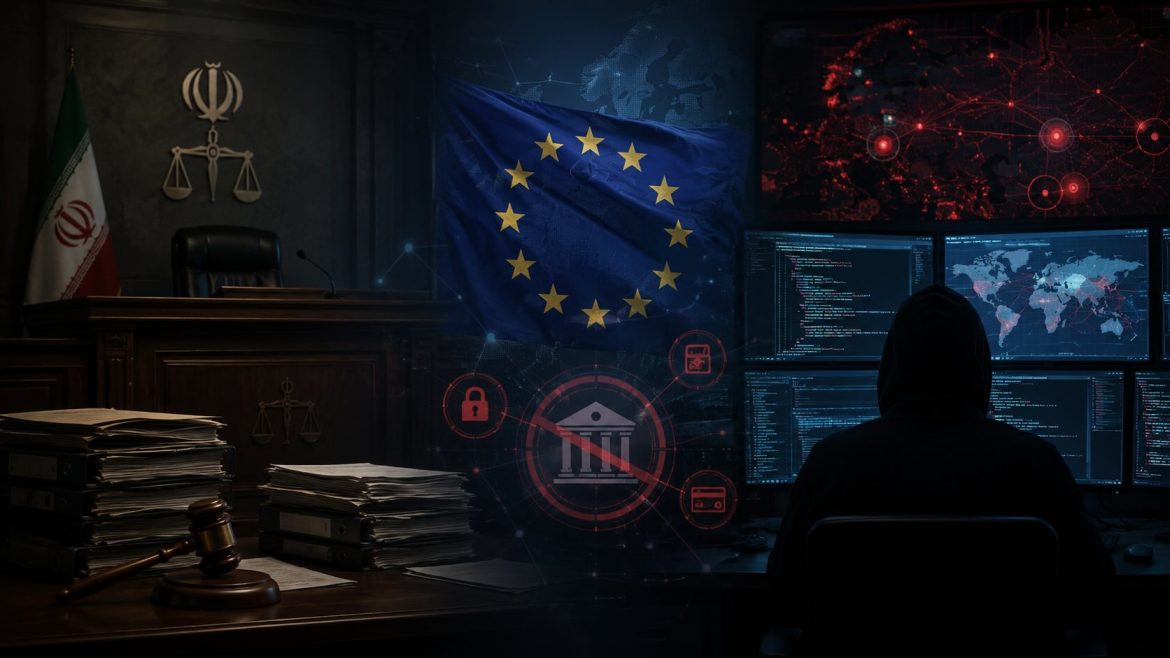
By listing five Revolutionary Court judges alongside hacker Nima Salehi, the Council is treating judicial punishment and digital intrusion as connected instruments of repression.
The European Union has sanctioned five Iranian judges and cyber operator Nima Salehi for serious human-rights violations, connecting prosecutions of dissidents and minorities with digital attacks against opponents and foreign institutions.
The Council’s official announcement says the judges presided over trials targeting religious minorities and political dissidents on vaguely defined national-security and religious charges.
According to the Council, the proceedings resulted in death sentences, long prison terms, flogging, fines and supplementary punishments. The cases included people associated with the 2022 “Woman, Life, Freedom” protests and Nobel Peace Prize laureate Narges Mohammadi.
Salehi is described by the Council as an Iranian hacker, computer engineer and founder or leading figure of the Ashiyane cyber group. The EU attributes to him intensive cyberattacks on domestic opponents and foreign institutions.
The listings impose an asset freeze and prohibit EU persons from making funds or economic resources available to those named. A travel ban also applies. The legal consequences arise from Council Implementing Decision 2026/1850 and Implementing Regulation 2026/1851, not merely from the press release.
Why judges are targeted
Sanctioning judicial officials is politically sensitive because legal systems normally protect judicial independence. That principle does not shield judges from responsibility for participating in serious abuses.
The EU’s case is that the named Revolutionary Court judges did not simply apply neutral law in good faith. It links them to proceedings using broad charges against peaceful political activity, religion or expression and to punishments incompatible with fundamental rights.
Individual listings must be evidence-based. Each person is entitled to receive reasons, seek reconsideration and challenge the measure before the EU courts. The Council must maintain an evidentiary file capable of supporting its conclusions.
That safeguard is particularly important when sanctions concern adjudicative conduct. A listing should identify personal responsibility rather than treat membership of the judiciary as sufficient.
The political message is nevertheless clear: the EU will not treat a courtroom as a barrier against accountability when criminal process is allegedly used as an instrument of repression.
The cyber connection
Salehi’s inclusion broadens the picture. Digital operations can identify dissidents, compromise communications, intimidate diaspora communities and attack institutions abroad. They can also produce evidence later used in prosecutions.
The Council’s decision places a cyber actor within a human-rights sanctions framework rather than treating hacking only as a technical security offence. That reflects how surveillance, intrusion and judicial punishment can form a single chain.
EU Today previously reported on EU sanctions against Chinese and Iranian cyber actors. The latest measure differs in its explicit pairing of a cyber operator with judges accused of punishing opposition and minority activity.
Attribution remains challenging. Cyber operations use compromised infrastructure and false identities, while technical indicators can be copied. Strong sanctions decisions should combine technical evidence with organisational, financial and human intelligence.
The Council should disclose enough to make its reasoning credible without revealing sources or defensive capabilities. Overly vague listings are vulnerable to legal challenge and reduce their deterrent value.
Practical effect
Asset freezes are most effective when listed persons hold property, accounts or economic interests within EU jurisdiction. Travel bans restrict access to member states and can carry reputational consequences even when few assets are found.
European banks, technology firms and professional-service providers must update screening systems. Exact name matching is insufficient where transliteration from Persian produces variants. Compliance teams need dates of birth, aliases and other identifiers from the legal annex.
Technology providers should also examine whether infrastructure or services are being used for malicious operations. Sanctions compliance does not replace cybersecurity: providers need abuse reporting, log preservation and cooperation with competent authorities.
Human-rights groups may welcome the recognition but question whether individual listings alter behaviour. Sanctions are unlikely by themselves to reform Iran’s judicial system. Their value lies in denying access, documenting responsibility and increasing the cost of international engagement.
They can also create unintended effects. Broad de-risking by banks may impede lawful transfers or civil-society activity. Authorities should issue clear humanitarian guidance and ensure that restrictions remain targeted.
Accountability and diplomacy
The EU’s Iran policy combines pressure with diplomacy on regional security, nuclear issues and detained citizens. Individual human-rights sanctions do not preclude negotiations; they establish that dialogue will not erase accountability concerns.
Tehran is likely to reject the listings as interference and may retaliate politically. Brussels should coordinate consular planning and protect researchers, journalists and dual nationals exposed to arbitrary detention.
The Council says the human-rights regime, introduced in 2011, has been extended until April 2027. That periodic renewal requires review. Listings should be maintained only while legal criteria remain satisfied, and errors should be corrected promptly.
The new action is more coherent than a simple list of names. It identifies two institutions of repression: courts that give punishment a legal form and cyber networks that can locate, monitor or intimidate the people brought before them.
Whether the sanctions have operational effect will depend on enforcement, defensible evidence and coordination with allies. Their broader importance is conceptual. In a digitally enabled authoritarian system, a hack and a sentence may not be separate abuses. They can be successive stages of the same state response to dissent.

