
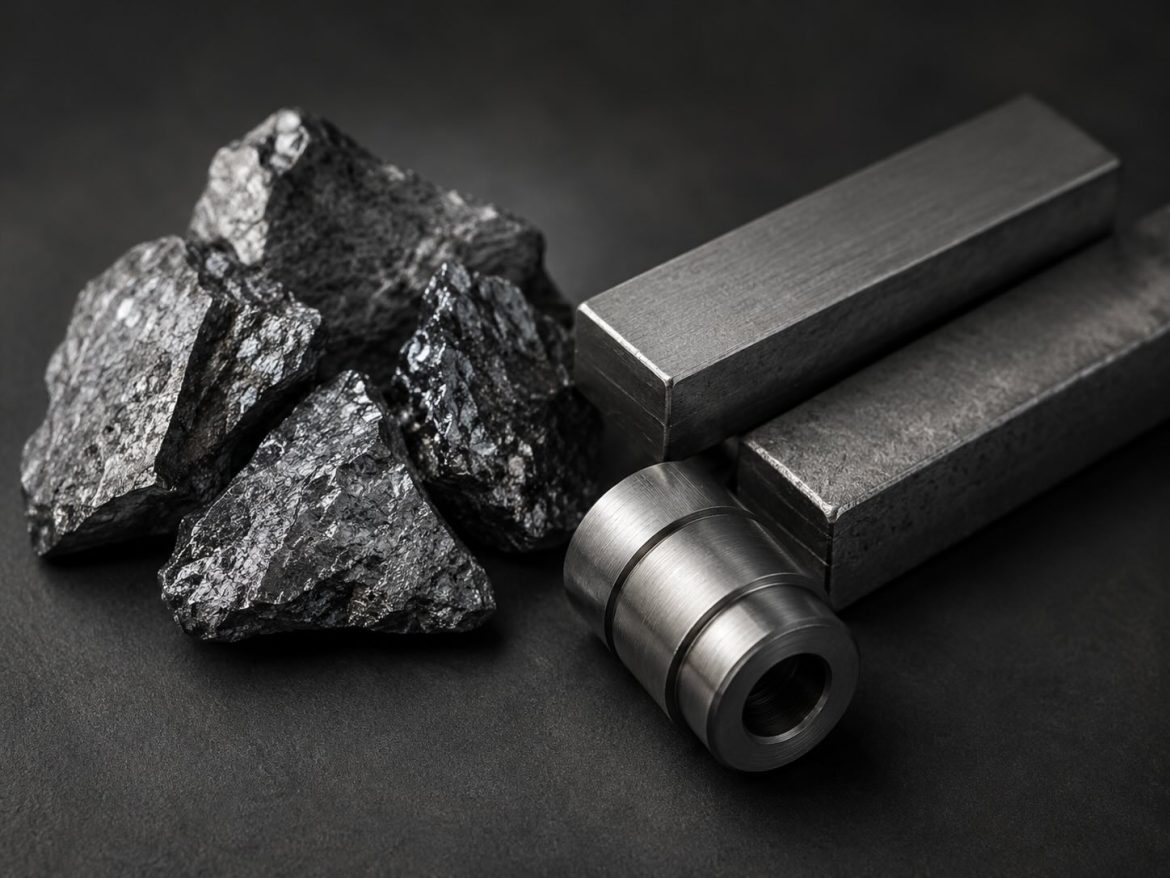
Stockholm’s decision to treat strategic extraction as a national-security interest could accelerate European supply diversification, but it also raises difficult questions about permits, local consent and environmental safeguards.
Sweden is placing critical metals and minerals inside national-security policy, signalling that decisions once treated mainly as matters of land use, industrial development and environmental regulation will increasingly be judged against Europe’s dependence on external suppliers.
The change reflects a wider reassessment across the continent. Rare earths, graphite, tungsten and other strategic materials are required for electric motors, batteries, semiconductors, radar, missiles, satellites and advanced communications. Europe consumes them in large quantities but remains highly exposed to processing and supply chains concentrated in China.
Sweden has important geological resources and a long mining tradition. It also has demanding environmental rules, extensive local permitting procedures and obligations towards Sámi communities whose reindeer-herding lands can overlap with proposed projects. Declaring extraction to be a security interest does not remove those conflicts. It changes the weight the state may give to speed and supply resilience when resolving them.
The security rationale is set out in the Swedish government’s new strategy for a peaceful, secure and sustainable Arctic. The strategy says critical metals and minerals are essential to the climate transition and to the defence and space industries. It explicitly links access and supply chains to European competitiveness and reduced dependence on potentially antagonistic actors.
That is stronger language than a conventional mining strategy. It identifies raw-material availability as a question of power and security. In practice, a disruption to a small number of processing nodes can affect production far beyond the mine. An aircraft manufacturer may have titanium, but not certified material in the required form. A missile producer may have designs and orders, but not permanent magnets or specialist alloys.
EU Today has already examined the Commission’s plan for a joint stockpile of critical minerals. Stockpiles provide insurance against temporary interruption. New mines and processing facilities address structural dependence. The two instruments are complementary, but neither delivers a quick solution.
A mine can require years of exploration, environmental assessment, consultation, financing and construction. Processing may be an even greater obstacle. China’s advantage is not limited to deposits; it includes refining capacity, technical knowledge, integrated manufacturing and the ability to operate at scale. Swedish ore exported for processing abroad would improve supply diversity less than a complete European value chain.
The national-security designation could help in three ways. It can give strategic projects greater priority inside government, improve coordination between agencies and make the case for public financial support where commercial returns alone are insufficient. It can also strengthen Sweden’s position when seeking EU funding under the Critical Raw Materials Act.
But speed must not become a synonym for weak scrutiny. Mining projects can affect water systems, biodiversity, landscapes and local livelihoods for decades. If national security is invoked to compress consultation or dismiss legitimate objections, projects may face litigation and public resistance that delay them further.
The Sámi dimension requires particular care. Northern Sweden contains some of Europe’s most important mineral prospects, but it is also the homeland of an Indigenous people whose culture and economy are closely connected to reindeer migration. Roads, pits, waste facilities, power lines and rail infrastructure can fragment grazing land even when the mine footprint appears limited.
Meaningful consultation therefore has to begin before a project is effectively decided. Compensation cannot substitute automatically for access to land that has cultural and practical significance. Security policy will be more durable if affected communities have a genuine role in shaping projects, monitoring impacts and sharing benefits.
Investment is another constraint. Strategic mines compete against established suppliers with lower costs and fewer regulatory obligations. European customers may support diversification in principle while continuing to purchase the cheapest available material. That gap can make projects unbankable.
Governments may need long-term purchasing agreements, price floors, loan guarantees or equity participation. Such support should be transparent and conditional on delivery, environmental performance and European processing. Otherwise, taxpayers could absorb risk while private investors retain most of the upside.
The defence argument also requires prioritisation. Not every mineral labelled “critical” creates the same vulnerability, and civilian demand may dominate some markets. Sweden and the EU should identify where domestic production would materially reduce exposure during a crisis, rather than spreading support across politically attractive projects without regard to downstream use.
Recycling and substitution remain important. A new mine cannot be the only answer to supply risk. Better recovery from electronics, batteries and industrial waste can reduce import demand, while research may replace scarce materials in some applications. Those approaches take time as well, but they reduce the pressure to treat every deposit as indispensable.
Sweden’s reframing is nevertheless consequential. It acknowledges that a state unable to access essential materials cannot fully control its energy transition, industrial policy or defence production. The permit for a mine can therefore have strategic effects comparable to decisions concerning ports, energy grids and weapons factories.
The test will be implementation. If national-security status produces faster, predictable decisions while preserving evidence-based environmental review and meaningful consultation, Sweden could provide a model for Europe. If it becomes a broad justification for overriding safeguards without building processing capacity, it will create conflict without delivering autonomy.
Europe needs more secure mineral supply. It also needs the public legitimacy required to sustain extraction over decades. Sweden’s policy will succeed only if it treats those objectives as mutually necessary rather than mutually exclusive.

