
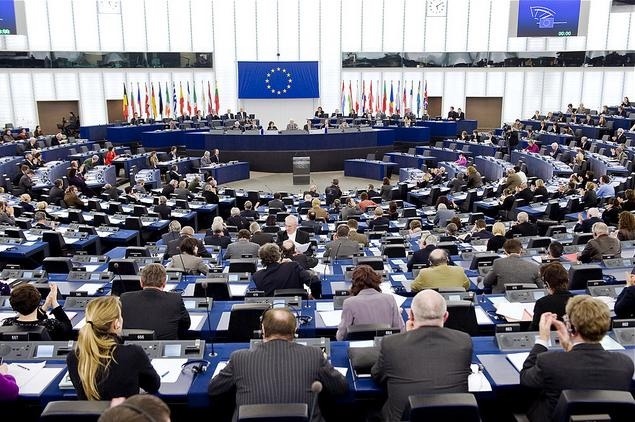
The European Parliament has sent an unambiguous message to Ankara: Türkiye’s strategic location may be valuable, but it cannot buy a seat at the EU table.
A report adopted this week with a firm majority – 367 votes in favour, 74 against and 188 abstentions – makes clear that the country’s deepening authoritarianism has rendered any resumption of its accession process untenable under current conditions.
In language unusually stark for a parliamentary report, MEPs warned that the Turkish government’s suppression of dissent and its erosion of democratic norms are fundamentally incompatible with EU membership. “We are constantly hearing from Turkish authorities about their supposed commitment to EU membership and how important it is for us to revive this process due to security and geopolitics, but they have got it wrong,” said rapporteur Nacho Sánchez Amor. “Membership is about democracy.”
The report singles out the crackdown on peaceful mass protests and the prosecution of hundreds of demonstrators in hasty, evidence-thin trials as emblematic of Türkiye’s shift toward authoritarianism. Particularly damning is the treatment of Istanbul’s popular mayor, Ekrem İmamoğlu. The MEPs describe the legal harassment of İmamoğlu – widely seen as a credible challenger to President Erdoğan – as a politically motivated attempt to remove him from the electoral stage.
Such actions, the Parliament warns, are pushing Türkiye “further towards a fully authoritarian model” and undermine the foundations required for EU accession: democracy, rule of law, human rights, and respect for minorities. These criteria, the report insists, “are absolute” and not up for negotiation.
This firm stance reflects growing exasperation in Brussels with the Erdoğan government’s long-standing pattern of flirting with European values while undermining them at home. Since accession talks formally began in 2005, progress has been halting at best. Over the past decade, Erdoğan’s consolidation of power, the weakening of judicial independence, and draconian controls on the press have put Türkiye ever further from the democratic standards the EU requires.
Yet despite the chill in formal talks, the EU is not closing the door entirely. MEPs emphasised the importance of maintaining a “closer, more dynamic and strategic partnership” with Türkiye, focused on areas of mutual interest such as climate action, energy security, counter-terrorism, and regional stability. Ankara’s role in the Black Sea region, its proximity to Middle Eastern flashpoints, and its membership in NATO make it a partner Brussels cannot simply ignore.
This dual-track approach – freezing full membership talks while deepening functional cooperation – reflects a broader shift in European thinking. There is a growing appetite in EU capitals for what some officials have described as a “privileged partnership” model: a relationship that acknowledges Türkiye’s significance without pretending that membership is realistically on the table.
However, even that pragmatic cooperation is not guaranteed if Ankara continues to chart a confrontational foreign policy course. MEPs condemned Erdoğan’s recent visit to the occupied areas of Northern Cyprus as a provocative and illegitimate act. The visit, they said, undermines prospects for reconciliation between Greek and Turkish Cypriots and flouts international norms.
Moreover, Türkiye’s persistent drift away from alignment with the EU’s common foreign and security policy adds further strain to the relationship. The country’s increasingly transactional diplomacy, frequently at odds with European interests in the Eastern Mediterranean and beyond, has raised questions about whether Ankara sees the EU as a partner or merely a platform for leverage.
Despite all this, the European Parliament expressed support for the Turkish people – particularly its youth – whose aspirations remain fundamentally pro-European. That popular sentiment, MEPs argue, is a vital reason to keep the idea of EU membership alive, even if only symbolically.
The message from Brussels is clear: Türkiye remains a country of immense strategic value, but it cannot use that leverage to shortcut the principles on which the European Union is built. As one senior EU official put it off-record, “If geography alone granted you a seat in the Union, Russia would be in too.”
For now, the accession process remains in deep freeze – not because Türkiye lacks importance, but because it lacks the democratic credentials the EU cannot afford to compromise. The ball, as ever, is in Ankara’s court. Will it choose the path of reform – or continue doubling down on authoritarianism?
Main Image: European Parliament.

