
A renewed energy shock has pushed the European Union back into crisis-management mode, with the European Commission now openly examining options including gas price subsidies or caps, wider state-aid measures and other short-term tools to contain rising costs. The immediate trigger is the war involving Iran, which has disrupted flows through the Strait of Hormuz and sent oil and gas markets sharply higher.
The Commission’s position has shifted in a matter of days. On 4 March, Brussels told member states that, while it was concerned by the rise in prices, there was no immediate threat to physical supply and no emergency response was being prepared. At that stage, officials stressed vigilance rather than intervention. Europe’s benchmark Dutch TTF front-month gas contract had nevertheless already climbed to three-year highs, touching €65.79 per megawatt hour after more than doubling within a week.
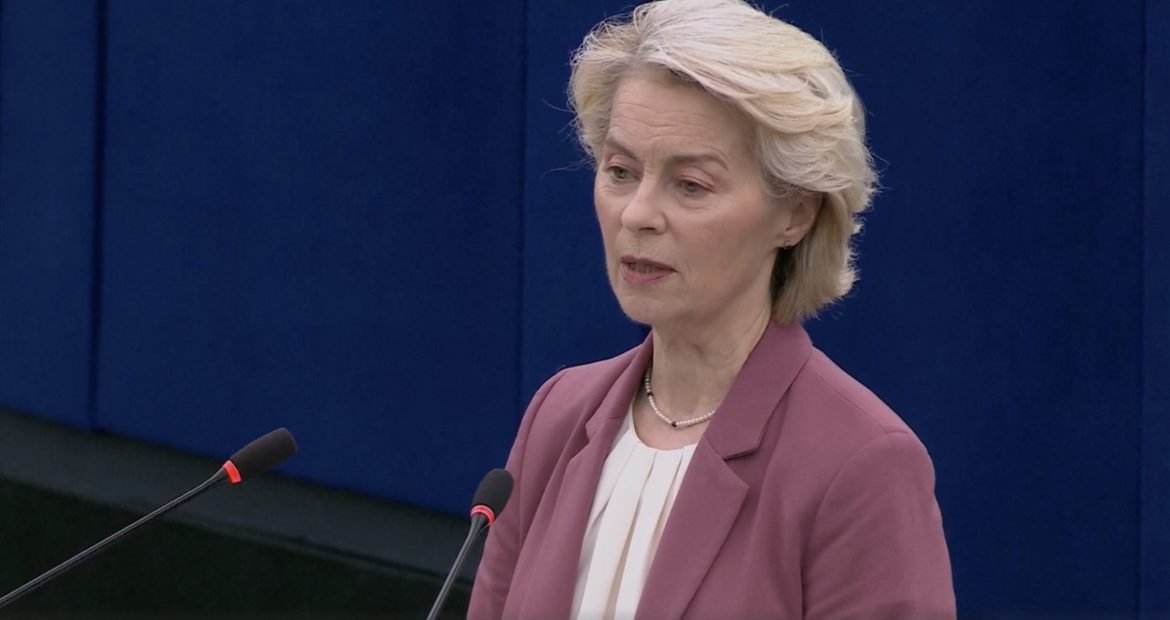
By 11 March, Commission President Ursula von der Leyen was signalling a broader readiness to act. In a speech to the European Parliament, she said the EU was preparing options to lower energy prices, including better use of power purchase agreements, state-aid instruments and possible subsidies or caps on gas prices. That language matters because it indicates that Brussels is no longer treating the surge as a passing market fluctuation, but as a political and industrial problem that may require intervention at Union level.
At the same time, von der Leyen drew a firm red line over Russia. She said that calls to respond to the present shock by reopening the door to Russian fossil fuels would amount to “a strategic blunder”. The remark is significant because it places the current price debate within the EU’s longer-term security doctrine: lower prices alone will not justify reversing the bloc’s post-2022 energy realignment.
That position is also consistent with the Commission’s formal roadmap published on 6 May 2025, which set out a plan to end all Russian gas imports by the end of 2027, prevent new Russian gas contracts and halt spot contracts by the end of 2025. The roadmap also includes fresh action on Russian oil shipping and tighter restrictions on Russian nuclear fuel supply arrangements. In other words, Brussels is trying to reconcile short-term price relief with a standing commitment to phase Russian energy out of the European system altogether.
Commission’s Proposal to Phase Out Russian Gas – the Legal Basis and other Implications
The difficulty is that the present shock is hitting an already strained market. On 2 March that European gas prices had jumped by more than 50% after disruption to shipments through the Strait of Hormuz. The waterway handles more than a fifth of global oil trade and roughly a fifth of global LNG. Europe has become more dependent on LNG since moving away from Russian pipeline gas, leaving it more exposed to maritime disruption outside its own neighbourhood.
The supply picture underlines the problem. The United States supplied 58% of EU LNG last year, while Qatar provided 6% of LNG imports in the third quarter of 2025. Separate Commission data show that Qatar accounted for 3.5% of the EU’s total gas supply in 2025, while the United States accounted for 25.4%. That means the loss or interruption of Gulf volumes does not create an immediate physical shortage, but it does tighten the LNG balance and raise the price Europe must pay to refill storage ahead of winter.
Storage levels are a further concern. On 2 March, EU gas storage was only 30% full, 9 percentage points below the level seen at the same point a year earlier. Reuters also reported that analysts could not rule out prices reaching €100/MWh if the shutdown of Qatari supply were prolonged. That would revive conditions closer to the 2022 crisis, even if the institutional and infrastructure backdrop is now stronger than it was then.
The Commission is therefore examining not just gas-market tools, but broader industrial relief. Brussels is studying energy taxes, network charges and carbon costs as possible areas for short-term intervention. Network charges account for about 18% of industrial power bills, while carbon costs represent around 11%. The same document said governments are underusing existing instruments, including state aid and contracts for difference, and warned that if the supply situation deteriorates further the EU may again need measures to curb demand, as it did in 2022.
That debate is already bleeding into wider market design. Draft conclusions for the 19 March European Council show that member states are set to ask the Commission to present a review of the EU Emissions Trading System by July 2026, with the aim of reducing carbon-price volatility and limiting its impact on electricity prices, while preserving the ETS’s core role in decarbonisation.
The immediate issue for Brussels is straightforward: whether it can soften the economic consequences of the Iran war without reopening strategic dependencies it has spent four years trying to dismantle. The answer, for now, appears to be intervention without reversal.

