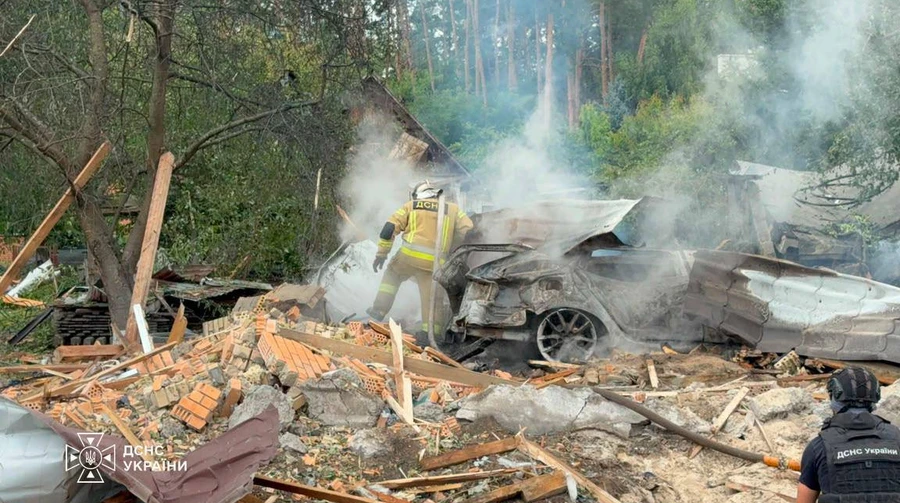
A Russian ballistic missile killed 10 people at a gathering involving Ukrainian defence companies. The attack has exposed questions over the protection of specialists whose work is becoming increasingly connected to Europe’s defence-industrial plans.
A Russian ballistic missile strike on a defence-industry gathering in the Kyiv region has killed 10 people and injured close to 100, prompting an investigation into whether adequate security precautions were taken when organising the event.
President Volodymyr Zelenskyy initially confirmed that rescue operations were under way, reporting six deaths and dozens of injuries. Prosecutor General Ruslan Kravchenko later raised the toll to 10 dead and about 100 wounded.
According to the Kyiv regional authorities, the missile struck a private training ground where events were being held. The Ukrainian Council of Defence Industry said representatives of domestic defence companies were present, although it denied organising the event and said the participants’ precise location had not been made public.
Valerii Borovyk, founder of the Ukrainian drone company First Contact, said the gathering included an exhibition of weapons and military technology. Kravchenko has opened criminal proceedings into possible improper performance of official duties during the organisation and conduct of the event.
The immediate responsibility for the deaths lies with Russia, which launched the ballistic missile. A separate question for the Ukrainian investigation is whether the organisers created an avoidable concentration of defence personnel, equipment and technical expertise at an insufficiently protected location.
Public information about the event had reportedly circulated before it took place. This has produced claims that Russian forces needed only to monitor the internet to locate the gathering. That conclusion has not been established.
The industry council’s statement that the precise location was not disclosed means other intelligence methods cannot be excluded. These could include agents, intercepted communications, compromised devices, aerial surveillance or information unintentionally revealed by participants.
An online announcement can nevertheless reduce the intelligence task. It may disclose the date, participating companies, subject matter or likely type of venue. Photographs, travel arrangements, vehicle movements and mobile telephone activity can then provide additional information.
The attack has relevance beyond Ukraine because the country’s defence companies are becoming more closely integrated with the European defence-industrial system.
The European Commission says the EU can provide up to €28.3 billion in 2026 to support Ukraine’s defence-industrial capacity. The assistance is intended not only to meet Ukraine’s immediate military requirements but also to support the gradual integration of Ukrainian manufacturers into the European Defence Technological and Industrial Base.
The European Defence Industry Programme has a budget of €1.5 billion for 2025–27, including €300 million specifically assigned to support Ukraine’s defence industry. Its purpose includes expanding production, supporting joint procurement and bringing Ukrainian companies into closer co-operation with manufacturers in EU member states.
The Commission has also begun disbursing €3.9 billion for drone procurement under the Ukraine Support Loan. Separately, the BraveTech EU initiative is intended to connect Ukrainian battlefield innovation with European companies, start-ups and research programmes.
As those links deepen, the physical security of Ukrainian engineers, companies and testing facilities becomes an issue for European programmes as well as Ukrainian national security. EU-supported projects depend on specialist knowledge, production capacity and the ability of Ukrainian companies to maintain operations under sustained Russian attack.
The personnel gathered at defence events may include drone developers, electronic-warfare engineers, air-defence specialists, military users and government officials. Many possess experience acquired directly from the battlefield and cannot be replaced quickly.
Ukraine still needs meetings between manufacturers and military units. Its defence sector has developed rapidly because engineers receive direct information about Russian tactics and modify their systems accordingly. Eliminating these contacts would damage the innovation process that European institutions increasingly seek to support.
The question is how such contacts should be organised during wartime. Smaller meetings, decentralised demonstrations, restrictions on electronic devices, protected venues and last-minute disclosure of locations may reduce the risk. Participation lists, transport and communications also require tighter control.
Ukraine faced similar questions after the August 2023 missile strike on Chernihiv, where a drone-related event was being held. The attack killed seven people and injured more than 140, according to figures published by the Ukrainian Interior Ministry.
The Kyiv-region investigation will need to establish who authorised the latest gathering, how the location was selected, what threat assessment was conducted and whether the available shelter arrangements were adequate.
Its findings may also matter to European institutions financing partnerships with Ukraine’s defence sector. Industrial integration requires funding, procurement rules and technology transfer. It also requires security standards capable of protecting the specialists on whom those programmes depend.