
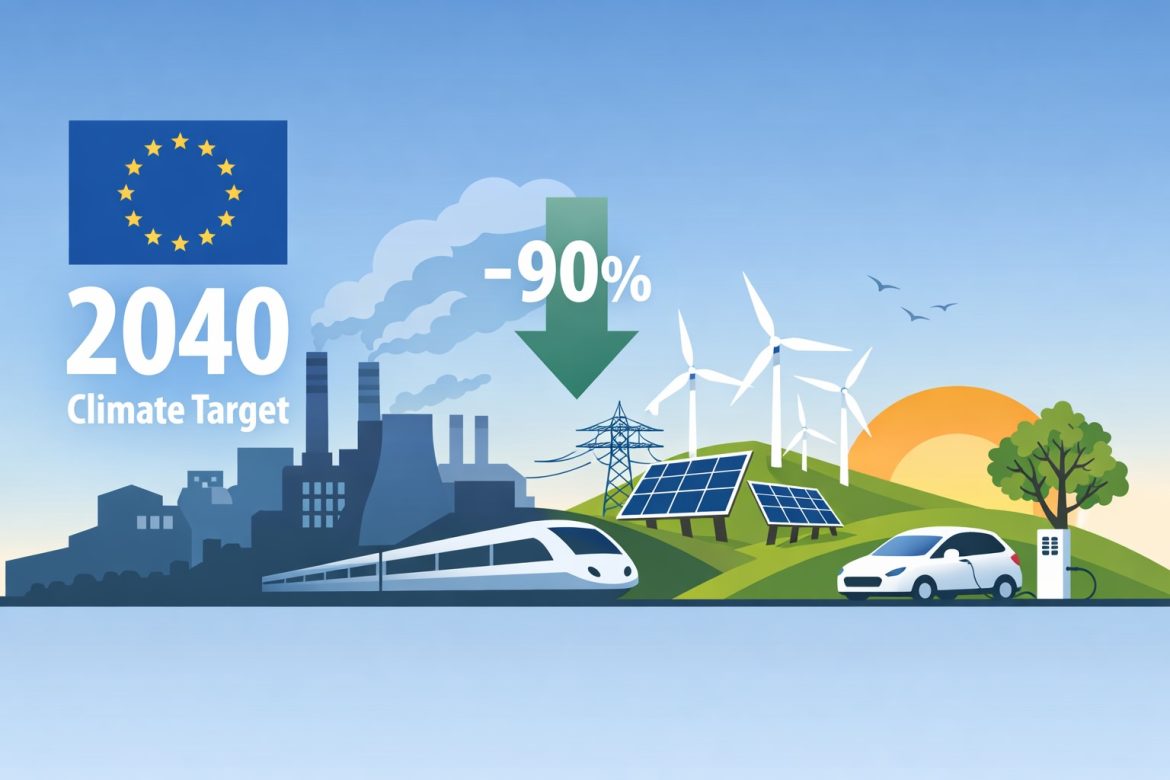
The European Union has formally approved a binding 2040 climate target requiring the bloc to reduce net greenhouse-gas emissions by 90 per cent from 1990 levels, completing one of the most significant pieces of Brussels legislation of recent months and placing climate policy back at the centre of the EU’s industrial and regulatory agenda.
The Council gave its final green light on 5 March, following a political agreement reached with the European Parliament in December 2025 and Parliament’s backing in February this year.
The measure amends the European Climate Law, which already commits the EU to climate neutrality by 2050 and to cutting net emissions by at least 55 per cent by 2030. The new 2040 benchmark is intended to bridge that gap and provide the legal basis for the next wave of energy, transport, industrial and carbon-market legislation after 2030. Under the new framework, the regulation will enter into force 20 days after publication in the Official Journal and will apply directly across all member states.
In headline terms, the 90 per cent figure preserves the ambition long championed by the Commission. In practice, however, the final deal is a political compromise. From 2036 onwards, up to five percentage points of the target may be met through high-quality international carbon credits, meaning at least 85 per cent of the required emissions reduction must be achieved inside the EU. The revised law also allows a role for permanent domestic carbon removals to offset residual hard-to-abate emissions under the EU emissions trading system, and it introduces broader flexibility across sectors and policy instruments.
Another element of the compromise concerns the EU’s new carbon market for road transport, buildings and other sectors, known as ETS2. Its full operation has been postponed by one year, from 2027 to 2028. That change was widely seen as part of the broader effort to secure support from governments concerned about consumer costs, industrial competitiveness and political resistance to further climate-related pricing measures. That delay was designed to help win over more sceptical countries during the negotiations.
The final vote also exposed the divisions that continue to shape EU climate politics. According to Reuters, the Czech Republic, Slovakia, Poland and Hungary opposed the measure when ministers gave the final formal sign-off in Brussels. Those governments, along with others during earlier stages of negotiation, argued that faster decarbonisation could impose excessive costs on industry, weaken competitiveness and place heavier burdens on economies still more reliant on fossil fuels or energy-intensive manufacturing.
By contrast, supporters of the target have argued that regulatory certainty is necessary precisely because Europe faces growing industrial pressure. The Commission has presented the 2040 target not only as climate legislation but also as part of a wider economic framework linked to the Competitiveness Compass, the Clean Industrial Deal and the Affordable Energy Action Plan. In that reading, the law is meant to guide long-term investment in clean power, electrification, grids, low-carbon industry and strategic technologies, while giving companies a clearer post-2030 trajectory.
There is, however, a clear distinction between the political deal and the scientific advice that preceded it. The European Scientific Advisory Board on Climate Change welcomed the 90 per cent target as an important milestone, but warned that the flexibilities built into the final agreement could weaken domestic action and risk complicating the EU’s path to climate neutrality by 2050. Reuters likewise noted that the final compromise is weaker than both the Commission’s earlier concept of a 90 per cent domestic cut and the recommendation of the EU’s climate science advisers.
That tension is likely to define the next phase of the debate. The law settles the target itself, but it does not settle how the EU will achieve it. The Commission must now prepare the legislative package for the post-2030 period, with the amended law requiring it to take account of competitiveness, simplification, social fairness, affordability and energy security. The legislation also requires a review every two years, including assessment of scientific developments, energy prices, industrial competitiveness, net removals and the use of international credits.
For Brussels, the significance of the 2040 target lies in that dual function. It is both a climate signal and an industrial signal. It re-establishes a long-term direction for the bloc after months in which green policy appeared increasingly entangled in wider debates over deindustrialisation, trade pressure and social cost. At the same time, the manner of its adoption shows that climate ambition in the EU now advances only through more explicit concessions to competitiveness and flexibility. The legal target is now fixed. The political argument over how much of the burden Europe’s industries, consumers and governments can bear is not.

