
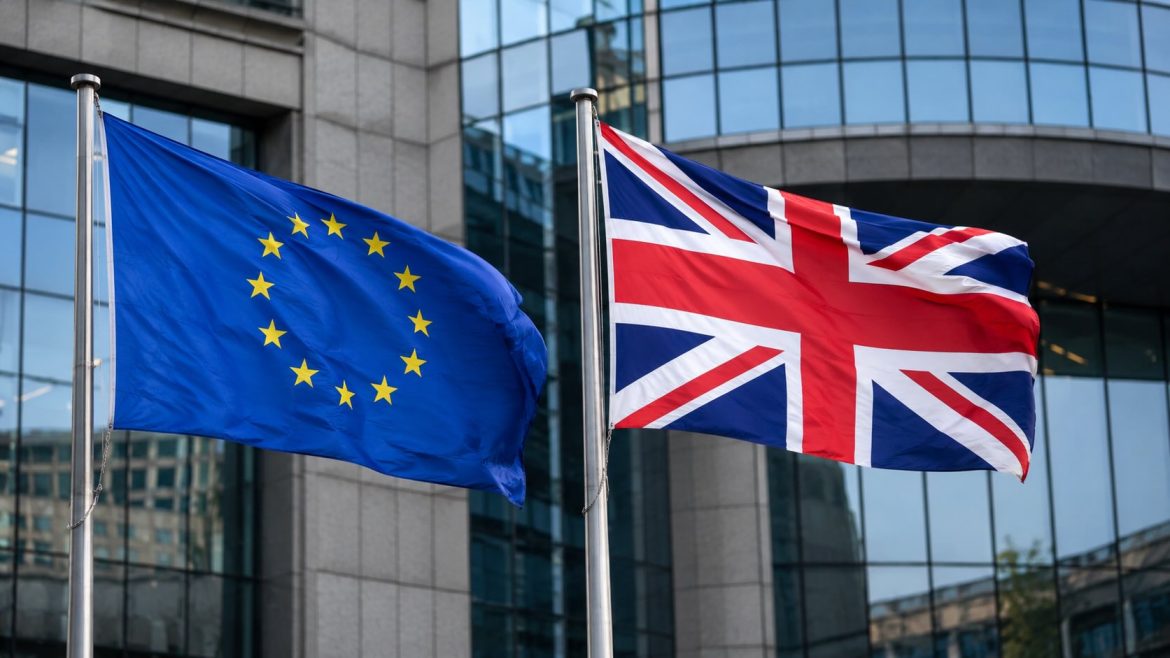
A new survey suggesting broad European support for the United Kingdom to rejoin the European Union has sharpened the political context around the next stage of EU-UK relations, even though formal re-entry remains far from the immediate agenda.
The polling, published by the European Council on Foreign Relations, found that 66 per cent of respondents across 15 EU countries would support the UK rejoining the bloc. Support was reported to be highest in the Netherlands and Denmark, at 75 per cent, and lowest in Bulgaria, at 56 per cent. The findings suggest that, ten years after the Brexit referendum, resistance to a British return may be less pronounced among EU voters than many policymakers had assumed.
The study also points to a shift inside Britain. According to the same polling analysis, three quarters of British respondents favoured a closer relationship with the EU, while a majority saw Brexit as having damaged the economy, trade, cost of living, youth opportunities and immigration management. The figures do not amount to a mandate for immediate re-accession, but they weaken the argument that any substantial move towards Europe would necessarily be politically toxic.
The timing is important. The UK and EU are due to hold a second summit on 22 July, with trade, security and economic cooperation on the agenda. The meeting follows earlier attempts to rebuild practical cooperation after years of post-Brexit dispute, including work on defence, food standards, emissions trading and youth mobility. The question is no longer only whether relations can be made less confrontational, but whether both sides are prepared to move beyond narrow technical adjustments.
For Brussels, the survey creates a different kind of calculation. The EU has little incentive to reopen a full membership debate unless Britain is ready to accept the obligations that come with it. That would mean confronting the single market, free movement, budget contributions and the wider legal framework of EU membership. There is no evidence that such a political consensus exists in Westminster.
That is why the near-term issue is not rejoining. It is the shape of the next EU-UK settlement. A deeper trade arrangement, closer defence cooperation, a veterinary agreement, energy-market links and a limited youth mobility scheme are more realistic than a formal accession track. Yet each of these steps carries political cost. The closer Britain moves to the EU rulebook, the harder it becomes to maintain the idea that post-Brexit autonomy can be preserved without economic trade-offs.
European caution is also clear. Officials and diplomats have repeatedly signalled that any future return would not be negotiated on exceptional terms. Britain would be expected to accept the same core principles as other applicants. The EU is unlikely to offer a special model that could encourage other governments to demand à la carte access to the single market.
The survey therefore matters less as a prediction of British re-entry than as evidence of a changed political environment. EU voters appear more open to Britain than during the years of withdrawal negotiations. British voters appear more open to practical reintegration than during the immediate post-Brexit period. That does not remove the institutional barriers, but it changes the assumptions around them.
The most immediate pressure now falls on the July summit. If the meeting produces only limited technical language, it will reinforce the view that political caution on both sides continues to outweigh the public appetite for closer ties. If it delivers movement on trade friction, defence cooperation or youth mobility, it may mark a shift from symbolic reset to practical reintegration.
For now, the case for rejoining remains politically distant. The case for a more substantial EU-UK relationship is becoming harder to avoid.

