
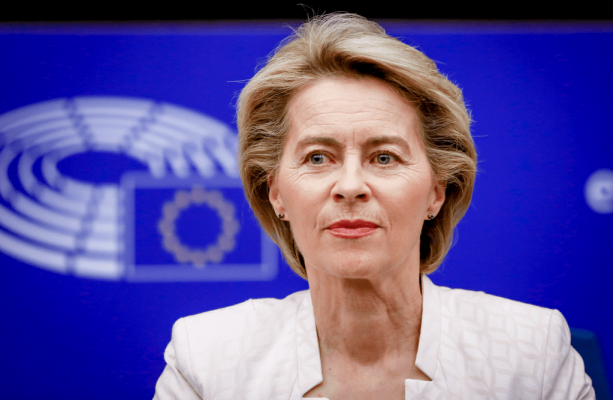
Ursula von der Leyen is facing the most significant threat to her leadership of the European Commission since taking office in 2019, after a no confidence motion was officially tabled in the European Parliament over her handling of the EU’s COVID-19 vaccine procurement — specifically, her opaque dealings with pharmaceutical giant Pfizer.
Romanian MEP Gheorghe Piperea, a member of the European Conservatives and Reformists (ECR) group, announced on June 26th that he had gathered the necessary signatures to trigger the motion, marking the beginning of a formal political challenge that could have sweeping consequences for the EU’s executive branch.
“After thorough legal and political preparation, I have successfully obtained the required number of supporting signatures to table this motion,” Piperea said in a press release. “This initiative is fundamentally about upholding transparency and ensuring a fair and genuine democratic process.”
The motion, signed by over 10 percent of sitting MEPs — more than the minimum 72 required under Parliament rules — accuses von der Leyen of serious breaches of transparency in connection with multi-billion-euro vaccine contracts signed during the pandemic. Central to the controversy is her personal role in negotiating a major deal with Pfizer via text message — messages that have never been disclosed, despite repeated calls from MEPs, journalists, and the European Ombudsman.
Von der Leyen has long dismissed criticism of the deal, arguing that the urgency of the pandemic justified extraordinary measures. However, critics say her refusal to release communications with Pfizer CEO Albert Bourla has undermined the EU’s credibility and eroded public trust.
The no confidence motion will first be reviewed by the Conference of Presidents — the Parliament’s political steering body — at its next meeting on July 2nd. If the Conference accepts the motion for debate, it will be placed on the agenda of the next plenary session in Strasbourg, scheduled between July 7th and 10th. A two-thirds majority of votes cast, along with an absolute majority of MEPs (361), would be needed to unseat von der Leyen and her entire College of Commissioners.
While the odds of success remain slim — such motions are rarely adopted — the political signal it sends is significant. It comes at a time when von der Leyen is actively courting parliamentary support for a second term as Commission President, with the centre-right European People’s Party (EPP) hoping to maintain its dominance after June’s elections.
Piperea’s initiative has reignited simmering tensions over the EU’s pandemic response and broader questions about executive overreach in Brussels. Though the Pfizer contracts were signed amid the panic of early 2021, many MEPs argue that the subsequent refusal to release key documents has crossed a red line.
“What we are witnessing is not merely a bureaucratic oversight,” said one ECR source familiar with the motion. “This is about accountability at the highest level of the EU.”
The motion also brings to the fore political shifts within the ECR group, which has grown increasingly assertive in Brussels. Romania’s delegation, originally elected on the ticket of the nationalist Alliance for the Union of Romanians (AUR), has seen three of its six MEPs distance themselves from the party. Yet on this issue, they appear united — at least temporarily — in backing Piperea’s push for accountability.
Political observers note that while the motion is unlikely to pass, it could still inflict reputational damage on von der Leyen and force her to make concessions to secure backing for a second term. The Socialists and Democrats (S&D), Greens, and Left groups have all criticised her leadership on various fronts, while some liberal Renew Europe MEPs have privately expressed unease over the Pfizer saga.
“The real impact may not be the vote itself, but the pressure it creates behind closed doors,” said one Brussels diplomat. “Von der Leyen’s support in Parliament is not unconditional, and this will be used as leverage.”
The European Commission has declined to comment on the motion directly, reiterating instead that vaccine procurement was conducted in accordance with EU law and that all contracts were subject to approval by member states.
Still, the refusal to release text messages has continued to cast a long shadow. Last year, the European Ombudsman declared the Commission’s failure to search for the texts a case of “maladministration”, a finding echoed by the European Court of Auditors in its own inquiry.
Piperea, a former law professor and an outspoken critic of EU overreach, has leveraged the controversy to build a cross-party coalition of MEPs frustrated by the Commission’s lack of transparency. His legal background and procedural savvy helped overcome early scepticism about whether the motion would gain traction.
With the Conference of Presidents meeting just days away, attention in Brussels is now turning to how party leaders will react. Some insiders suggest the motion could be used by von der Leyen’s opponents as a bargaining chip in the allocation of top EU posts — including Commission portfolios and parliamentary committee chairs.
The vote, if allowed to proceed, would take place during what is already expected to be a heated plenary session in Strasbourg. Beyond the outcome itself, the debate promises to serve as a referendum of sorts on the Commission’s legitimacy as it enters a new legislative cycle.
For von der Leyen, the motion is unlikely to end her presidency. But it may well tarnish it — and complicate her campaign to stay on as Europe’s most powerful civil servant.

