
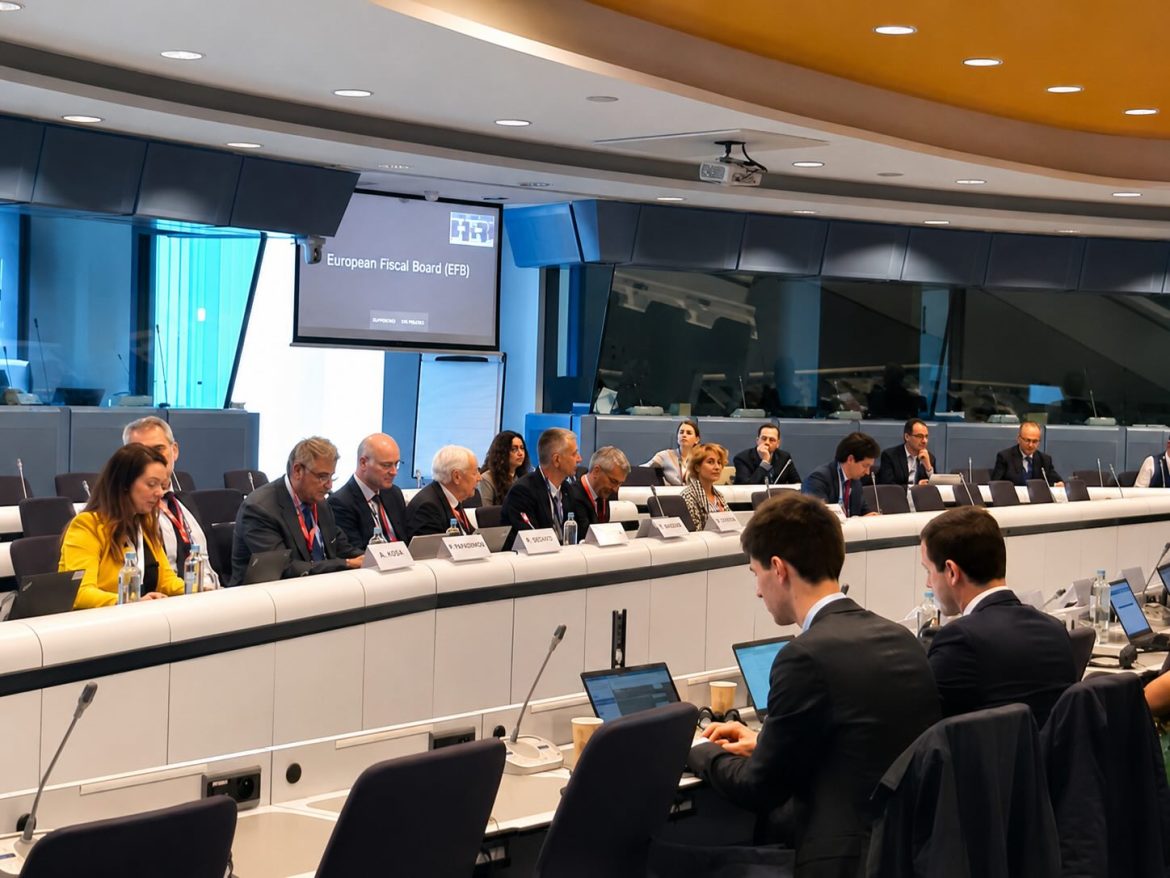
The European Union’s independent fiscal watchdog has criticised the European Commission’s decision to allow part of the budget flexibility granted for defence spending to be used for clean-energy transition measures, warning that the move risks weakening the credibility of the bloc’s fiscal rules.
The criticism from the European Fiscal Board comes after the Commission agreed that member states may use part of the fiscal leeway originally linked to defence spending for measures intended to reduce dependence on fossil fuels. The shift follows pressure from Italy, which has argued for greater budget flexibility to respond to high energy costs.
Under the EU’s revised fiscal framework, member states may invoke a national escape clause to deviate from normal expenditure limits in exceptional circumstances. The defence-related flexibility was designed to allow governments to spend more on military capability without breaching the EU’s fiscal rules, which include the 3 per cent of GDP deficit limit.
The Commission had allowed governments to increase defence-related expenditure by up to 1.5 per cent of GDP annually for four years. According to reporting on the fiscal-board criticism, the Commission has now agreed that 0.3 per cent of GDP of that annual leeway may be used for clean-energy transition spending.
The decision is limited in scope, but politically significant. It shifts a tool originally justified by the need to strengthen Europe’s defence readiness into a broader debate over energy prices, industrial costs and public support for the green transition. That is why the fiscal board’s intervention matters.
The European Fiscal Board is an independent advisory body attached to the Commission and tasked with assessing the implementation of the EU fiscal framework. Its mandate includes advice on the Stability and Growth Pact and the use of escape clauses. Its warning therefore goes directly to the question of whether exceptional flexibility is being kept narrow, temporary and credible.
The board’s concern is not that energy security is irrelevant. Europe remains exposed to energy shocks, and high fossil-fuel prices can create pressure on households, businesses and governments. The issue is whether the EU should respond by expanding exceptions to fiscal rules each time a new political priority emerges.
That concern is particularly sensitive because the defence escape clause was introduced in response to a clear strategic need. Russia’s war against Ukraine and uncertainty over long-term American security commitments have forced European governments to increase military spending. The fiscal exemption was presented as a targeted response to that security environment.
Allowing part of the same leeway to be used for energy-transition spending blurs that boundary. It may help governments finance electrification, renewables, heat pumps, electric vehicles or other measures aimed at reducing fossil-fuel dependence. But it also creates a precedent: a fiscal carve-out justified by defence can be adapted for another policy field under political pressure.
Italy’s role has made the issue more contentious. Rome has been pushing for greater flexibility as high energy costs weigh on voters and businesses ahead of next year’s elections. EU Today previously reported that Brussels was weighing energy-spending flexibility as member states argued over how to cushion the impact of energy prices without undermining fiscal discipline.
The Commission has tried to draw a line by rejecting fossil-fuel subsidies and insisting that any flexibility must support the transition away from imported fossil fuels. That distinction is important, but it does not remove the fiscal question. Spending financed through relaxed budget constraints still adds to public borrowing unless offset elsewhere.
The European Fiscal Board’s warning also reflects lessons from the 2022–23 energy crisis, when governments across Europe spent heavily on subsidies, tax cuts and price relief. Some measures were targeted, but others became broad, expensive and difficult to withdraw. The risk now is that energy-price pressure again becomes a justification for looser budgets, even as several member states face high debt and tighter financing conditions.
For Brussels, the immediate political calculation is understandable. Governments want room to protect households and firms from energy shocks while investing in alternatives to fossil fuels. Yet the EU has only recently revised its fiscal rules after years of dispute over debt, deficits and enforcement. If the first major test of the new framework leads to widened exceptions, the rules may again be seen as negotiable.
The fiscal board’s intervention therefore raises a wider question than energy policy. It asks whether the EU can maintain discipline while responding to overlapping crises: war, energy insecurity, industrial competition and the cost of the green transition. Each of these pressures has a political case. Together, they can turn a rule-based framework into a system of rolling exemptions.
The Commission’s decision may be defensible as a limited response to energy vulnerability. But it also exposes the weakness of the EU’s fiscal architecture. Once exceptional flexibility is opened, the argument over what counts as exceptional rarely ends there.

